FCL Shipping from China to the UK: The Complete 2026 Guide (Rates, Transit Times & Customs)
· By SinoShipment
If you are importing goods from China into the UK, the quoted ocean rate on an FCL shipping from China to the UK booking is almost never your true landed cost. Between origin haulage, export clearance, the sea leg, UK border clearance, import VAT, and final delivery, a “cheap” container quote can quietly become thousands of pounds more expensive by the time your goods reach the warehouse.
This guide gives you the operational detail that generic shipping pages skip: which container size actually fits your cargo, what a realistic 2026 port-to-port rate looks like from each major Chinese port, how long the full door-to-door journey takes, and how post-Brexit UK customs through the Customs Declaration Service (CDS) and Postponed VAT Accounting (PVA) affects your cash flow. By the end, you will be able to compare quotes line by line and avoid the demurrage, detention, and documentation mistakes that delay FCL imports. For a route-specific quote covering pickup, ocean freight, and UK delivery, see our freight shipping from China to UK service page.
What Is FCL Shipping from China to the UK?
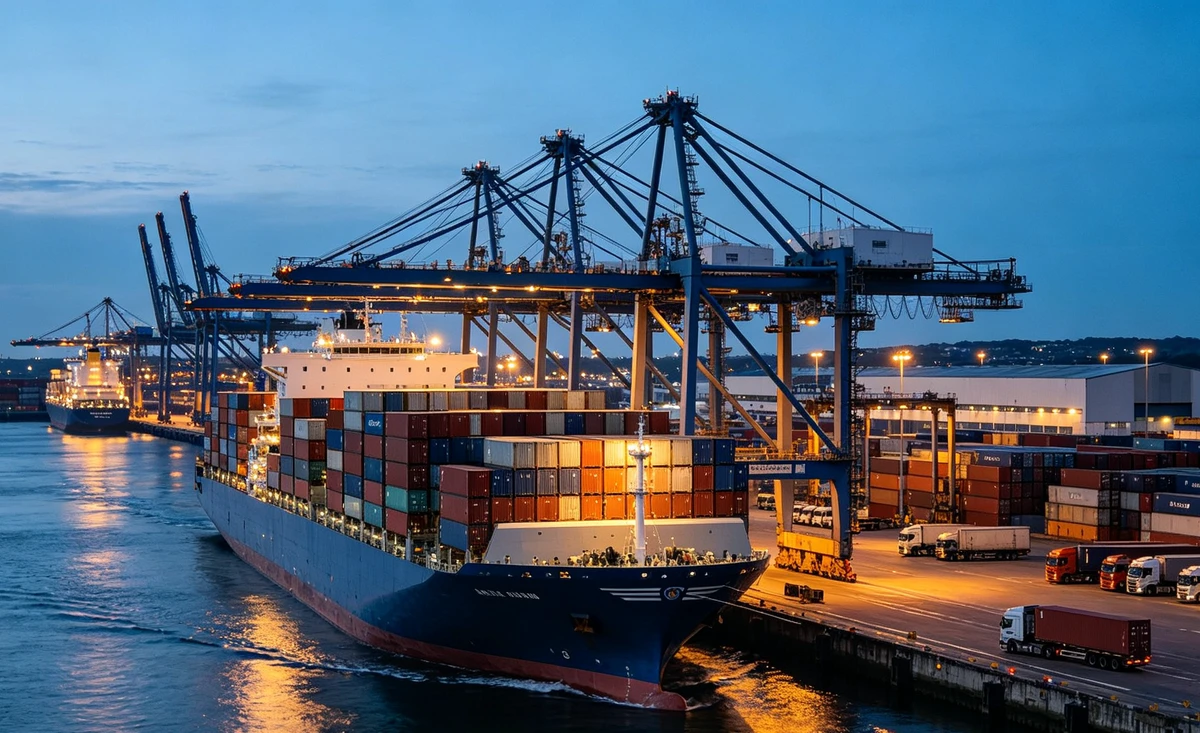
FCL (Full Container Load) means you book an entire shipping container exclusively for your cargo — typically a 20ft GP, 40ft GP, or 40ft High Cube (HQ). The container is loaded and sealed at the factory or warehouse in China and opened only at your destination in the UK, with your company named as the sole shipper and consignee on the Bill of Lading (B/L).
This is the opposite of LCL (Less than Container Load), where your cargo shares space with other shippers’ goods and must be consolidated before sailing, then deconsolidated at a UK depot. Because FCL skips those extra handling steps, it usually moves faster through both ports and carries a lower risk of damage or contamination.
Choosing the right container is the first decision. The three standard dry containers differ in volume and payload, and the wrong choice either wastes money or overloads the box.
| Container Type | Usable Volume | Max Payload | Best For |
|---|---|---|---|
| 20ft GP | ~33 CBM | ~28,000 kg | Dense, heavy cargo: machinery, tiles, metal parts |
| 40ft GP | ~67 CBM | ~26,500 kg | General merchandise, mixed pallets |
| 40ft HQ | ~76 CBM | ~26,500 kg | Bulky, light goods: furniture, textiles, packaging |
Our Industry Insight: A common mistake we see is booking a 40ft HQ for cargo that would fit a 20ft GP simply because “bigger feels safer.” Payload is not higher on a 40ft — both 40ft types cap around 26,500 kg. If your goods are heavy relative to their volume (like tiles or machinery), a 20ft GP gives you more usable payload and a lower rate. We always ask clients for the actual carton dimensions and gross weight first, then match the container to the cargo — not the other way around.
FCL vs LCL Shipping from China to the UK: Which Should You Choose?
The decision between FCL and LCL comes down to volume, cargo value, and handling sensitivity. As a rule of thumb, once your shipment approaches 13–15 CBM, a full container usually wins on cost per cubic metre — and it also skips the consolidation and deconsolidation steps that add days and handling risk to LCL.
| Factor | FCL | LCL |
|---|---|---|
| Container use | Exclusive, sealed origin-to-destination | Shared with other shippers |
| Best volume | ~15 CBM or more | 1–13 CBM |
| Pricing | Flat container rate | Per CBM (or per tonne, whichever is greater) |
| Transit | Faster, skips deconsolidation | Slower due to consolidation |
| Damage risk | Lower | Higher (more handling points) |
| Best for | Full loads, fragile or high-value goods | Small or trial shipments |
Below roughly 13 CBM, LCL is usually cheaper in absolute terms even though its per-unit rate is higher. Above that, the flat FCL rate spreads across more cargo and beats LCL. But cost is not the only factor: fragile furniture, high-value electronics, or any cargo where one dropped pallet is expensive often justifies FCL even at smaller volumes, purely for the reduced handling.
How Much Does FCL Shipping Cost from China to the UK in 2026?
FCL rates on the China–UK lane eased through mid-2026 after the July peak-season surcharges unwound, but they remain sensitive to Red Sea routing, fuel (bunker) adjustments, and equipment availability. The figures below are planning ranges as of August 2026, not binding offers — always confirm a fresh quote with 2–3 week validity before booking.
| Origin Port | UK Destination | 20GP (USD) | 40GP (USD) | 40HQ (USD) |
|---|---|---|---|---|
| Shenzhen (Yantian/Shekou) | Felixstowe / Southampton | 2,300 – 2,800 | 4,100 – 5,000 | 4,200 – 5,100 |
| Guangzhou (Nansha) | Southampton | 2,400 – 2,900 | 4,200 – 5,100 | 4,300 – 5,200 |
| Shanghai | Felixstowe | 2,400 – 2,900 | 4,300 – 5,200 | 4,400 – 5,300 |
| Ningbo-Zhoushan | Felixstowe | 2,350 – 2,850 | 4,150 – 5,050 | 4,250 – 5,150 |
| Qingdao | Felixstowe | 2,550 – 3,050 | 4,500 – 5,400 | 4,600 – 5,500 |
Note: Port-to-port ocean freight only. Rates swing 20–30% within a month when fuel surcharges, Cape of Good Hope rerouting, or peak-season demand shift.
The headline sea freight rate is only one layer. A complete FCL budget also includes origin haulage, export documentation, terminal handling charges (THC), the Bunker Adjustment Factor (BAF), UK customs entry, import duty and VAT, and final delivery. Ask for an all-in quote that names every surcharge — otherwise a low base rate hides a higher destination bill.
How to get the cheapest FCL rate without overpaying later:
- Book 4–6 weeks ahead, especially before Chinese New Year and the autumn pre-Christmas peak.
- Match the origin port to your factory location to cut inland trucking (South China cargo should load at Shenzhen or Nansha, not Qingdao).
- Consolidate multiple suppliers into one container instead of booking several small LCL shipments.
- Use PVA to defer import VAT if you are VAT-registered, protecting working capital.
For a detailed breakdown of every charge that goes into the total bill, read our Freight Costs from China to UK guide.
How Long Does FCL Shipping Take from China to the UK?
As of 2026, direct China–UK ocean transits have stretched because many carriers reroute around the Cape of Good Hope instead of the Suez Canal, adding roughly 10–14 days. Port-to-port typically runs 30–40 days, with some rotations reaching 45 days.
| Route | Typical Port-to-Port Transit |
|---|---|
| Shenzhen / Guangzhou → Felixstowe / Southampton | 30 – 38 days |
| Shanghai → Felixstowe | 30 – 40 days |
| Ningbo-Zhoushan → Felixstowe | 30 – 40 days |
| Qingdao → Felixstowe | 33 – 43 days |
Port-to-port is only part of the story. Door-to-door adds pickup, China export clearance, UK customs release, and final delivery, pushing the realistic total to 38–50 days.
The biggest sources of delay are usually not the vessel. Origin document errors, incorrect HS codes, and missing GB EORI details hold containers at UK customs far longer than any ocean routing change. Build at least one week of buffer beyond the published sailing time, and confirm the actual vessel rotation before committing. For a fuller lead-time breakdown across every mode, see our How Long Does Shipping Take from China to the UK guide.
FCL Shipping from Shenzhen to the UK: China Ports & UK Ports
Choosing the right port pair is one of the most effective ways to reduce both cost and lead time. The goal is to load at the deep-sea port nearest your factory, then land at the UK gateway nearest your final delivery postcode.
Major Chinese origin ports:
- Shenzhen (Yantian / Shekou): The natural choice for the Pearl River Delta — electronics, consumer goods, and e-commerce cargo from Shenzhen, Dongguan, and Huizhou.
- Guangzhou (Nansha): Ideal for furniture, ceramics, and textiles from Foshan, Shunde, and Zhongshan.
- Shanghai & Ningbo-Zhoushan: The default for Yangtze River Delta manufacturing — machinery, textiles, and auto parts.
- Qingdao: Serves northern China and Shandong industry.
Major UK destination ports:
- Felixstowe: The UK’s busiest container port, handling nearly half of Britain’s containerised trade and serving the Midlands and North well.
- Southampton: Strong deep-sea gateway with excellent road and rail connections for the South.
- London Gateway: A growing Thames-side hub convenient for the South East.
- Liverpool / Tilbury: Regional options for specific distribution needs.
For a broader comparison of ocean routing options into the UK, see our Shipping from China to UK by Sea guide.
Our Industry Insight: Matching the port to the factory is where avoidable cost hides. A Dongguan electronics supplier loading at Shenzhen Yantian typically pays $150–$300 for inland trucking, but if the same cargo is routed through Qingdao, inland transport can double before the box even reaches the water. We routinely save clients more on the origin leg than they would ever negotiate off the ocean rate itself.
UK Customs, Duty & VAT for FCL Imports (CDS, PVA & EORI)
Since Brexit, every commercial import from China into Great Britain requires a full customs declaration. The fundamentals must be in place before your goods sail:
- GB EORI number: Free to apply for and mandatory to import. It must start with “GB” — you can register through gov.uk.
- Commodity (HS) code: The ten-digit classification that sets your duty rate and flags any licence or restriction.
- CDS declaration: Filed electronically through HMRC’s Customs Declaration Service, which replaced the legacy CHIEF system.
- Import VAT at 20%: Charged on the goods value plus duty plus transport-to-border costs.
- Postponed VAT Accounting (PVA): Lets VAT-registered importers account for import VAT on their VAT return instead of paying at the border, using a Monthly Postponed Import VAT Statement (MPIVS) as the supporting record — no border payment and no C79 certificate needed. Check eligibility in the gov.uk import VAT guidance.
Required documents for an FCL shipment include the Commercial Invoice, Packing List, Bill of Lading, and a Certificate of Origin where preferential treatment or proof of origin applies, plus any product-specific certificates such as UKCA marking. For the authoritative step-by-step, HMRC’s import goods into the UK guidance and the UK Trade Tariff tool are the official references for duty rates and declaration rules.
Worked duty and VAT example:
- FOB goods value: $20,000
- Freight and insurance to the UK border: $3,000
- Customs value: $23,000
- Import duty at 4% (illustrative): $920
- Import VAT at 20% of ($23,000 + $920): $4,784
If you are VAT-registered and use PVA, that $4,784 is deferred onto your VAT return rather than paid at the border — a significant cash-flow advantage. If you are not VAT-registered, the full VAT is paid at import and is not recoverable, so it becomes a real cost in your landed price. If you need support preparing the entry, customs clearance coordination can handle the CDS declaration and PVA setup.
DDP Door-to-Door FCL Shipping from China to the UK
Your choice of Incoterm determines who controls the shipment, who files customs, and where risk and cost transfer. The most common terms on this lane are:
| Incoterm | Supplier Handles | Buyer Handles | Best For |
|---|---|---|---|
| EXW | Minimal origin responsibility | Everything from the factory door | Experienced buyers with China-side control |
| FOB | Export delivery and loading at origin port | Main freight, UK import, delivery | Most importers wanting balanced control |
| CIF | Ocean freight to a UK port | UK import, destination charges | Buyers wanting simple origin pricing |
| DDP | Most end-to-end charges and delivery | Limited logistics work | First-time importers and e-commerce sellers |
DDP (Delivered Duty Paid) is the most popular choice for importers who do not have their own UK customs broker. Under DDP, your forwarder handles factory pickup, China export clearance, ocean freight, UK import clearance, duty and VAT, and final delivery — all wrapped into a single all-inclusive quote.
Here is a realistic DDP FCL landed-cost example for a 40ft HQ of furniture from Foshan to a Manchester warehouse:
| Cost Component | Amount (USD) |
|---|---|
| FOB cargo value | $35,000 |
| Ocean freight (Nansha → Felixstowe) | $4,400 |
| Origin haulage and export clearance | $450 |
| UK import duty (2% illustrative) | $700 |
| Import VAT (20%, recoverable if VAT-registered) | $7,220 |
| Destination THC, delivery, and handling | $650 |
| Total landed cost (DDP, before VAT recovery) | ~$48,420 |
The appeal of DDP is predictability: one partner, one price, no surprise destination charges. The trade-off is that you rely on your forwarder’s customs compliance, so it is essential to choose a provider with genuine China-side and UK-side experience.
FCL Shipping for Amazon FBA to the UK
For e-commerce sellers restocking UK Amazon fulfilment centres, FCL is the most cost-efficient way to move high-volume inventory from Chinese factories to Amazon FBA UK. The workflow adds a few FBA-specific steps on top of a standard FCL move:
- Labelling and palletisation: Cartons need the correct FBA shipment labels, and pallets must meet Amazon’s size and weight rules before the container is sealed.
- Booking and delivery appointments: Amazon warehouses operate strict delivery windows; a missed appointment turns an on-time container into detention charges.
- DDP is common: Many sellers use DDP so a single partner handles duty, VAT, and delivery into the fulfilment centre without a UK entity.
Our Industry Insight: For FBA sellers without a UK VAT registration, PVA is not available, so the 20% import VAT is a genuine cost that must be built into the unit economics — not discovered after the goods land. We help clients model the VAT impact before they commit to a restock, because a container that “looks cheap” on freight can destroy margin once VAT and duty are added at the border.
Common FCL mistakes that inflate cost and delay delivery:
- Booking too late before peak season, forcing a premium rate or a rollover.
- Guessing the HS code instead of confirming the correct ten-digit classification.
- Inconsistent weights or descriptions between the invoice and packing list.
- Underestimating landed cost by quoting freight alone and forgetting duty, VAT, and handling.
- Ignoring demurrage and detention free time, then paying daily charges at the UK port.
Why Choose Sinoshipment for FCL Shipping from China to the UK
Sinoshipment is a China-based freight forwarder headquartered in Shenzhen, operating since 2013 and serving over 5,000 clients worldwide. Because we sit inside the Pearl River Delta logistics ecosystem, we handle the China side of your FCL move directly — factory pickup, consolidation, export clearance, and carrier booking — rather than outsourcing it.
For China-to-UK FCL shipments, we provide:
- End-to-end FCL service from factory pickup and China export clearance through ocean freight, UK import clearance, and final delivery.
- Transparent, itemised quoting that separates ocean freight, origin charges, destination fees, duty, VAT, and delivery — no hidden surcharges.
- UK customs expertise covering GB EORI, CDS declarations, commodity codes, and PVA setup for VAT-registered importers.
- DDP door-to-door options for importers and Amazon FBA sellers who want a single all-inclusive price.
- Local Shenzhen operations that load at Yantian, Shekou, and Nansha every day and know which carriers have equipment this week.
FAQ: FCL Shipping from China to the UK
How long does FCL shipping take from China to the UK?
Port-to-port typically takes 30–40 days, with Cape of Good Hope rerouting pushing some sailings to 45 days. Door-to-door, including pickup, customs, and final delivery, usually runs 38–50 days.
How much does a 40ft container cost from China to the UK?
As of August 2026, a 40ft GP or 40HQ from a main Chinese port to Felixstowe or Southampton is roughly $4,100–5,500 port-to-port, depending on the origin port and carrier. Confirm a fresh quote before booking, as rates can swing 20–30% within a month.
How much does a 20ft container cost from China to the UK?
A 20ft GP runs roughly $2,300–3,050 port-to-port as of August 2026. The exact figure depends on your origin port, destination port, and seasonal surcharges.
What is the cheapest way to ship a full container from China to the UK?
Ocean FCL is the cheapest per-unit option once you can fill a container (roughly 15 CBM or more). Reduce total cost by matching the origin port to your factory, booking 4–6 weeks ahead, consolidating suppliers, and using PVA to defer import VAT.
Do I pay VAT and duty when importing FCL from China to the UK?
Yes. Import duty is charged on the customs value, and import VAT at 20% is charged on the goods value plus duty plus shipping. VAT-registered importers can defer the VAT using Postponed VAT Accounting, recording it on their VAT return via a Monthly Postponed Import VAT Statement — no C79 certificate is issued when PVA is used.
What is the difference between FCL and LCL shipping from China to the UK?
FCL gives you exclusive use of a sealed container and is cheaper per unit above roughly 13–15 CBM. LCL shares container space and is priced per CBM, suited to smaller shipments but slower and with more handling.
Can Sinoshipment handle DDP door-to-door FCL shipping from China to the UK?
Yes. Sinoshipment provides DDP FCL from factory pickup and China export clearance through ocean freight, UK import clearance, duty and VAT handling, and final delivery under a single all-inclusive quote.
What documents do I need for FCL shipping from China to the UK?
At minimum you need a GB EORI number, a correct commodity code, a Commercial Invoice, a Packing List, and a Bill of Lading, plus any product-specific certificates such as UKCA marking. The declaration is filed through HMRC’s CDS.
FCL shipping from China to the UK is a series of decisions — container size, origin and destination ports, Incoterm, and customs strategy — that together determine your landed cost and delivery reliability. If you want a quote that reflects the full logistics picture rather than just the ocean leg, contact Sinoshipment for a tailored FCL plan based on your cargo, volume, and UK delivery location.
Disclaimer: Freight rates, transit times, and customs regulations change frequently. All price and timing references in this article are planning estimates as of August 2026 and should be verified against current carrier, broker, and official UK guidance before shipment. This article is for logistics education only and does not constitute legal or tax advice.