How to Import and Ship Cars from China to UK: The Ultimate Guide (2026)
· By SinoShipment
The UK is importing Chinese vehicles at a pace nobody predicted five years ago. Brands like BYD, MG, Geely, Chery, and Great Wall Motors now sell everything from budget city cars to premium electric SUVs, and the sticker prices are hard to argue with. But if you are planning to import a car from China to the UK, that price is only the beginning. Behind it sits post-Brexit customs regulation, compliance testing, and paperwork.
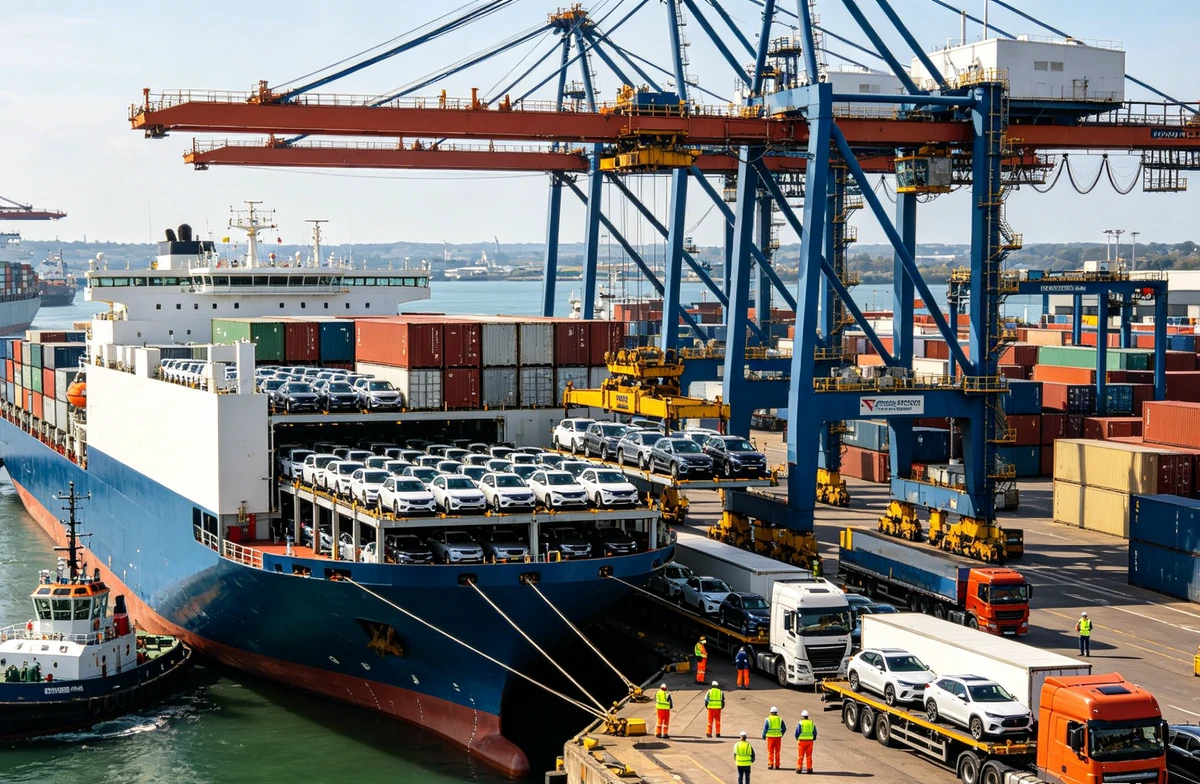
Importers get caught out most often by hidden costs, compliance failures (missing UKCA or IVA certification), and border delays from incorrect documentation or improperly declared EV batteries. One missed HMRC deadline triggers daily penalties that eat into your savings fast.
In this comprehensive guide, our team at Sinoshipment provides a step-by-step walkthrough of the entire process for freight shipping from China to UK—from choosing a verified Chinese supplier to HMRC clearance and DVLA registration. We break down exact shipping costs, transit times, payment security, and every compliance checkpoint, ensuring your automotive imports arrive safely, legally, and on budget.

Key Takeaways
- Verify Before You Pay: Work only with licensed Chinese exporters. Use secure payment structures like a 30⁄70 T/T split or escrow—never pay 100% upfront to an unverified supplier.
- Compliance Is Everything: Without an IVA pass or UKCA certification, your vehicle cannot be registered with the DVLA. Budget 4–6 weeks for testing appointments—miss that window and port storage charges can run into hundreds of pounds.
- 14-Day NOVA Deadline: You have just 14 days from arrival to notify HMRC. Miss it and you will be fined £5 per day—a penalty that adds up fast.
- Tax Reality Check: Factor in 10% import duty + 20% VAT on the total CIF (Cost + Insurance + Freight) value, with VAT applied on top of the duty. On a £20,000 CIF car, that is £6,400 in taxes alone.
- Pick the Right Shipping: RoRo saves money on drivable cars ($1,200–$1,800); container shipping protects high-value EVs and allows extra cargo like spare parts.
Step 1: Choose Your Vehicle and a Verified Chinese Supplier
Before any paperwork begins, you need to answer two questions: which car are you buying, and who are you buying it from? Getting this wrong is the single most common reason vehicle imports fail before the car even reaches the port.
Popular Chinese Brands for UK Import
The most frequently imported brands to the UK include BYD (electric vehicles and hybrids, with strong UK dealer presence), MG (SAIC-owned, widely available through UK dealerships and parts networks), Geely, Chery, and Great Wall Motors (Ora, GWM). For importers, EVs and plug-in hybrids currently offer the strongest value proposition due to China’s manufacturing scale and battery supply chain advantages.
Where to Find Suppliers
You can source vehicles through three main channels:
| Channel | Best For | Watch Out For |
|---|---|---|
| Official manufacturer export divisions (e.g., BYD’s export arm) | Bulk orders, dealerships | High MOQs, slower negotiation |
| Licensed Chinese export dealers/trading companies | 1–10 vehicles, mixed models | Varying service quality—verify carefully |
| B2B platforms (Alibaba, Made-in-China, Global Sources) | Price discovery, supplier discovery | Many middlemen; insist on export license proof |
How to Verify a Chinese Car Exporter
Buyers lose deposits to “suppliers” who turn out to be neither licensed exporters nor the actual vehicle owners. Before committing a single pound, verify:

- Export License: The company must hold a valid Chinese vehicle export license. Ask for the license number and cross-check it.
- Business License: Request the business registration (营业执照) and confirm the legal company name matches the bank account you are paying into. A red flag: the invoice name differs from the bank beneficiary.
- Track Record: Ask for recent export references—bills of lading (with sensitive data redacted) showing shipments to the UK or EU.
- Certifications: ISO 9001 and CCC (China Compulsory Certification) for the vehicle model you are buying.
- Physical Address: Verify the showroom or yard exists via video call before paying.
Agree on the Right Trade Terms (Incoterms)
Most China-to-UK car deals are quoted under FOB (Free On Board) or CIF (Cost, Insurance, and Freight):
- FOB: You pay for the car plus delivery onto the vessel at the Chinese port; you arrange and control the ocean freight. This gives you transparency and is our recommended option if you work with your own freight forwarder.
- CIF: The supplier arranges freight and insurance to a UK port. Convenient, but margins are often built into the freight line—request a breakdown.
Payment Security: Never Wire Blind
Payment fraud is the biggest non-logistics risk in China car imports. Use a structured approach:
| Payment Method | How It Works | Risk Level | Our Recommendation |
|---|---|---|---|
| T/T Bank Transfer (30⁄70) | 30% deposit to start, 70% against copy of B/L | Medium | ✅ Standard for vehicle trade—always pay the company account, never a personal account |
| Letter of Credit (L/C) | Bank guarantees payment against documents | Low | Best for large orders (5+ vehicles); costly for single cars |
| Escrow (Alibaba Trade Assurance) | Platform holds funds until delivery confirmed | Low | Good for first-time buyers via B2B platforms |
| 100% T/T upfront | Full payment before production/loading | ⚠️ High | ❌ Never do this with an unverified supplier |
Pro Tip from Our Team: For your first import, use a 30⁄70 T/T split combined with a video inspection of the vehicle and its VIN before paying the 70% balance. Our Shenzhen team performs these pre-shipment inspections for clients daily—it’s a 24-hour check that has saved buyers from receiving the wrong trim level, wrong battery configuration, or worse.
Step 2: Pre-Export Preparation and Documentation
Once your supplier is verified and terms are agreed, the export machinery starts moving. Your Chinese supplier must hold a valid export license and provide a complete documentation package before the vehicle can be loaded.

Ensure the supplier uses the correct HS Code (e.g., 8703 for passenger vehicles, 8704 for commercial vehicles)—an incorrect HS code is one of the most common causes of customs delays on both ends.
Required Documentation Checklist:
- Commercial Invoice: Must clearly state the VIN (Vehicle Identification Number), engine number, and transaction price. HMRC will cross-check this value against market data—undervaluation triggers inspections and penalties.
- Packing List: Detailing the dimensions, weight, and contents.
- Bill of Lading (B/L): The official receipt of shipment and title document. For RoRo shipments, this is a “RoRo B/L”; for containers, a standard ocean B/L.
- Certificate of Origin (COO): Verifies where the vehicle was manufactured.
- Vehicle Compliance Certificate (CoC): Essential for the UK homologation process—confirm with the supplier that the vehicle’s CoC covers UK-market specifications where possible.
- Export Customs Declaration: Filed by the supplier in China; ask for the export declaration number for your records.
UK Car Import Technical & Safety Requirements (UKCA & IVA)
Any car imported from China to the UK must meet rigorous technical standards, specifically passing the Individual Vehicle Approval (IVA) test or holding UKCA certification, along with strict compliance for RHD (Right-Hand Drive) conversion and EV battery safety.
The UK has stringent safety and environmental regulations. The UK Government’s own guidance on importing vehicles is blunt: you must prove your vehicle meets these standards before it can be driven on public roads.
- UKCA Certification: This is the post-Brexit requirement replacing CE marking for vehicles and automotive parts entering Great Britain.
- Individual Vehicle Approval (IVA): If the car lacks UK type approval, it requires mandatory testing by the Driver and Vehicle Standards Agency (DVSA). Testing slots fill up fast—we have watched importers wait three weeks for an appointment because they did not book early enough. Book at least 4 to 6 weeks ahead, or your vehicle will sit at the port accruing storage fees.
- Right-Hand Drive (RHD) Rules: UK roads require RHD vehicles for practical use. If importing a Left-Hand Drive (LHD) vehicle, specific lighting alignment and speedometer (mph) conversions are mandatory to pass the IVA.
- Emissions Standards: Internal combustion engines (ICE) must comply with Euro 6 emissions standards.
- EV-Specific Considerations: Shipping Electric Vehicles involves strict Dangerous Goods (DG) protocols. You must provide Material Safety Data Sheets (MSDS) for the battery, and batteries must be shipped at a reduced state of charge (typically under 30% for ocean transport under IMDG SP388). Charging ports should comply with UK standards (Type 2 / CCS2).
Shipping Cars from China to UK: RoRo vs. Container Shipping
You have two primary methods for shipping cars from China to the UK: Roll-on/Roll-off (RoRo) and container shipping. RoRo is the budget-friendly choice for standard drivable vehicles. For high-value EVs, luxury cars, or non-running vehicles, container shipping from China to UK offers superior protection.
Choosing the right method directly impacts your total cost and the vehicle’s condition upon arrival.

Comparison: RoRo vs. Container Shipping
| Feature | Roll-on/Roll-off (RoRo) | Container Shipping (20ft / 40ft) |
|---|---|---|
| Best For | Standard drivable cars, fleets | High-value EVs, luxury cars, non-runners |
| Typical Cost (per vehicle) | $1,200 – $1,800 | $2,000 – $3,000 (20ft dedicated) / $2,200 – $2,800 (shared 40ft) |
| Pros | Cost-effective, faster port turnaround | Maximum security, weather protection, allows extra spare parts |
| Cons | Less protection (exposed to elements), no extra cargo | Higher cost per unit, longer loading/unloading time |
| Condition Needed | Vehicle MUST be drivable | Can be drivable or non-runner |
Major Routes: Most automotive shipments depart from key Chinese ports—Shanghai (the busiest automotive export hub), Shenzhen (ideal for EV shipments from Guangdong-based manufacturers like BYD), and Guangzhou (Nansha). On the UK side, Southampton is the primary RoRo terminal with dedicated vehicle processing lanes, Felixstowe handles the majority of containerized vehicle imports, and London Gateway offers the fastest inland distribution to the Midlands and North of England. Transit times range from 30 to 45 days depending on the port pair and carrier schedule.
Northern Ireland Note: If your vehicle’s final destination is Northern Ireland, additional post-Brexit requirements may apply under the Windsor Framework. Consult with your customs broker to confirm whether EU-type approval or UKCA marking is required for your specific case.
Shipping Costs and Transit Times for China-to-UK Auto Transport
How long does shipping take from China to the UK? For vehicles, expect 30–45 days by sea. Costs range from $1,200 to $3,000 depending on your choice of RoRo or container shipping. For ultra-urgent deliveries, air freight cuts transit to 3–7 days, but at a significant premium.
Note: All cost estimates and timelines below are based on our operational data as of Q3 2026 and are subject to seasonal changes (e.g., Chinese New Year, peak season surcharges, and port congestion).
| Transport Mode | Transit Time | Cost per Vehicle | Best For |
|---|---|---|---|
| RoRo (Ocean) | 30–45 days | $1,200 – $1,800 | Drivable standard cars, fleets |
| FCL Container 20ft (Ocean) | 30–45 days | $2,000 – $3,000 | Single high-value vehicle, non-runner |
| Shared 40ft Container (LCL/Consolidation) | 30–45 days | $2,200 – $2,800 | 2–4 vehicles, mixed cargo with spare parts |
| Air Freight | 3–7 days | $10,000+ | Ultra-luxury, press/deadline vehicles |
Additional Costs to Budget:
- Terminal Handling Charges (THC): Port fees at origin and destination, typically $200–$400 per vehicle.
- Marine Insurance: Highly recommended for vehicle shipments—typically 1–3% of the CIF value.
- Compliance Modifications: Headlight alignment, speedometer conversion, and IVA rectification work if the vehicle fails its first inspection.
UK Customs Clearance, Import Duties, and VAT on Chinese Vehicles
Once your vehicle arrives at a UK port, the clock starts ticking. You must notify HMRC via the NOVA system within 14 days and pay 10% import duty plus 20% VAT. This is where first-timers bleed money—the two most common slips are undervaluing the CIF and missing the NOVA window entirely.
Last spring, a Manchester dealer importing three BYD Dolphin hatchbacks asked the supplier to invoice them at 60% of the real transaction price. HMRC flagged the declaration, held the container at Felixstowe for nine days, and issued a valuation challenge that cost more in broker hours than the duty saved. The cars cleared only after the dealer produced bank transfer records and a corrected invoice.

Customs clearance is where first-time importers lose the most money. Here is what HMRC expects from you:
- EORI Number Registration: Mandatory for all UK businesses and individuals importing goods. Apply online—it is free and usually issued within a few days.
- Notifying HMRC (NOVA): You MUST use the Notification of Vehicle Arrivals (NOVA) service within 14 days of the vehicle arriving in the UK. Failure to do so results in late penalties.
- Import Duty and VAT Calculation:
- Duty: Standard duty is 10% for passenger vehicles.
- VAT: 20% VAT is applied to the CIF value (Cost of the car + Insurance + Freight) plus the 10% duty.
Worked Example: Importing a £20,000 Vehicle (CIF Value)
| Line Item | Calculation | Amount |
|---|---|---|
| CIF Value (car + freight + insurance) | — | £20,000 |
| Import Duty (10%) | £20,000 × 10% | £2,000 |
| VAT Base (CIF + Duty) | £20,000 + £2,000 | £22,000 |
| VAT (20%) | £22,000 × 20% | £4,400 |
| Total Taxes Payable | £2,000 + £4,400 | £6,400 |
- Customs Declaration (CDS): Filing the C88 form via the Customs Declaration Service (CDS). We strongly advise using a licensed customs broker to handle this technical step.
First Registration Note: There is no duty-free allowance for personal vehicle imports under normal circumstances. Vehicles transferred as part of a permanent relocation to the UK may qualify for Transfer of Residence (ToR) relief—but you must apply for ToR approval before the vehicle arrives.
Post-Clearance: DVLA Registration for Imported Cars
After clearing customs and passing the IVA test, you must register the imported vehicle with the DVLA, pay the first registration fee, and secure UK-compliant insurance before driving on public roads.
Once the car clears the port, you cannot simply drive it away. You must complete the homologation and registration process:
- Get Approved: Pass the Individual Vehicle Approval (IVA) test to prove the car meets UK safety and environmental standards.
- Registration & Tax: Send your paperwork (NOVA confirmation, IVA certificate, foreign registration documents) to the Driver and Vehicle Licensing Agency (DVLA). You will need to pay the first registration fee (£55 at time of writing) and vehicle tax.
- License Plates & Insurance: Once the DVLA assigns a UK registration number, you can get your number plates made up and secure vehicle insurance. You will need a UK address for the V5C registration document.
Frequently Asked Questions about Importing Cars to the UK
Can I import a single car from China to the UK for personal use? Yes. There is no minimum quantity—you can import one vehicle. However, per-unit costs (freight, compliance, broker fees) are spread across only one car, so savings versus buying from a UK dealer are smaller for single personal imports. Fleets of 2–4 vehicles consolidated in a 40ft container achieve the best economics.
Can I import an electric vehicle (EV) from China to the UK duty-free? No. EVs get lower UK road tax (VED), but the 10% import duty and 20% VAT still apply on imports from China. There is no duty exemption for privately imported EVs.
Are Chinese EVs eligible for UK government grants? For cars, no. The plug-in car grant ended in 2022. Some OZEV grants remain for vans, trucks, and taxis, but they apply to qualifying UK-registered purchases—privately imported vehicles generally do not qualify.
Do I need to convert a Left-Hand Drive (LHD) car to Right-Hand Drive (RHD)? A full RHD conversion is usually not required for registration. To pass the IVA, however, the headlights must be adjusted or adapted so they do not dazzle oncoming traffic, and the speedometer must display miles per hour (mph). You can legally drive an LHD car in the UK once registered, though overtaking and tolls are less convenient.
What happens if I miss the 14-day HMRC NOVA deadline? HMRC will issue a late notification penalty of £5 for every day you are late, which can quickly add up. Late notification can also flag your import for closer scrutiny of duty and VAT valuations.
How much does it cost to ship a standard SUV from China to the UK via RoRo vs. Container? A standard mid-size SUV typically costs $1,200–$1,800 via RoRo. In a container, expect $2,200–$2,800 when consolidated into a shared 40ft container, or $2,500–$3,500 for a dedicated 20ft container. The final price varies by port pair, fuel surcharges, and seasonality—contact Sinoshipment for a precise, obligation-free quote.
Do I need to be a UK resident or have a UK company to import and register a car? You need a UK address for DVLA registration (the V5C is mailed there), and an EORI number to clear customs—individuals can obtain an EORI starting with “GB” using their National Insurance number. Non-residents importing temporarily may use temporary admission instead, but permanent registration requires a UK address.
Does an imported car need an MOT before registration? Vehicles over three years old generally need a valid MOT (or an IVA pass, which covers the safety assessment) before the DVLA will register them. Brand-new vehicles are registered without an MOT until their third anniversary. Check the current rules on GOV.UK before your vehicle arrives.
How long does the entire import process take, end to end? From signing the purchase contract to receiving UK plates, budget 8–14 weeks: 1–2 weeks for sourcing and payment, 1–2 weeks for Chinese export filing and loading, 30–45 days at sea, 1–2 weeks for customs/IVA, and 1–2 weeks for DVLA registration. Air freight shortens the transit leg to under a week.
Why Choose Sinoshipment to Ship Cars from China to the UK?
Here is the honest version: importing a car from China is not especially hard, but it punishes anyone who treats it as a simple purchase. You need the technical approvals (UKCA/IVA) right, the tax filings (NOVA, VAT, duty) filed on time, and a shipping method that actually suits the vehicle. One bad document and your car sits at the port while demurrage runs.
We have moved a few hundred vehicles out of China, and the UK is one of the corridors we handle most. The pattern we see is consistent: deals that fail were almost always rushed at the verification stage or the paperwork stage, not the shipping stage.
What we do
- Factory to your driveway: We handle collection in China, export filing, ocean freight, port handling, and the final leg to your UK address—you deal with one team instead of five.
- Customs filings: Our licensed brokers file NOVA notifications and CDS declarations. The Manchester case above is exactly the kind of mistake we exist to prevent; our process builds in valuation checks before the declaration goes in.
- Supplier vetting and payment structure: Before you wire anything, we help you confirm the exporter’s license, match the invoice to the bank beneficiary, and structure terms such as a 30⁄70 T/T split.
- EV battery compliance: Lithium batteries are dangerous goods, and most holdups on EV shipments come from paperwork rather than the cars themselves. We handle MSDS documentation, state-of-charge requirements, and carrier approvals for brands like BYD and MG.
Request a free shipping quote and our automotive team will map out the full cost and timeline for your specific vehicle.
Conclusion
Importing a car from China to the UK works—thousands of UK buyers of BYD, MG, and Geely vehicles prove it every month. But the buyers who get it right are not smarter than the ones who get burned. They just verify the supplier before wiring money, book the IVA slot before the ship docks, and set a calendar reminder for that 14-day NOVA window. The ones who skip those steps watch their “bargain” Chinese EV rack up storage fees at Southampton, and the savings disappear.
Whether you are bringing in a single electric vehicle for yourself or a fleet of cars for your dealership, our team can take the whole chain off your hands. Contact Sinoshipment for a customized quote and a realistic timeline for your vehicle.