Shipping Construction Materials from China to Libya: The Complete 2026 Guide (Cost, Transit Time, Container Types & Customs)
· By SinoShipment
Shipping construction materials from China to Libya has never been more relevant — and never more complex. Libya’s reconstruction boom pushed China–Libya bilateral trade to USD 4.84 billion in 2025, with Chinese exports of machinery, vehicles, and building materials hitting USD 4.04 billion (China MFA, August 2026). As part of our broader freight shipping from China to Libya service, we handle this lane daily — yet in our 10+ years moving cargo from Shenzhen to North Africa, we have seen the same two mistakes sink project after project: a container of tiles that “filled up” to 28 CBM but was refused at the terminal for exceeding weight limits, and a shipment held at port for weeks over a missing pre-shipment certificate.
This guide fixes both. Below you will find real 2026 rates, transit times, container-selection logic by material type, the full ACI/ECTN/Letter-of-Credit compliance chain, and a practical door-to-door playbook — so your materials arrive at the job site on schedule and on budget.
1. FCL vs LCL and Choosing the Right Container for Construction Cargo
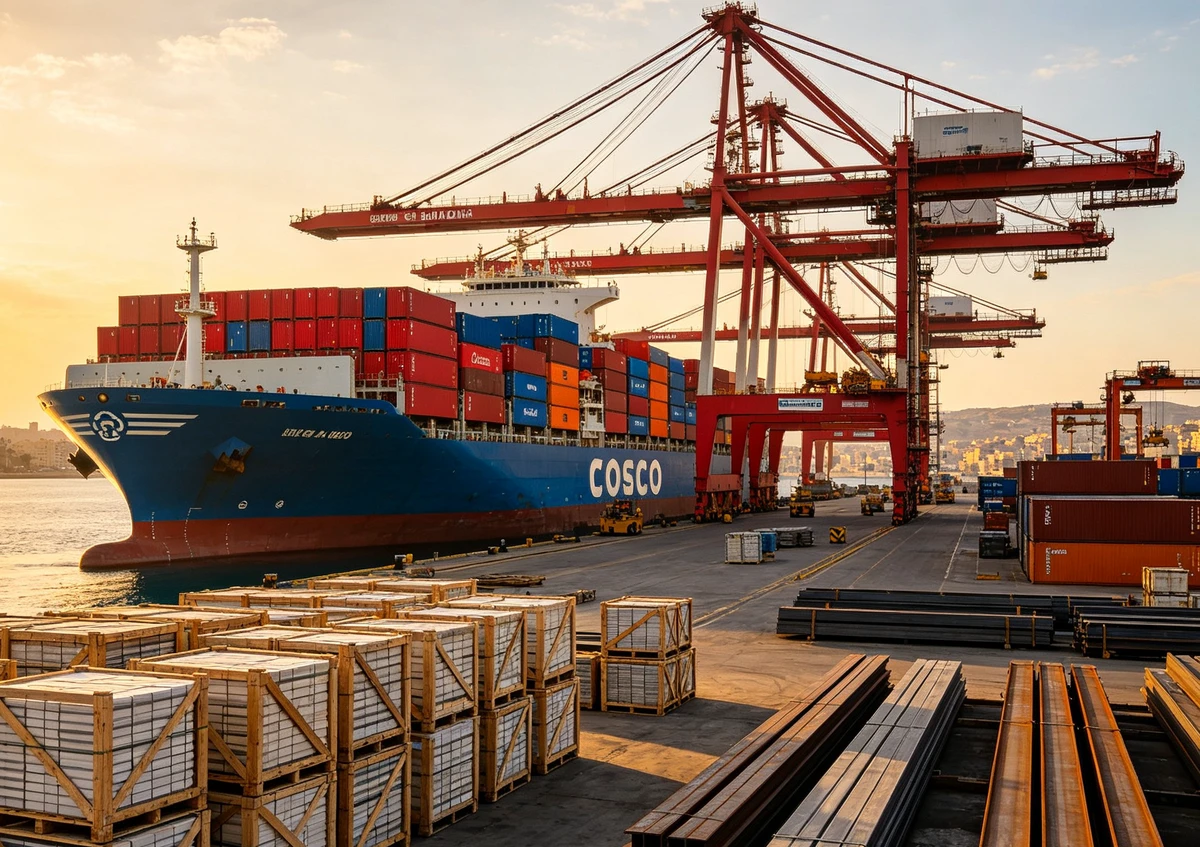
Most construction cargo travels by FCL (Full Container Load) — your goods are sealed at the factory and opened only at your warehouse. Choose LCL (Less than Container Load) only for shipments under ~15 CBM; at $150/CBM, 15 CBM already costs $2,250, the price of a full 20ft container. Both modes are covered under our sea freight services from every major Chinese port.
Container selection is where building materials differ from ordinary cargo:
| Container | Capacity | Payload Limit | Best For |
|---|---|---|---|
| 20GP | 28 CBM | 25–28 t | Heavy materials: tiles, stone, steel, cement |
| 40GP / 40HQ | 58 CBM | 26–28 t | Light, bulky cargo: insulation, panels, doors, sanitary ware |
| Flat Rack | — | — | Oversized steel structures and machinery |
| Open Top | — | — | Tall cargo requiring crane loading |
The #1 trap for construction shippers: weight density, not volume. Tiles stack at roughly 2.3 tonnes per CBM — filling a 20GP to its 28 CBM brim would mean ~64 tonnes, more than double the legal payload. In practice, a “full” tile container holds only 11–12 CBM. Understanding your cargo’s stowage factor (usable CBM per tonne) before booking prevents rejected loads, re-stuffing fees, and demurrage.

Our industry insight: A contractor shipping porcelain tiles from Foshan once asked us why a rival’s 20GP quote was “cheaper per CBM.” The rival had quoted by volume; the cargo was weight-limited. We re-planned the load around payload, added a second 20GP, and the client’s per-tonne cost dropped 18%. For tiles, stone, and steel, always quote by weight first.
2. Cost of Shipping Construction Materials from China to Libya
Current market rates for standard dry containers (2025–2026 planning benchmarks; always confirm with a line-by-line quote):
| Origin Port | Destination | 20GP | 40GP | 40HQ |
|---|---|---|---|---|
| Shenzhen (Shekou/Yantian) | Tripoli | $2,000–3,000 | $3,050–4,500 | $3,200–4,700 |
| Shanghai | Tripoli | $2,050–2,850 | $3,050–4,500 | $3,200–4,700 |
| Ningbo-Zhoushan | Misrata | $2,100–3,150 | $3,150–4,200 | $3,300–4,400 |
| Guangzhou (Nansha) | Tripoli | $2,150–3,150 | $3,150–4,200 | $3,300–4,400 |
| Qingdao | Benghazi | $2,150–3,250 | $3,250–4,350 | $3,400–4,500 |
Planning benchmarks compiled from 2025–2026 forwarder market data; actual quotes vary by carrier, season, and contract terms. Always request a line-by-line quotation.
LCL runs $80–150 per CBM (e.g., Shenzhen→Tripoli $165–190; Ningbo→Misrata $140–170), billed on the greater of actual or volumetric volume (1:1,000 kg ratio), minimum 1 CBM.
The headline rate is never the real price. A complete invoice adds BAF ($100–400), LSS ($30–80), origin THC ($100–180), documentation ($50–80), ECTN ($80–150), destination THC ($150–300), and — if you miss free time — demurrage at $80–150/day. On a $2,500 base rate, expect $800–1,800 in additions. Seasonality matters too: Chinese New Year adds 15–25%, pre-Ramadan 10–15%, Golden Week 10–20%.
Real-life scenario: We audited a competitor’s $2,950 quote for a 40ft tile container to Tripoli. Buried exclusions — BAF, LSS, destination THC, ECTN — added $1,120. Our $3,400 all-inclusive quote was $330 cheaper in the end. Always demand a line-by-line quotation.
Add cargo insurance at 0.3–0.5% of cargo value — non-negotiable for tiles and glass on a 40-day Mediterranean voyage.
3. Transit Time and Choosing the Right Libyan Port
Transit time depends on the routing — and 2026 brought a genuine game-changer:
| Route | Transit Time | Notes |
|---|---|---|
| COSCO direct service (new, fortnightly) | ~25 days (Guangzhou → Benghazi/Misrata) | Qingdao/Shanghai/Ningbo/Guangzhou loop; launched 2025 |
| Suez Canal + transshipment | 35–45 days | Via Malta (Marsaxlokk), Istanbul (Ambarli), or Port Said; transshipment adds 7–10 days |
| Cape of Good Hope rerouting | 32–46 days | Red Sea security diversions; dynamic situation |
Missing a feeder connection in Malta or Istanbul can cost a full week — factor this into project schedules.

Port selection is a supply-chain decision, not a shipping one:
| Port | Share | Best For |
|---|---|---|
| Tripoli | ~60% of imports | Western Libya; highest sailing frequency |
| Misrata | ~10% | Project cargo; Free Zone undergoing USD 2.7bn expansion; LISCO steel hub |
| Benghazi | ~30% | Eastern reconstruction and oil & gas projects; COSCO direct call |
| Al Khoms | — | Ro-Ro and breakbulk; machinery arrivals |
Our industry insight: Libya’s West (Tripolitania) and East (Cyrenaica) operate as separate logistics zones. Trucking a container from Tripoli to Benghazi means checkpoints, poor roads, and 7–15 extra days. Route to the port closest to your final warehouse — western projects via Tripoli/Misrata/Al Khoms, eastern projects direct to Benghazi or Tobruk.
Customs clearance itself takes 5–15 working days depending on document accuracy — which is why the compliance chapters below matter more than any freight rate. If your project also involves re-exporting or bonded handling inside Libya, our customs clearance team can map the full document chain before you book space.
4. Importing Ceramic Tiles from China to Libya
Ceramic and porcelain tiles are Libya’s largest Chinese building-material import — and the most mishandled. Sourcing clusters in Foshan (ceramics) ship conveniently through nearby Shenzhen and Guangzhou ports.
- HS codes & duty: Glazed tiles (HS 6907) and unglazed tiles (HS 6908) enter at 5%–10% duty on CIF value — a reconstruction-friendly band.
- Weight planning: At ~2.3 t/CBM, plan ~11–12 CBM per 20GP and quote by weight, not volume.
- Packaging SOP: Reinforced cartons with foam separators, ISPM-15-compliant pallets, edge protection, and moisture defense — desiccants, barrier film, and a pre-loading container inspection for a 40-day sea voyage.
- Damage claims: Photograph every staged load, record seal numbers, and hold your insurance certificate — the three documents every successful tile claim needs.
The same logic extends to glass (HS 7007 — crate vertically, mark fragile, isolate from steel) and worked stone (HS 6802 — steel or timber frames, non-slip strapping).
5. Shipping Steel Structures, Prefab Warehouses and Construction Machinery
Project cargo follows different rules. Steel structures and prefab warehouses (HS 7308, HS 9406) typically move on flat racks or open tops, priced per shipment at 50–200% above standard box rates, and require professional lashing and dunnage plus a route survey at destination. Steel buyers benefit from China’s northern clusters — Shandong and Hebei mills shipping via Qingdao or Tianjin — and can consolidate with southern materials into one Shenzhen-built container.
For construction machinery — excavators, batching plants, block-making machines — Ro-Ro (Roll-on/Roll-off) to Al Khoms or Misrata is usually cheapest. Sailings are sparse: Xiamen→Misrata can exceed 60 days, and we advise booking one month ahead.
Real-life scenario: A prefab steel warehouse for an eastern Libya housing program left Shandong on the COSCO direct loop. Because the consignee’s L/C and ACI registration were completed before loading — not after arrival — clearance took 5 working days instead of the 15-day average. Pre-shipment compliance, not ocean speed, determined the project’s schedule.
6. Libya Import Duty on Building Materials and Required Documents
Libyan duties are assessed on CIF value (cost + insurance + freight):
| Material | HS Code | Duty Rate |
|---|---|---|
| Ceramic/porcelain tiles | 6907 / 6908 | 5%–10% |
| Cement | 2523 | 5%–10% |
| Steel bars & sections | 7213 / 7214 | 5%–10% |
| Steel structures / prefab | 7308 / 9406 | 5%–10% |
| Aluminium profiles | 7604 / 7610 | 5%–10% |
| Glass | 7007 | 5%–10% |
| Worked stone | 6802 | 5%–10% |
Libya abolished traditional customs tariffs in 2005; most imports now carry a 5% service fee, with specific rates varying by HS code. Building materials for reconstruction typically fall in the 5%–10% range. Confirm current rates with Libyan customs before shipping.
VAT is 0%. Note that since May 2026, China grants zero-tariff treatment to 53 African nations including Libya on the Chinese export side — a margin advantage for Chinese suppliers.
Your document set must include: commercial invoice (×2), packing list, bill of lading, CCPIT Certificate of Origin (×2, chamber-stamped), the blacklist declaration (confirming no Israeli-origin goods or port calls — a Libya-specific requirement), ISPM-15 certification for wood packaging, and — for regulated building products — a pre-shipment inspection certificate under CBL Resolution 96⁄2015 (issued by Bureau Veritas or SGS), which is a condition for opening the import L/C. The Libyan consignee must hold a valid import licence covering your exact product categories, and the B/L consignee name must match it verbatim. According to the Libyan Customs Authority, documentation errors cause over 60% of held shipments.
7. ACI, ECTN and Central Bank of Libya Letter of Credit Requirements
This is the compliance chain that decides whether your cargo moves or stalls. Here’s the reality: no ACI, no sailing.
ACI (Advanced Cargo Information) comes first — and it applies before your vessel loads. Since 1 November 2024, Libya has fully enforced the ACI system: exporters and importers register at aci.customs.gov.ly, submit cargo data, and obtain an ACI number — in practice at least 48 hours before loading, with the number required on the Bill of Lading. No ACI number, no sailing. Most competing guides still omit this step; carriers will not accept your booking without it.
ECTN (Electronic Cargo Tracking Note) is the second gate, required before arrival at a Libyan port. Budget $80–150 per B/L and 1–3 working days. Critical timing: applications filed within 48 hours of arrival are flagged for manual review, adding 3–7 days. We submit at least 5 working days before estimated arrival — a habit that has saved our clients hundreds of dollars in demurrage per shipment.
The Central Bank of Libya (CBL) requires most commercial imports to be settled by Letter of Credit, and your shipping documents must mirror the L/C exactly — industry veterans say even a misplaced comma can block bank release and customs clearance. Common killers: B/L consignee names that don’t match the L/C, prohibited partial shipments, and late document presentation. In September 2026, Libya tightened this further with Decision 449⁄2026: commercial shipments may not clear customs until all banking, commercial, and customs requirements are satisfied — and imports for trade outside official banking channels are banned outright from 30 September 2026. Have your freight forwarder pre-review every document against the L/C before dispatch.
8. Door-to-Door Shipping from China to Libya: DDP vs DAP and Consolidation
Can you use DDP shipping from China to Libya? Honestly, no. True DDP requires the seller’s side to pay Libyan import duties — but Libyan law makes the licence holder (your consignee) legally responsible for duty payment, and CBL foreign-exchange controls block third-party settlement. Any forwarder advertising “DDP to Libya” without explaining this deserves scrutiny. DAP (Delivered at Place) is the workable standard: the forwarder manages everything through delivery; the consignee clears customs and pays duties. Note that with Decision 449⁄2026, paying outside official banking channels is now banned — another reason informal “DDP workarounds” carry real risk.
Real-life scenario: An importer of electrical equipment to Tripoli budgeted $6,800 for a promised “all-inclusive DDP” shipment. Actual cost after 12% duty and brokerage settled directly with Libyan authorities: ~$9,200. After we restructured the deal as transparent DAP with a pre-calculated duty estimate, their budgeting landed within 3%.
A typical DAP timeline (45–55 days door-to-door):
| Stage | Duration | Cost Component |
|---|---|---|
| Supplier pickup | 1–2 days | $150–400 |
| Export clearance (China) | 1–3 days | $80–300 |
| Ocean transit | 35–45 days | $2,000–4,800 |
| Import clearance + ECTN | 3–10 days | $250–600 |
| Last-mile delivery | 2–5 days | $200–600 |
All-in door-to-door: 20GP $3,500–5,200; 40GP $5,000–7,500; LCL $200–350/CBM — a 15–30% premium over port-to-port that covers pickup, brokerage, ECTN, and delivery.
For distributors buying from multiple suppliers — tiles in Foshan, fittings in Zhejiang, glass in Shandong — consolidation is the biggest lever: collect everything at our Shenzhen or Guangzhou warehouse services hub, build one FCL, and issue one document set and one ECTN instead of paying separate LCL minimums three times.
9. FAQs
How much does a 20ft container of tiles cost from China to Libya? Base ocean freight runs $2,000–3,100; the all-in port-to-port figure including surcharges and ECTN is typically $3,000–4,500.
How long does sea freight take — and is the COSCO direct service faster? Transshipment routings take 35–45 days; the COSCO direct loop cuts Guangzhou→Benghazi/Misrata to roughly 25 days.
What happens if my ACI or ECTN is missing when the vessel loads or arrives? Without ACI, the carrier will not load your container in China. Without a validated ECTN at arrival, customs blocks discharge and fines plus demurrage ($80–150/day) accumulate.
Which Libyan port should I choose — Tripoli, Misrata, or Benghazi? Match the port to your job site’s region: Tripoli/Misrata/Al Khoms for the west, Benghazi/Tobruk for the east. Never plan on trucking across the West–East divide.
Is LCL safe for tiles and glass? Under 15 CBM it works with export-grade packaging, but FCL’s sealed-container handling is strongly recommended for fragile, high-value materials.
Can I consolidate materials from different Chinese suppliers into one container? Yes — a consolidation warehouse collects goods from multiple factories, builds one FCL, and merges all documents into a single shipment.
10. Conclusion: Getting Your Materials to the Job Site
Here’s the playbook we give every client: match the container to your cargo’s weight density first. Compare line-by-line quotes, not headline rates. Where routing allows, ride the new COSCO direct service. And treat ACI, ECTN, and L/C alignment as pre-shipment tasks — not arrival problems. Plan around DAP, not DDP. Contractors sourcing for simultaneous projects elsewhere in the region can also review our guides to fcl shipping from china to Iraq and Sea Freight from China to Algeria for comparable North African and Middle East lanes.
At Sinoshipment, we’ve been moving freight from Shenzhen to North Africa since 2013 — over 5,000 clients and counting. This lane is our daily bread: supplier pickup in Foshan and Shandong, consolidation at our Shenzhen warehouse, ACI/ECTN filing, L/C pre-review, and delivery to job sites across Tripoli, Misrata, Benghazi, and Al Khoms. We quote transparent, itemized pricing — no surprises. Visit Sinoshipment to get a free, detailed quote for your construction materials within 24 hours.
Compliance rules and rates cited reflect September 2026 conditions; verify current requirements with Libyan customs and the CBL before shipping.