USMCA Joint Review 2026: Key Risks and Action Plan for China-to-US and Mexico Importers
· By SinoShipment
Are you worried that one policy meeting in North America could quietly reshape your China-to-US or China-to-Mexico shipping strategy before your next peak season order cycle? If yes, you are looking at the right signal early. The March 18, 2026 U.S.–Mexico technical talks are not a formal tariff change, but they are a practical warning that origin scrutiny, supplier traceability, and regional sourcing pressure are likely to intensify ahead of the July 1, 2026 USMCA Joint Review, especially for lanes like freight shipping from china to usa and freight shipping from china to mexico.
For importers, distributors, and cross-border eCommerce operators, the key question is not “Will USMCA still exist?” The key question is “How do we keep cost, lead time, and customs compliance stable if North America pushes harder on non-market input control?”
This guide gives you a decision framework, a 90-day action plan, and a lane-level logistics playbook based on operational realities we see in daily freight execution.
Key Takeaways
- The March 18 U.S.–Mexico announcement is a policy direction signal, not an immediate tariff schedule update (as of 2026-03).
- The strongest likely pressure point is rules of origin and supply-chain traceability, especially for products with non-North American intermediate inputs.
- Importers should run dual landed-cost scenarios now: USMCA-qualified and non-qualified.
- High-risk operators need a 90-day response plan covering documentation, sourcing fallback, and route flexibility.
- SinoShipment can support execution through sea freight, air freight, customs clearance, amazon fba, warehouse services, and cargo insurance.
1) Introduction: Why This March 18 Event Matters Now
The March 18, 2026 discussion matters because it aligns policy language, review timing, and supply-chain security goals in one place. For companies moving goods from China into North American value chains, this raises near-term uncertainty around origin qualification, customs scrutiny, and sourcing strategy, even before legal texts are formally changed.
The official release confirms that technical teams are expected to explore options to increase U.S. and Mexican production and limit non-market inputs in North American supply chains. That is a direct signal for importers using multi-country assembly models or complex bill-of-materials structures.
Who should pay attention first:
- U.S. importers buying finished goods assembled in Mexico with Asian components
- Mexico-based manufacturers serving U.S. customers
- China-based intermediate suppliers linked to North American final assembly
- Amazon and omni-channel sellers who depend on stable replenishment lead times
- Procurement and trade compliance teams managing margin-sensitive SKUs
2) What Exactly Happened on March 18, 2026?
On March 18, 2026, USTR and Mexico’s Economy Ministry launched technical talks before the July 1 Joint Review and directed teams to examine supply-chain gaps, economic security cooperation, rules of origin, and complementary trade actions. This is preparatory coordination, but it usually shapes negotiation priorities and enforcement posture.
What is confirmed (as of 2026-03):
- Bilateral technical process was officially initiated.
- Teams were asked to identify deliverables before July 1, 2026.
- Focus areas include manufacturing employment, origin rules, and non-market inputs.
What is not confirmed:
- No immediate, published tariff line update linked to this press release.
- No blanket cancellation of USMCA preferences.
- No one-size-fits-all product treatment announced at this stage.
Authoritative source:
- USTR press release (March 18, 2026):
3) How the USMCA Joint Review Works
The USMCA Joint Review is a built-in institutional checkpoint, not an overnight termination mechanism. In practical terms, the review can reshape expectations, negotiation pressure, and compliance intensity long before firms see final legal amendments in day-to-day customs processing.
Under USMCA’s review architecture, parties assess continuation and future trajectory. That creates three business realities:
- Political signaling comes first: language around economic security and non-market inputs often appears before technical customs detail.
- Enforcement can tighten before treaty text changes: importers may face stricter document checks, supplier-origin questions, or higher audit readiness expectations.
- Commercial contracts lag policy cycles: if your contracts, booking plans, and inventory assumptions are static, your margin risk rises quickly.
For policy background and agreement text reference:
- USMCA agreement resources
- If your exposure includes trilateral flows, also benchmark capacity and routing assumptions for freight shipping from china to canada.
4) Policy Direction Signal: From “Non-Market Inputs” to Stricter Origin Scrutiny
The direct implication of the current wording is simple: authorities are likely to pay more attention to where value is added, where key components originate, and whether claimed preferential treatment is economically consistent with regional integration goals. That means the compliance burden shifts from form filing to proof quality.
In operations, the event-to-impact chain looks like this:
| Layer | What changes | Why it matters |
|---|---|---|
| Event | U.S.–Mexico technical talks launched before July 1 review | Sets negotiation direction early |
| Policy track | Greater focus on economic security and origin architecture | Increases uncertainty for non-regional inputs |
| Product impact | Automotive, machinery, electronics, strategic intermediates likely face closer attention | These sectors have deep multi-country value chains |
| Supply-chain impact | Higher traceability requirements and supplier substitution pressure | Documentation gaps can become commercial delays |
| Execution outcome | More compliance cost and timing variability | Landed cost and service levels need scenario planning |
In our freight execution experience, the biggest pain point is not the headline policy. It is the mismatch between what procurement assumes and what customs documentation can actually support during a stricter verification cycle.


5) Who Is Most Exposed? A Practical Risk Segmentation for 2026
Exposure is highest when your BOM depends on non-North American intermediates, your origin files are fragmented, and your replenishment model has little schedule buffer. Companies with single-source assumptions and limited document governance are typically affected first when enforcement intensity rises.
Use this segmentation model to prioritize internal action:
| Business profile | Typical exposure trigger | Risk level (as of 2026-03 assessment) | Immediate mitigation |
|---|---|---|---|
| U.S. importer sourcing from China via Mexico assembly | Insufficient proof of regional value under preferential claims | High | Launch SKU-level origin audit and supplier declaration refresh |
| Mexico assembler using Asian components | Heavy reliance on imported key parts | High | Build alternative sourcing map and phase-in localization scenarios |
| China exporter selling intermediates into NA chains | Customer requests deeper origin and compliance evidence | Medium-High | Standardize technical files, production records, and origin statements |
| Cross-border eCommerce brand | Short lead-time model, weak customs resilience | Medium | Add transit buffers and dual routing options |
| Traditional B2B distributor | Limited policy monitoring cadence | Medium | Monthly policy-risk dashboard and broker alignment review |
A useful rule: if one documentation failure can stop your top 20% revenue SKUs, your operational risk is high even if your average duty rate looks stable today.
6) Cost, Lead Time, and Compliance Impact: What to Recalculate
Do not wait for a final policy text to run numbers. The most effective approach is to model two realistic landed-cost paths now: one where your current origin strategy remains accepted, and one where qualification becomes harder and your duty/compliance burden increases.
6.1 Dual landed-cost model (qualified vs non-qualified)
Build a side-by-side model for each priority SKU group:
| Cost block | Scenario A: Preferential path holds | Scenario B: Preferential path weakens |
|---|---|---|
| Duty/tariff | Lower under qualifying treatment | Higher baseline exposure |
| Customs processing | Standard review effort | More document prep and verification cycles |
| Logistics | Current routing mostly valid | Potential lane shifts and premium freight risk |
| Inventory | Normal safety stock | Higher buffer stock requirement |
| Margin impact | Stable-to-manageable | Sensitive, especially for low-margin SKUs |
6.2 Documentation readiness
Minimum package to reinforce origin confidence:
- Supplier declarations with consistent product detail
- BOM-to-origin mapping by critical component
- Production and transformation evidence by site
- HS classification logic aligned across shipper, broker, and importer
- Archive process that supports retrospective customs queries
6.3 Lead-time and service continuity
Add resilience where it matters:
- Build booking windows with contingency space during key sales periods
- Pre-qualify alternate ports and carrier options for North America lanes
- Link customs milestones to inventory reorder triggers
- Define escalation SOP when origin-related holds occur
In our operations, companies that combine trade compliance and logistics planning in one workflow recover faster than teams that treat them as separate functions.
7) 90-Day Action Plan Before and After the July 1 Review
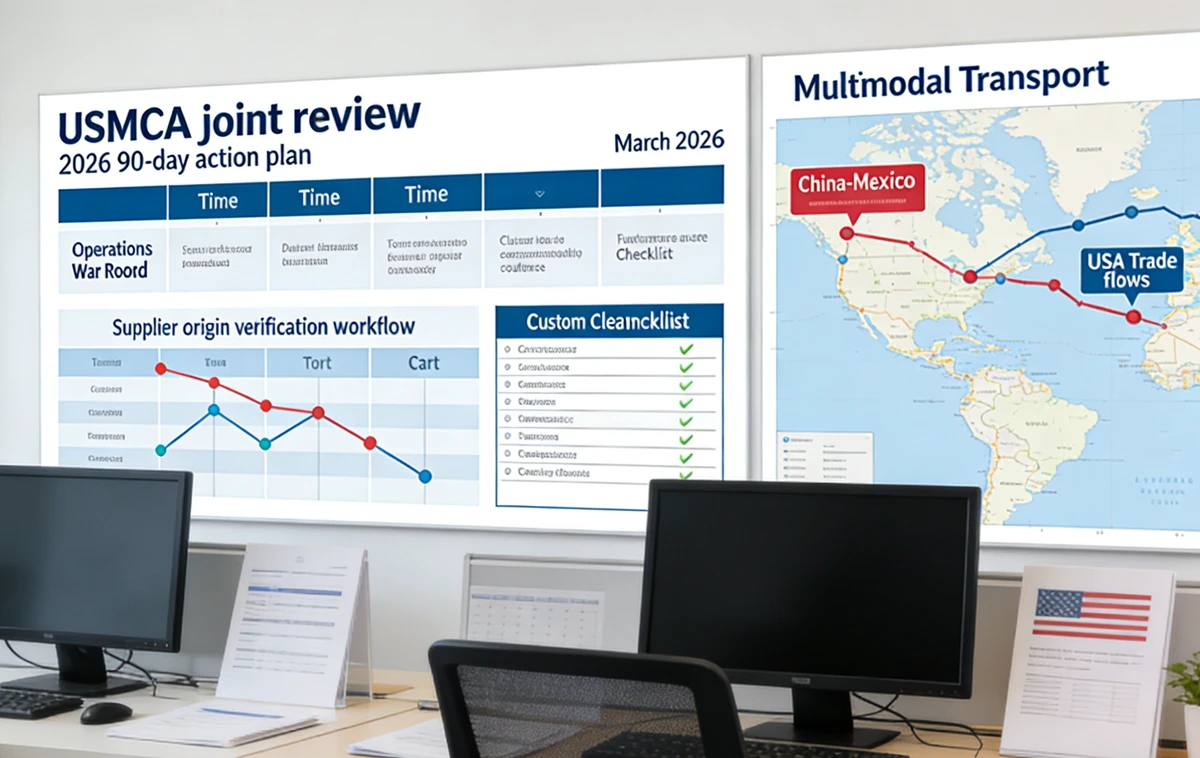
A 90-day plan turns uncertainty into execution. Start with exposure mapping, move to option design, then lock process controls. This phased model helps avoid overreaction while still protecting service levels and gross margin if policy tone tightens after the review milestone.
Days 1–30: Exposure mapping and gap diagnosis
- Rank SKUs by margin, volume, and origin complexity
- Identify documents that are missing, inconsistent, or outdated
- Map lane dependencies (port, carrier, customs broker, final fulfillment node)
- Flag products with no validated fallback sourcing plan
Days 31–60: Build and test alternatives
- Run alternate sourcing or assembly scenarios for high-risk SKU groups
- Validate customs and broker interpretation on sensitive origin points
- Test routing alternatives (port pairs, service modes, transit buffers)
- Align procurement terms with compliance evidence requirements
Days 61–90: Institutionalize operating controls
- Update SOPs for origin documentation and exception handling
- Set monthly review cadence with procurement, logistics, and compliance teams
- Create trigger thresholds for switching lanes or inventory posture
- Prepare executive dashboard for cost, delay, and compliance risk
Recommended governance table:
| Owner | Deliverable | Required data | Completion standard |
|---|---|---|---|
| Procurement | Supplier-origin confidence map | BOM, declarations, contract terms | Top SKUs fully mapped |
| Compliance | Documentation control matrix | HS logic, certificates, archive system | Audit-ready package |
| Logistics | Dual-route transport plan | Carrier options, transit stats, cut-off windows | Tested fallback lane |
| Finance | Margin sensitivity model | Duty scenarios, freight rates, buffer stock cost | Decision-ready model |

8) Decision Matrix: Keep, Shift, or Split Supply Sources?
No single strategy is universally correct. The right choice depends on your margin profile, origin-certainty level, demand volatility, and your ability to absorb requalification effort. A structured decision matrix prevents panic-driven changes and keeps teams aligned on economics and service commitments.
| Decision path | Best fit conditions | Main upside | Main trade-off |
|---|---|---|---|
| Keep current sourcing | Strong origin evidence, healthy margins, stable demand | Lowest disruption to current operations | Higher exposure if enforcement tone changes quickly |
| Shift to more regional inputs | Persistent origin uncertainty, strategic North America volume | Better long-term compliance resilience | Transition cost and supplier onboarding complexity |
| Split multi-origin sourcing | Mixed product risk and uncertain demand profile | Flexibility and risk diversification | More planning complexity and higher coordination burden |
Use these filters before deciding:
- Margin sensitivity: how much landed-cost increase can you absorb?
- Origin certainty: how confident are you in proving qualification?
- Demand volatility: can your service model tolerate delays?
- Requalification complexity: how hard is supplier or process migration?
- Logistics resilience: how quickly can you re-route and recover?
9) Why Recommend SinoShipment for North America-Bound Freight Under USMCA Uncertainty
When policy direction is evolving, importers need an operator that can convert uncertainty into executable transport and compliance workflows. SinoShipment is a practical fit for this phase because the service mix supports both cost control and resilience, from transport mode planning to customs coordination and inventory buffering.
How service fit maps to real needs:
| Client need | SinoShipment service | Operational value |
|---|---|---|
| Cost discipline on predictable lanes | Sea Freight | Better baseline landed-cost planning |
| Urgent replenishment for sales continuity | Air Freight | Reduced stockout risk and faster response |
| Marketplace compliance and handover accuracy | Amazon FBA + Customs Clearance | Fewer documentation and handoff errors |
| Shock absorption during policy or transit disruptions | Warehouse Services + Cargo Insurance | Better continuity when delays or claims occur |
Practical next-step package you can request:
- Lane-by-lane shipping and customs feasibility check for your top SKUs
- Dual-scenario route design (assuming easier vs stricter origin outcomes)
- Monthly policy-and-transit risk review for North America-bound plans
10) FAQ
Is the March 18 announcement an immediate tariff increase?
No. As of 2026-03, the published communication is a technical discussion roadmap ahead of the Joint Review, not an immediate tariff schedule notice. You should still prepare because policy direction can influence enforcement focus before formal tariff instruments change.
Does the July 1 Joint Review automatically end USMCA preferences?
No. The review is a treaty governance mechanism. It does not automatically cancel preferences overnight. However, the policy process can raise compliance and documentation expectations, which can affect practical access to preferential treatment.
Which documents should importers prioritize first?
Start with supplier declarations, BOM-origin mapping, classification consistency, and transformation records. These are the core files that determine whether your preferential claim remains defensible under tighter scrutiny.
How can China-based suppliers stay competitive if regionalization pressure increases?
Improve evidence quality, shorten response time for origin-related requests, and co-design compliance-ready SKU documentation with buyers. Suppliers that provide fast, credible data usually remain preferred even in stricter policy environments.
Which sectors are more likely to face early pressure?
Sectors with strategic value chains and high cross-border integration, such as automotive components, electronics, machinery, and selected industrial intermediates, generally face earlier and deeper origin-related questions.
11) Conclusion
The core message is straightforward: March 18 was an early signal, not a final rulebook. But for importers and exporters linked to China-origin inputs, waiting for perfect policy certainty is usually more expensive than preparing now.
If you want to stabilize cost, lead time, and compliance under USMCA uncertainty, start with a dual-scenario operating model and build a lane-level execution plan before peak decisions lock in.
For practical support, use SinoShipment as your execution partner for routing, customs coordination, warehousing, and risk protection planning.
Evidence and Compliance Notes
- This article reflects publicly available information and operational interpretation as of 2026-03.
- The July 1, 2026 Joint Review is a policy milestone; downstream implementation and enforcement specifics may evolve.
- Always validate binding legal/tariff outcomes with the latest official customs and trade authority releases.
Additional authority context: