Air Freight from China to Egypt: 2026 Cost, Transit Time & Complete Shipping Guide
· By SinoShipment
Air freight from China to Egypt has shifted from a last-resort emergency option to a strategic supply chain necessity in 2026. With Red Sea disruptions pushing standard sea freight transit past 40 days via the Cape of Good Hope, Egyptian importers can no longer afford to rely solely on ocean routes for time-sensitive inventory. Yet most buyers still struggle with a familiar set of questions: How much does it actually cost per kilogram? Which Chinese airport should I use? And how do you navigate Egypt’s complex ACID customs requirements without costly delays at Cairo International Airport?
At Sinoshipment, freight shipping from China to Egypt is a service we have managed from our Shenzhen base since 2013. This guide is built on more than 5,000 client shipments on this lane, live 2026 market rate data from our active airline contracts, and the exact procedures our Shenzhen operations team executes every week to move electronics, textiles, and industrial parts from South China to Cairo, Alexandria, and beyond. By the end of this article, you will know precisely how to budget for air freight, choose the right airline and service model, prepare bulletproof documentation, and avoid the customs mistakes that cost inexperienced importers days in detention.
What Is Air Freight from China to Egypt?
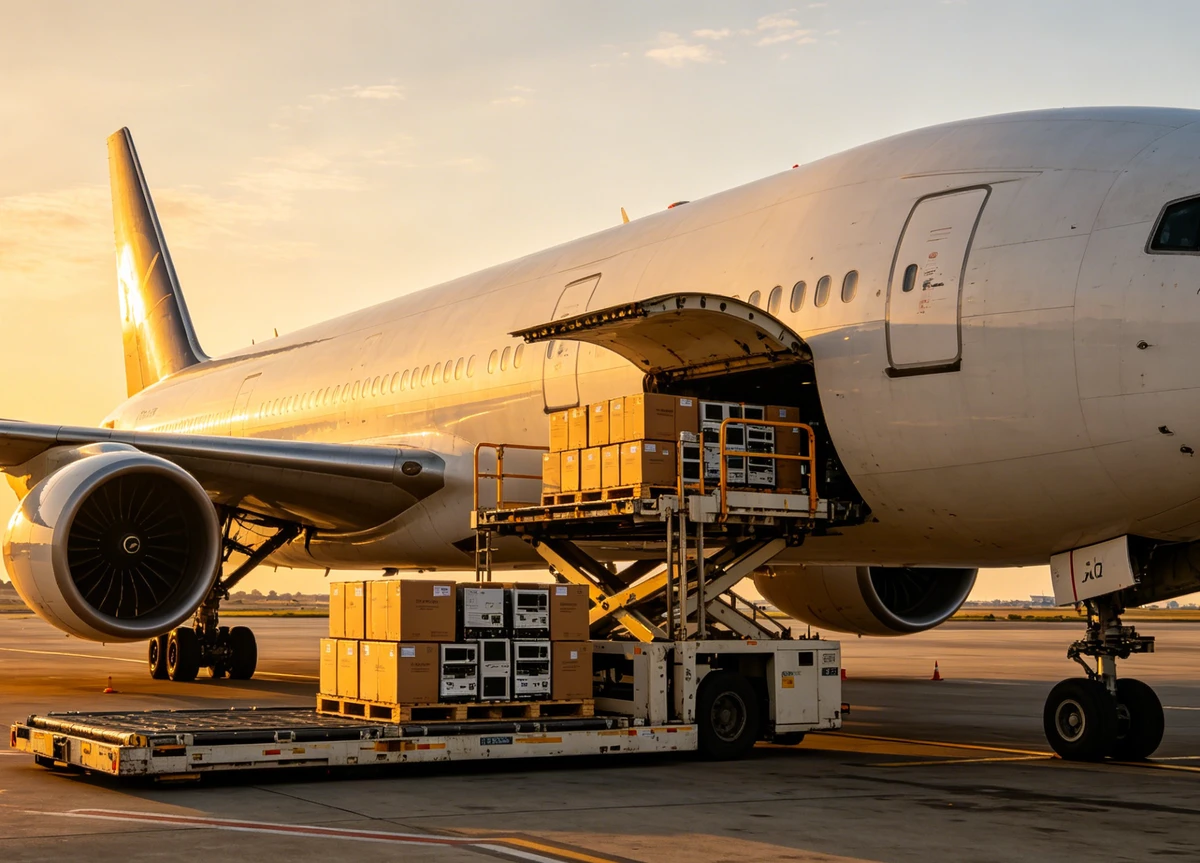
Air freight is the transportation of commercial cargo via scheduled passenger or all-cargo airline networks between China and Egypt. It is distinct from express courier services like DHL, FedEx, or UPS, which operate their own dedicated door-to-door networks and typically charge a premium for smaller parcels under 100 kg.
When you book air freight, you are usually working with a freight forwarder who purchases space from airlines such as EgyptAir, Emirates, or Turkish Airlines. The forwarder issues a House Airway Bill (HAWB) under their master contract, while the airline itself holds the Master Airway Bill (MAWB). Your cargo may travel on a direct flight from Guangzhou or Shenzhen straight to Cairo, or it may move via a transfer hub such as Dubai, Istanbul, or Doha.
Key terms to know before you book:
- Airway Bill (AWB) — The airline’s contract of carriage. It is not a title document like a sea freight Bill of Lading, but it serves as proof of shipment and a tracking reference.
- Chargeable Weight — The metric used to price your shipment. Airlines charge whichever is greater: the actual gross weight or the volumetric weight calculated from dimensions.
- Consolidated Air Freight (Consol) — Multiple shippers’ cargo grouped into one master shipment to unlock lower weight-break rates.
- Direct Flight — A single routing from origin to destination without plane changes.
- Transfer / Transshipment — Cargo switches aircraft at a hub airport. This usually adds 12–24 hours but can reduce cost.
Typical cargo moved by air on the China–Egypt lane includes electronics and mobile accessories, textile samples and fast-fashion restocks, industrial spare parts, pharmaceutical samples, and high-value consumer goods.
Why Air Freight Is a Strategic Choice for Egyptian Importers in 2026
For most of the past decade, air freight was the expensive alternative you used only when a factory line stopped or a seasonal deadline loomed. That calculus changed in 2024–2026.
The Red Sea Context
Houthi attacks in the Red Sea and ongoing uncertainty around Suez Canal transits have forced ocean carriers to reroute Asia–Europe and Asia–Mediterranean services around the Cape of Good Hope. According to UNCTAD, rerouting vessels via the Cape has added roughly 10 days to Asia–Europe sailings, and Suez Canal tonnage remains approximately 70% below pre-crisis levels as of mid-2025. To understand how these disruptions affect regional logistics, read our analysis of the Middle East Shipping Crisis. For Egyptian ports, this has extended typical FCL transit from China to 40–50 days—double the historical norm. LCL shipments are even slower, often stretching past 55 days once consolidation and deconsolidation are factored in.
When your Egyptian retail shelf sits empty for two months, the savings of sea freight evaporate quickly. For a complete ocean transport breakdown on this corridor, see our guide to Container Shipping from China to Egypt.
When Air Freight Makes Financial Sense
Air freight is not always the cheapest option, but it is frequently the most profitable one. Consider air cargo when:
- You are moving time-sensitive shipments such as fashion collections for Ramadan or New Year promotions, new electronics launches, or production-line spare parts that halt manufacturing.
- Your goods are high-value or high-margin. A $50,000 shipment of consumer electronics can absorb a $2,500 air freight bill far more easily than a $5,000 shipment of low-margin commodities.
- Cargo is under ~300 kg or ~2 CBM. Below this threshold, air freight’s total cost often beats sea freight once you factor in LCL minimums, handling fees, and capital tied up in transit.
- Your final destination is in Upper Egypt or remote areas where sea freight to Alexandria plus inland trucking takes longer than air to Cairo plus local delivery.
Total Cost of Ownership (TCO)
Smart importers look beyond the freight invoice. Air freight slashes inventory carrying cost, reduces warehousing needs, and eliminates stockout losses. If missing a two-week selling window costs you $10,000 in lost revenue, paying an extra $1,500 for air cargo is not an expense—it is insurance.
Air Freight Costs from China to Egypt: 2026 Market Rates
Air freight rates fluctuate weekly based on fuel prices, seasonal demand, and available belly-hold capacity. The figures below reflect the May 2026 market and are intended as planning benchmarks. Always request a fresh quote before booking, as validity is typically 2–3 weeks.
May 2026 Rate Snapshot by Origin
| Origin Airport | Destination | Rate Range (USD/kg) | Best For |
|---|---|---|---|
| Shenzhen (SZX) → Cairo (CAI) | $3.50 – $5.50 | Electronics, high-tech goods | |
| Guangzhou (CAN) → Cairo (CAI) | $3.50 – $5.20 | Textiles, furniture, consumer goods | |
| Shanghai (PVG) → Cairo (CAI) | $4.20 – $6.50 | Machinery, East China suppliers | |
| Beijing (PEK) → Cairo (CAI) | $4.30 – $6.30 | North China industrial cargo | |
| Hong Kong (HKG) → Cairo (CAI) | $3.50 – $4.50 | Transshipment, competitive rates | |
| Express Courier (DHL/FedEx/UPS) | $10.00 – $15.00 | Urgent samples, <100 kg parcels |
Note: Express rates are door-to-door and include customs clearance; standard air freight rates are typically airport-to-airport or all-in DDP depending on your forwarder’s quote structure.
Weight Break Analysis
Rates drop significantly as you cross higher weight thresholds:
| Chargeable Weight | Example Rate (USD/kg) | Estimated Cost | Typical Scenario |
|---|---|---|---|
| 100 kg | $5.90 | $590 | Small urgent shipment, samples, spare parts |
| 300 kg | $4.60 | $1,380 | Medium restock for a promotion |
| 500 kg | $4.05 | $2,025 | Regular weekly replenishment |
| 1,000 kg | $3.75 | $3,750 | Large planned shipment, stable demand |
What Determines Your Final Rate
Beyond the base airline tariff, several variables affect your invoice:
- Chargeable weight — The single biggest factor. See the practical explanation below.
- Fuel and security surcharges — Adjusted monthly by airlines; typically $0.30–$0.60/kg in 2026.
- Seasonality — Peak seasons (pre-Chinese New Year in January/February and Q4 holiday stock-up) can spike rates 20–40%.
- Cargo type — General cargo is cheapest. Dangerous goods, temperature-controlled cargo, and high-value items attract premiums.
- Origin and destination handling — Pickup trucking in China and terminal handling at CAI add flat fees ($80–$150 per shipment).
Practical Tool: How Chargeable Weight Works
Airlines do not bill on actual weight alone. They use chargeable weight, which is the greater of:
- Gross weight — what the shipment physically weighs.
- Volumetric weight —
(Length × Width × Height in cm) ÷ 6000for standard air cargo, or÷ 5000for express.
Real example: You ship 10 cartons of clothing. Each carton weighs 8 kg (gross weight = 80 kg). But each carton measures 60 × 50 × 40 cm. The volumetric weight per carton is (60 × 50 × 40) ÷ 6000 = 20 kg. For 10 cartons, that is 200 kg volumetric versus 80 kg actual. The airline charges you for 200 kg.
Actionable tip: Reducing carton height by 10 cm cuts volumetric weight by 25%. Use vacuum-compression bags for textiles, remove excess packaging at origin, and nest smaller items inside larger ones. Every kilogram of reduced chargeable weight saves $4–6.
How to Get Cheaper Air Shipping Without Sacrificing Reliability
- Consolidate orders — Combine multiple small supplier shipments into one weekly consol to hit +500 kg or +1,000 kg breaks.
- Book from South China — SZX and CAN consistently offer the lowest rates to Cairo for electronics and textiles due to high competition and volume.
- Avoid last-minute peak bookings — Reserve space 2–3 weeks ahead of Chinese New Year and Q4.
- Partner with a forwarder holding block-space agreements — This guarantees capacity at locked rates even when spot markets spike.
Transit Times: How Long Does Air Freight Take from China to Egypt?
The most common misconception about air freight is confusing flight time with door-to-door delivery time. A plane can cross from China to Egypt in 11–14 hours, but your cargo still needs pickup, export clearance, unloading, import customs, and last-mile trucking.
Flight Times vs. Total Transit
| Route Type | Flight / Transport Time | Total Door-to-Door |
|---|---|---|
| Direct flight (CAN → CAI) | ~11 hours | 3–4 days |
| Direct flight (SZX → CAI) | ~12 hours | 3–4 days |
| Direct flight (PEK → CAI) | ~14 hours | 4–7 days |
| Transfer via Dubai (DXB) | 15–20 hours | 4–5 days |
| Transfer via Istanbul (IST) | 16–20 hours | 4–6 days |
| Transfer via Doha (DOH) | 14–18 hours | 4–5 days |
Day-by-Day Breakdown
| Day | Activity |
|---|---|
| Day 0 | Supplier pickup or warehouse delivery in China |
| Day 1 | Export customs clearance, security screening, loading |
| Day 1–2 | Flight to Cairo (direct or transfer) |
| Day 2–4 | Egyptian customs clearance at CAI (1–3 working days) |
| Day 4–5 | Last-mile delivery to Cairo, Alexandria, Giza, or inland |
Factors That Cause Delays
- Missing ACID number — Without the 19-digit ACID registered in NAFEZA, cargo sits in CAI customs indefinitely.
- Incomplete commercial invoice or HS code mismatch — Egyptian customs cross-references declared values against historical import data. Discrepancies trigger inspections.
- Peak-season capacity shortages — November through March sees tight belly-hold space on passenger flights.
- Random customs inspections — Especially common for electronics, branded apparel, and shipments with unusually low declared values.
Main Airports, Routes & Best Airlines for China–Egypt Air Freight
Choosing the right origin airport and airline is as important as choosing the right freight rate. The wrong route can add two days and hundreds of dollars in unnecessary handling.
Origin Gateways in China
| Airport | Code | Strategic Advantage | Best Cargo Types |
|---|---|---|---|
| Shenzhen Bao’an | SZX | Sinoshipment’s home base; EgyptAir direct; proximity to Dongguan electronics factories | Electronics, 3C accessories, high-tech goods |
| Guangzhou Baiyun | CAN | Strong African cargo connections; direct EgyptAir service | Textiles, furniture, consumer goods |
| Shanghai Pudong | PVG | Massive capacity; multiple daily options to Middle East hubs | Machinery, automotive parts, East China exports |
| Beijing Capital | PEK | North China gateway; Air China wide-body network | Industrial goods, northern manufacturing |
| Hong Kong | HKG | Leading transshipment hub; 220+ destinations; competitive rates | Mixed cargo, global consolidation |
Destination Airports in Egypt
- Cairo International (CAI) — Egypt’s largest airport and the primary air cargo gateway. Over 90% of air freight from China lands here before trucking to final destinations nationwide.
- Borg El Arab (HBE) — Serving Alexandria and the northern coast. Useful for coastal consignees, but direct freighter service from China is very limited.
Best Airlines Comparison
| Carrier | Hub | Frequency | Best For | Sinoshipment Insight |
|---|---|---|---|---|
| EgyptAir (MS) | Direct CAN-CAI | 3× weekly | Speed, direct routing, minimal handling | We hold weekly block space on MS direct from CAN and SZX |
| Emirates (EK) | Dubai (DXB) | Daily | Cost efficiency, large-volume textiles, reliability | Our preferred carrier for 500 kg+ textile consols via DXB |
| Turkish Airlines (TK) | Istanbul (IST) | Daily | Reliability, schedule flexibility, mixed cargo | Best option when you need backup routings and predictable connections |
| Qatar Airways (QR) | Doha (DOH) | Daily | High-value goods, pharma, fast transfer | Premium choice for electronics and temperature-sensitive shipments |
| Ethiopian Airlines (ET) | Addis Ababa (ADD) | Daily | Competitive rates, African network coverage | Strong for general cargo when cost matters more than speed |
Route Recommendations by Cargo Type
- Electronics & battery cargo → EgyptAir direct (fastest) or Qatar Airways (premium handling)
- Textiles & fashion restocks → Emirates via DXB (best cost-to-weight ratio for bulky goods)
- Urgent spare parts / AOG → EgyptAir direct or emergency charter from SZX/PVG
- Pharmaceuticals & perishables → Qatar Airways or Emirates with active temperature-controlled containers
For importers with multi-country supply chains across the Middle East and North Africa, Sinoshipment also publishes dedicated lane guides. Explore our resources on Air Freight from China to UAE, Air Freight from China to Saudi Arabia, and Air Freight from China to Algeria for country-specific rates and customs procedures.
Service Models: Airport-to-Airport vs. Door-to-Door Air Freight
Not every importer needs the same level of service. Your choice should match your internal logistics capability and risk tolerance.
Airport-to-Airport
The forwarder moves cargo from the origin airport to Cairo International Airport. You or your Egyptian broker handle pickup, customs clearance, duties, and local delivery.
Best for: Large distributors with an established customs broker in Cairo and existing trucking relationships.
Pros: Lowest service fee, maximum control. Cons: High coordination burden; one documentation error can strand cargo at CAI.
Door-to-Door (DDP — Delivered Duty Paid)
The forwarder manages everything: factory pickup in China, export customs, air freight, Egyptian import customs, duty/VAT payment, and final delivery to your warehouse.
Best for: First-time importers, e-commerce sellers, small teams without a Cairo broker, and anyone who wants predictable landed costs.
Pros: Single point of contact; no surprise fees; fastest resolution if problems arise. Cons: Higher upfront quote; less direct control over the Egyptian broker selection.
DAP / DDU (Delivered at Place / Delivered Duty Unpaid)
The forwarder delivers to your door or to CAI, but you pay Egyptian duties and taxes upon arrival.
Best for: Importers who have their own customs broker but want the forwarder to manage China-side logistics and air routing.
Decision Framework
| Importer Profile | Recommended Model | Why |
|---|---|---|
| First-time importer | DDP | Eliminates customs complexity and hidden fees |
| Large distributor with Cairo broker | FOB or airport-to-airport | Lower service fee; retains control |
| E-commerce seller | DDP | Predictable landed cost per unit |
| Urgent production spare parts | DAP + broker expedite | Fastest clearance flexibility |
Sample DDP Quote Breakdown (300 kg shipment, SZX → CAI → Alexandria)
| Cost Component | Calculation | Amount (USD) |
|---|---|---|
| Air freight rate | $5.20/kg × 300 kg | $1,560 |
| Fuel surcharge | $0.45/kg × 300 kg | $135 |
| Security fee | $0.08/kg × 300 kg | $24 |
| Origin handling (SZX) | Flat fee | $85 |
| CAI terminal handling | Flat fee | $120 |
| Customs broker + clearance | Flat fee | $180 |
| Duty / VAT (estimated) | ~15% on CIF | $420 |
| Last-mile delivery (CAI → Alexandria) | Flat fee | $95 |
| Total DDP | ~$2,619 | |
| Effective rate | ~$8.73/kg all-in |
Documentation and Customs Clearance for Air Cargo in Egypt
Documentation is where air freight shipments live or die. Egyptian customs is stringent, and the digital ACID system leaves little room for error.
China Export Documentation Checklist
Before cargo leaves the factory, ensure you have:
- Commercial Invoice — Must show accurate HS codes, clear product descriptions, and realistic unit values. Vague terms like “parts” or “accessories” trigger inspections.
- Packing List — Must match the commercial invoice exactly: carton count, gross weight, dimensions, and item references.
- Airway Bill (AWB) — Issued by the airline or forwarder. For consolidated shipments, you receive a House AWB (HAWB).
- China Customs Declaration / Export License — Required for restricted categories or brand-name goods.
- Certificate of Origin (CO) — Essential for claiming preferential rates under the China-Egypt FTA.
- MSDS / UN38.3 Test Report — Mandatory for lithium batteries, power banks, and liquid/chemical products.
- Fumigation Certificate — Required if wooden pallets or crates are used.
Egypt Import Requirements: The ACID / CargoX Workflow for Air Freight
Egypt’s Advanced Cargo Information Declaration (ACID) system, operated through the NAFEZA single window and CargoX blockchain platform, is mandatory for all commercial imports. For air freight, the timeline is tighter than sea freight.
Step 1 — The Egyptian importer registers on NAFEZA and generates a unique 19-digit ACID number.
Step 2 — The ACID is shared with the Chinese exporter or forwarder before the flight departs.
Step 3 — The exporter uploads the Commercial Invoice and Packing List to CargoX, referencing the ACID on every document.
Step 4 — The forwarder ensures the ACID is noted in the AWB handling information.
Step 5 — Pre-arrival filing happens at CAI. Because air freight lands faster than sea freight, documents must be complete 24–48 hours before touchdown. Missing paperwork means cargo sits in the CAI import terminal accruing storage fees of $0.10–$0.30 per kg per day.
Critical note from our operations team: We have seen shipments delayed five days because the exporter uploaded documents to CargoX but forgot to reference the ACID in the AWB remarks. Always double-check both the documents and the airway bill.
Calculating Egyptian Import Duties and VAT
Egypt assesses duties and taxes on the CIF value (Cost of goods + Insurance + Freight).
| Calculation Step | Formula | Example ($10,000 CIF Electronics) |
|---|---|---|
| Customs Value | CIF | $10,000 |
| Import Duty | CIF × HS Rate (e.g., 15%) | $1,500 |
| VAT Base | CIF + Duty | $11,500 |
| VAT (14%) | VAT Base × 14% | $1,610 |
| Total Import Tax | Duty + VAT | $3,110 |
Common Customs Mistakes That Delay Air Shipments
- Vague descriptions — “Electronic parts” is unacceptable. Use “Bluetooth 5.0 wireless earphones, model XY-2026.”
- Mismatched values — If your invoice shows $8,000 but your payment record shows $12,000, customs will flag the shipment.
- Missing Certificate of Origin — Without a CO, you cannot claim China-Egypt FTA preferential duties.
- Branded goods without authorization — Egyptian customs may require a manufacturer authorization letter for trademarked electronics and apparel.
Shipping Specific Product Types by Air to Egypt
Most competitor guides stop at generic advice. In our experience, the real problems—and the real cost savings—hide in product-specific compliance details.
Electronics & Battery Cargo
Egypt imports enormous volumes of Chinese electronics, but this category faces the strictest air freight scrutiny.
- NTRA approval — Telecommunications equipment (routers, phones, Bluetooth devices) may need pre-approval from Egypt’s National Telecom Regulatory Authority.
- MSDS & UN38.3 — Lithium batteries and power banks require a Material Safety Data Sheet and a UN38.3 test summary demonstrating that the cells have passed the eight mandatory safety tests defined by IATA dangerous goods regulations. Without these documents, airlines are legally prohibited from accepting the cargo at the origin airport.
- Branded goods authorization — If you are importing Apple, Samsung, or Xiaomi accessories, Egyptian customs may request a manufacturer authorization letter to confirm legitimacy.
- Packaging — Use anti-static bags, shock-absorbing foam, and clear external labeling stating battery chemistry and watt-hour rating.
Sinoshipment advantage: Because we are based in Shenzhen, we perform pre-flight battery compliance checks at our warehouse before cargo ever reaches the airport. Last month, we caught a mislabeled “power bank” shipment that was actually classified as loose lithium cells—saving our client a five-day customs hold in Cairo.
Textiles, Clothing & Fast Fashion
Fashion does not wait for slow boats. A 40-day sea transit can miss an entire Ramadan or summer selling season.
- GOEIC registration — The General Organization for Export and Import Control may require registration for certain textile categories. Verify before shipping.
- Volumetric efficiency — Textiles are light but bulky. Vacuum-compression packing can reduce chargeable weight by 30–40%, often saving more money than the cost of the vacuum bags themselves.
- Seasonal urgency — Air freight from CAN or SZX to CAI in 4–5 days lets you restock based on real sales data rather than four-month forecasts.
Machinery, Spare Parts & Oversized Cargo
When a production line stops, every hour of downtime costs money.
- HS code precision — Machinery “parts” often carry different duty rates than complete “machines.” A single HS digit error can change your duty from 5% to 20%.
- Oversized dimensions — Standard airline pallets are 318 cm × 224 cm. Exceed this and you need special handling or charter service.
- Charter solutions — For true emergencies, charter flights from SZX or PVG can move 5,000 kg+ of spare parts in 24–36 hours.
Pharmaceuticals, Medical Supplies & Perishables
- Ministry of Health permit — Required before shipment. Apply early; processing can take 2–4 weeks.
- Cold-chain requirements — Temperature-sensitive pharma (2–8°C) requires active containers. Qatar Airways and Emirates offer CEIV Pharma-certified handling.
- Certificate of Analysis (COA) — The original manufacturer’s COA must accompany the shipment.
Step-by-Step: How Air Freight from China to Egypt Works
Understanding the full process helps you set realistic expectations and spot red flags before they become expensive problems.
Step 1 — Pre-Booking & Quote Share your cargo details with your forwarder: pickup city, dimensions, gross weight, HS code, delivery address in Egypt, and preferred Incoterm. The forwarder confirms chargeable weight and checks airline space availability.
Step 2 — Pickup & Origin Handling Cargo is collected from your supplier. If you source from multiple factories, the forwarder can consolidate everything at a warehouse—Sinoshipment uses our Shenzhen facility—so you ship one unified lot instead of five separate small shipments.
Step 3 — Export Customs Clearance (China) Your forwarder submits the commercial invoice, packing list, and export declaration to China Customs. If shipping DDP to Egypt, the ACID number is referenced on all export documents to ensure alignment.
Step 4 — Airport Handling & Loading Cargo is security-screened, weighed, measured, and loaded onto the aircraft. The airline issues the MAWB; your forwarder issues the HAWB for tracking.
Step 5 — Flight & Transit The shipment flies direct or via a Middle East hub to Cairo International Airport. Your forwarder monitors the flight and alerts you to any schedule changes.
Step 6 — Arrival & Egyptian Import Customs Cargo enters the CAI import terminal. Your customs broker submits ACID-linked documents through NAFEZA. Egyptian customs assesses duty and VAT. Under DDP, your forwarder pays these charges on your behalf.
Step 7 — Final Delivery Once released, cargo is loaded onto a truck for last-mile delivery to Cairo, Alexandria, Giza, Port Said, Luxor, or any other Egyptian destination.
How to Choose a Reliable Freight Forwarder from China to Egypt
The right forwarder turns a complex international lane into a routine operation. The wrong one turns it into a monthly headache.
What a Competent Forwarder Offers on the China–Egypt Lane
- Proven experience with ACID/NAFEZA/CargoX procedures
- Block-space agreements with EgyptAir, Emirates, Turkish Airlines, and Qatar Airways
- Transparent, all-in quotes that do not hide CAI terminal handling or fuel surcharges
- Local pickup capability across China’s manufacturing belt, especially South China
Five Questions to Ask Before You Book
- How many China–Egypt air shipments do you handle every month?
- Which airlines do you have fixed space or contract rates with?
- Can you walk me through the ACID registration process for my specific product?
- What is included in your DDP quote—and what is explicitly excluded?
- Can you share references from Egyptian importers in my industry?
Red Flags
- Quotes that exclude fuel surcharges or CAI handling fees (surprise bills guaranteed)
- Forwarders who cannot clearly explain ACID, NAFEZA, or CargoX
- No physical presence in China (impossible to manage pickup, inspection, or last-minute changes)
Why Sinoshipment?
We are not writing this guide from a desk in London or Dubai. Sinoshipment is a professional freight forwarder based in Shenzhen, China, operating since 2013. We have served over 5,000 clients across the Middle East, Africa, Europe, and the Americas. Beyond Egypt, our Freight Shipping from China to Africa network connects businesses to markets across the continent.
For the China–Egypt lane specifically:
- We maintain weekly fixed air cargo space to Cairo (CAI) via Shenzhen Bao’an (SZX) and Guangzhou Baiyun (CAN).
- Our team handles both China export clearance and Egypt import clearance under one roof.
- We offer transparent all-in rates with no hidden terminal fees or surprise fuel adjustments.
- Our warehouse services in Shenzhen provide consolidation, labeling, and pre-flight inspection before cargo reaches the airline.
Cost Control and Risk Management
Even with the best forwarder, smart importers take steps to protect their margins.
Optimize Packaging
Every centimeter of unnecessary carton space costs money. Use vacuum-sealed bags for textiles, nest products efficiently, and choose lightweight protective materials over heavy foam. A 15% reduction in chargeable weight on a 500 kg shipment saves $300–450.
Consolidate Shipments
Instead of shipping three separate 150 kg orders, consolidate them into one 450 kg shipment. You jump from the +100 kg rate tier to the +300 kg or +500 kg tier, where per-kilogram costs drop significantly.
Book Early for Peak Seasons
Chinese New Year (January/February) and Q4 holiday stocking (October–December) create capacity crunches. Rates can spike 20–40%, and space disappears. Book 2–3 weeks in advance to lock in rates.
Cargo Insurance
Air freight is statistically safe, but accidents and theft happen. For shipments valued over $5,000, we recommend all-risk cargo insurance. Premiums typically run 0.3–0.5% of CIF value—a negligible cost for peace of mind.
Mitigating Customs Delays
- Submit documents for pre-clearance before the flight lands whenever possible.
- Always verify that the 19-digit ACID number on your AWB matches the NAFEZA record exactly.
- Build a 1–2 day buffer into your delivery promises to Egyptian customers. Customs inspection is unpredictable, but a buffer keeps your reputation intact.
FAQ: Air Freight from China to Egypt
How much does air freight from China to Egypt cost per kilogram? Rates vary by origin, weight break, and season. As of May 2026, standard air freight ranges from $3.50–$6.50/kg for shipments over 100 kg, while express courier services run $10–$15/kg door-to-door. For an exact quote, provide your carton dimensions, total weight, pickup city, and desired Incoterm.
How long does air freight take from China to Egypt? Standard door-to-door air freight takes 3–7 business days. Direct flights from Shenzhen or Guangzhou to Cairo typically arrive in 3–4 days, while transfers via Dubai or Istanbul add 1–2 days. Express couriers can deliver in 2–5 days but at a premium.
What is the cheapest air shipping option from China to Egypt? For shipments over 100 kg, consolidated standard air freight from Shenzhen (SZX) or Guangzhou (CAN) is almost always cheaper than express couriers. Book in advance, avoid peak seasons, and use a forwarder with block-space agreements to access the lowest rates.
What documents are required for air freight to Egypt? You need a Commercial Invoice, Packing List, Airway Bill (AWB), and Certificate of Origin. For Egypt specifically, an ACID number generated through NAFEZA is mandatory. Product-specific shipments may also require MSDS (batteries), NTRA approval (telecom), or Ministry of Health permits (pharma).
What is DDP air freight from China to Egypt? DDP (Delivered Duty Paid) means the seller or forwarder handles all costs—including air freight, Egyptian customs clearance, duties, VAT, and final delivery—to your door. It offers predictable landed costs and is ideal for first-time importers.
Do I need a customs broker for air cargo in Egypt? You are not legally required to use one, but it is strongly recommended. Egypt’s ACID/NAFEZA digital system is complex, and a competent broker can save you days of delay and hundreds of dollars in storage fees.
Which airport in China is best for shipping to Cairo? Shenzhen (SZX) and Guangzhou (CAN) are best for South China electronics and textiles. Shanghai (PVG) is ideal for East China suppliers. Beijing (PEK) serves northern industrial zones. Hong Kong (HKG) offers competitive transshipment rates.
Can I ship electronics with batteries by air from China to Egypt? Yes, but you need proper documentation: MSDS, UN38.3 test summary, and sometimes NTRA approval. The products must be packed and labeled according to IATA dangerous goods regulations. Sinoshipment performs pre-screening at our Shenzhen warehouse to ensure compliance before airport delivery.
What is the difference between air freight and express shipping? Air freight uses commercial airline networks and is cost-effective for shipments over 100 kg. Express shipping (DHL, FedEx, UPS) uses dedicated courier networks, offers faster door-to-door service, and charges a premium—typically best for small parcels and samples under 100 kg.
How can I track my air freight shipment from China to Egypt? Use the AWB number on the airline’s cargo tracking portal. Your forwarder should also provide dashboard updates at every milestone: pickup, export clearance, departure, arrival, customs release, and final delivery.
What is chargeable weight and why does it matter?
Chargeable weight is whichever is greater: the actual gross weight or the volumetric weight calculated as (Length × Width × Height in cm) ÷ 6000. Airlines use this to price your shipment, so bulky but lightweight cargo can cost significantly more than expected.
Is sea freight or air freight better for my China–Egypt shipments? Choose sea freight for large, heavy, non-urgent cargo where cost per unit matters most. Choose air freight for time-sensitive, high-value, or small-to-medium shipments where stockout costs exceed the freight premium. Many importers use a hybrid strategy: base inventory by sea, urgent restocks by air.