Rail Freight from China to Iran via Central Asia: The Complete 2026 Guide (FCL, LCL & DDP)
· By SinoShipment
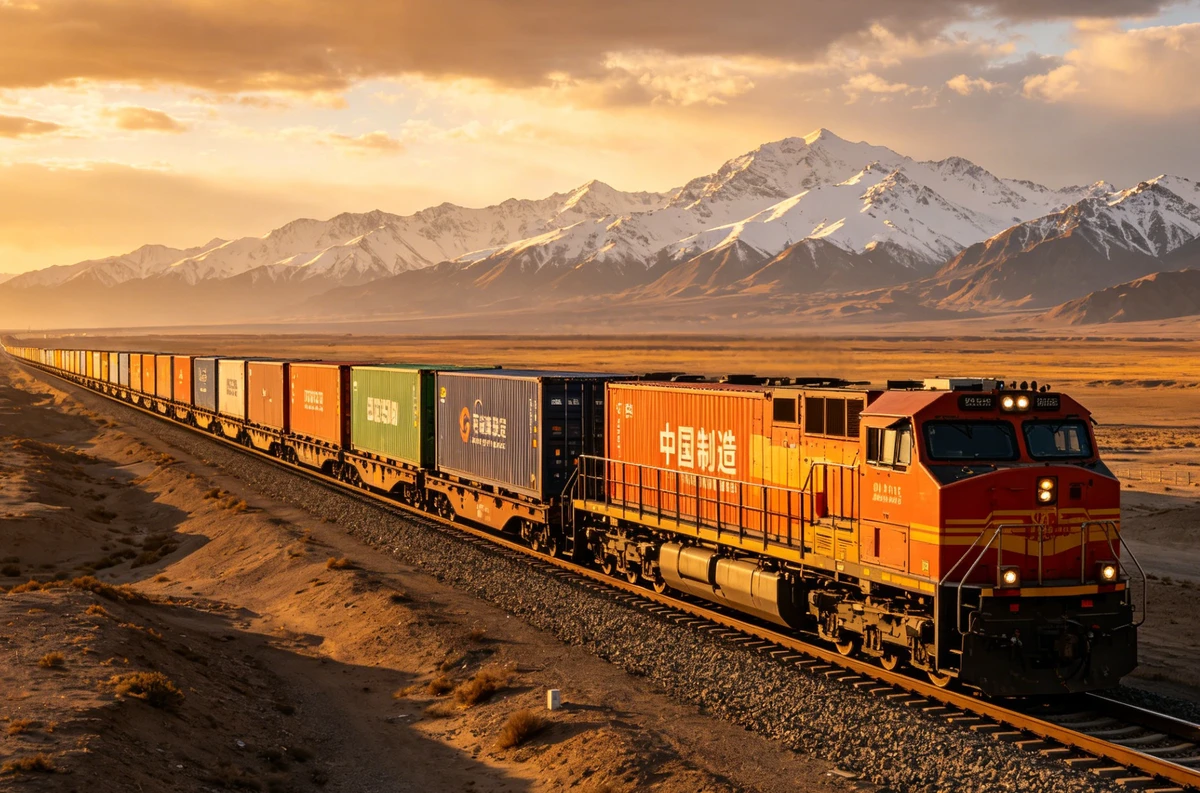
Rail freight from China to Iran via Central Asia has moved from a niche option to a strategic supply-chain shortcut. In the first nine months of 2025, the number of container trains on the China–Iran corridor jumped sixfold to 43, cutting typical transit to just 15–17 days compared with 30–45 days by sea. If you source electronics, machinery, textiles, or auto parts from China and need a faster lane than sea freight without paying air freight rates, this guide is for you.
Below, Sinoshipment breaks down the full corridor for freight shipping from China to Iran: route map, transit times, 2026 cost estimates, FCL and LCL options, gauge changes, customs documents, IRICA Form T1, sanctions-compliant workflows, and how to choose a freight forwarder that actually covers both ends of the journey.
Expert note from the Sinoshipment operations team: This guide reflects hands-on experience routing FCL and LCL containers from Xi’an, Changsha, Yiwu, and Shenzhen to Tehran via the Khorgos–Sarakhs corridor, plus continuous monitoring of IRICA, GACC, and China–Kazakhstan–Turkmenistan–Iran rail-operator updates. Since 2013, we have coordinated end-to-door freight for 5,000+ clients across the Middle East, Europe, the Americas, Africa, Asia, and Oceania.
Key Takeaways at a Glance
- Transit time: 14–18 days terminal-to-terminal; premium block trains can reach ~14 days.
- Cost benchmark: 20ft GP ≈ $3,000–$3,800; 40ft GP/40HQ ≈ $4,500–$5,000; LCL ≈ $150–$280/CBM.
- Best cargo fit: Medium-value, time-sensitive, containerized inventory such as electronics, machinery, auto parts, and textiles.
- Critical route nodes: Khorgos/Altynkol, Dostyk, and Sarakhs are where most delays and gauge changes occur.
- Must-have documents: Commercial invoice, packing list, certificate of origin, CIM/SMGS consignment note, and IRICA Form T1.
- Success factor: A forwarder with direct China-rail and Iran-customs coordination, not just a booking agent.
What Is Rail Freight from China to Iran via Central Asia?
Rail freight from China to Iran via Central Asia is an overland container service that runs from Chinese industrial hubs westward through Kazakhstan and Turkmenistan, enters Iran at the Sarakhs or Incheh Burun border, and continues to Tehran, Mashhad, Isfahan, and other Iranian cities. It is part of the China–Central Asia–West Asia rail corridor under China’s Belt and Road Initiative (BRI) and connects to the broader Middle Corridor and the International North–South Transport Corridor (INSTC).
Unlike a single-country truck move, this is a multi-operator, multi-gauge railway. Cargo rides in standard ISO containers, but the wagons underneath must be swapped at border points where track gauges change. That means shippers rely on a forwarder that can coordinate the handoffs, customs bonds, and documentation across three or four countries.
Key Terms You Need to Know
- FCL (Full Container Load): You book an entire 20ft or 40ft container. Faster handling, lower risk of damage, and predictable schedules.
- LCL (Less than Container Load): Your cargo shares a container with other shippers. Cost-effective for 1–15 CBM but adds consolidation and deconsolidation time.
- TEU (Twenty-foot Equivalent Unit): The standard container measurement. One 40ft container equals two TEU.
- Block train: A dedicated train carrying containers for one customer or a fixed group of customers, often with priority scheduling.
- Gauge change / break-of-gauge: The switch between China’s 1,435 mm standard gauge and the 1,520 mm broad gauge used in Kazakhstan, Turkmenistan, and Iran.
- CIM/SMGS consignment note: The international rail waybill that governs carriage across Europe/Asia (CIM) and the former Soviet bloc (SMGS).
- Customs bond / T1 transit: A guarantee that allows cargo to cross Kazakhstan and Turkmenistan without paying import duty there; duties are settled at final destination in Iran.
Main Rail Route and Border Crossings (Khorgos to Tehran)
The standard China–Iran rail corridor follows a clear westward path. Understanding each node helps you estimate real transit time and identify where delays usually happen.
Typical Route Map
China origin city → Khorgos / Alashankou / Altynkol → Kazakhstan → Turkmenistan → Sarakhs / Incheh Burun → Iran → Tehran (Shahyar Railway Yard or Aprin Dry Port) → final inland destination
Key Border Nodes and Their Roles
| Node | Country / Border | Function | Typical Delay |
|---|---|---|---|
| Khorgos Dry Port | China–Kazakhstan | First consolidation, customs exit, first gauge change | 1–2 days |
| Altynkol | Kazakhstan side of Khorgos | Kazakh entry, container reload to broad-gauge wagons | 0.5–1 day |
| Dostyk | Kazakhstan | Major gauge-change and transshipment hub | 1–2 days |
| Sarakhs | Turkmenistan–Iran | Primary Iran entry; ~80% of Iran’s rail transit passes here | 1–2 days |
| Incheh Burun | Turkmenistan–Iran | Alternative Caspian-side entry, useful for certain project cargo | 1–2 days |
| Aprin Dry Port / Shahyar Yard | Tehran area | Final rail yard, customs inspection, de-stuffing, last-mile dispatch | 1–2 days |
Corridor Distance and Facts
- Changsha to Tehran: approximately 10,297 km.
- Bayannaoer to Tehran: approximately 8,000 km.
- Sarakhs Special Economic Zone handles roughly 80% of Iran’s rail transit, making it the most critical gate on the corridor.
China Origin Cities and Their Cargo Strengths
| Chinese Hub | Best-Suited Cargo | Notes |
|---|---|---|
| Xi’an | Electronics, machinery, auto parts | Major China-Europe班列 hub with Iran branch lines |
| Changsha | Industrial equipment, auto parts | Weekly block train to Tehran, 40HQ focus |
| Yiwu | Small commodities, textiles, e-commerce samples | Strong consolidation network |
| Bayannaoer | Agricultural goods, sunflower seeds/oil | Launched direct Iran service in 2026 |
| Chengdu / Zhengzhou | High-value manufacturing, cross-border e-commerce | Good feeder connections from South China |
The April 2024 Four-Party Rail Tariff Agreement
In April 2024, the railways of China, Kazakhstan, Turkmenistan, and Iran signed a unified tariff agreement in Beijing. The deal established:
- A single through-rate structure for the corridor.
- A benchmark 15-day transit from Khorgos/Altynkol to Tehran.
- Weekly round-trip block trains.
That agreement is the main reason train frequency surged and transit times became more predictable in 2025–2026.
Rail Freight Transit Time from China to Iran
Standard rail freight transit time from China to Iran is 14–18 days terminal-to-terminal. Premium block-train services can hit ~14 days, usually at a 20–30% cost premium.
How the 15-Day Journey Breaks Down
| Leg | Activity | Estimated Time |
|---|---|---|
| China origin to Khorgos/Alashankou | Haulage + export customs | 2–4 days |
| Khorgos–Kazakhstan broad-gauge entry | Gauge change + border formalities | 1–2 days |
| Kazakhstan + Turkmenistan rail transit | Mainline movement under customs bond | 6–8 days |
| Dostyk / Sarakhs gauge changes | Reloading containers onto new wagons | 2–3 days |
| Iran entry + IRICA clearance | Form T1, inspection, duty assessment | 1–3 days |
| Tehran yard to final destination | Last-mile trucking | 1–2 days |
| Total | 14–18 days |
Future Corridor: Kashgar–Osh Railway
Once the Kashgar–Osh railway through Kyrgyzstan is operational, it could create a shorter southern path and push China–Iran rail transit toward 7 days. Until then, the Kazakhstan–Turkmenistan–Iran route remains the practical option.
Factors That Delay Rail ETAs
- Chinese New Year (CNY): Space tightens 2–3 weeks before the holiday; book early.
- Central Asian winter: Snow and ice in Kazakhstan can slow mainline movement.
- Sarakhs congestion: The border’s popularity means backups during peak seasons.
- Invoice–manifest mismatches: Even small discrepancies can trigger 2–4 day inspections.
China to Iran Rail Freight Cost (2026 Estimates)
Rail sits between sea and air on cost. It is not the cheapest base freight, but it can deliver lower total landed cost when inventory carrying cost and stock-out risk are factored in.
FCL Station-to-Station Reference Rates
| Container Type | Estimated Rate (USD) | Best For |
|---|---|---|
| 20ft GP | $3,000 – $3,800 | General cargo, electronics, small machinery |
| 40ft GP / 40HQ | $4,500 – $5,000 | Machinery, textiles, bulk consumer goods |
| Per TEU (Khorgos–Tehran corridor) | $3,500 – $4,500 | Benchmark quoting unit |
LCL Rates
| Service | Estimated Rate | Best For |
|---|---|---|
| LCL per CBM | $150 – $280 | 1–15 CBM, samples, mixed small orders |
Typical Add-On Costs
| Cost Item | Estimated Range | Notes |
|---|---|---|
| Gauge change fee | $500 – $800 per container | Applied at Dostyk and Sarakhs |
| China export customs + haulage | $200 – $500 | Depends on inland distance to rail hub |
| Iran import clearance (IRICA) | $300 – $600 | Varies by HS code and cargo value |
| Duties and VAT | 9%–40%+ of CIF | Depends on HS code; VAT generally 9% |
| Terminal handling at Aprin/Shahyar | $150 – $350 | Storage, lift, de-stuffing |
| Final-mile trucking in Iran | $200 – $800 | Tehran vs. provincial city |
Rail vs. Sea vs. Air: A Cost and Transit Comparison
| Mode | Transit Time | Cost per TEU (Approx.) | Best For |
|---|---|---|---|
| Rail (via Central Asia) | 14–18 days | $3,500 – $4,500 | Medium-value, time-sensitive, containerized cargo |
| Sea (to Bandar Abbas) | 25–45 days | $1,050 – $3,200 base rate | Bulk, heavy, non-urgent cargo |
| Air (to IKA Tehran) | 3–7 days | $4.50 – $8.50/kg | Urgent, high-value, small shipments |
Note: The sea-freight figures above are base ocean rates. A full DDP landed cost for sea often rises significantly once THC, clearance, duties, and inland haulage are added. Rail all-in quotes can therefore be competitive on total landed cost for time-sensitive inventory.
FCL vs. LCL Rail Freight: Which One Fits Your Shipment?
FCL (Full Container Load)
- Best when cargo exceeds 15 CBM or is heavy/dense.
- Container choices: 20ft GP, 40ft GP, 40ft HQ.
- Some China–Iran block trains only accept 40HQ containers, so confirm equipment availability when booking.
- Less handling, lower damage risk, fixed departure schedule.
LCL (Less than Container Load)
- Best for 1–15 CBM, e-commerce samples, mixed supplier orders.
- Cargo is consolidated at a Chinese hub such as Shenzhen, Yiwu, or Xi’an.
- Adds 2–4 days for consolidation and deconsolidation.
- Cheaper per unit for small volumes but requires precise packing lists.
Sinoshipment runs weekly LCL consolidation departures from major Chinese rail hubs, letting smaller importers access block-train schedules without filling a full container.
Step-by-Step Rail Freight Process: China Factory to Iran Door
A successful China–Iran rail shipment moves through eight distinct stages. Missing any one creates delay or extra cost.
Supplier pickup or CY delivery
Cargo is collected from the factory or delivered to the designated Chinese rail terminal.China export customs declaration
The forwarder files with General Administration of Customs China (GACC), submitting invoice, packing list, HS codes, and export permits if required.Loading onto the block train
Containers are loaded at origin hubs such as Xi’an, Changsha, or Yiwu.Cross-border transit at Khorgos / Altynkol
Containers exit China and are reloaded onto Kazakh broad-gauge wagons.Transit through Kazakhstan and Turkmenistan
Cargo moves under a customs bond (T1 transit); no import duty is paid in transit countries.Gauge change and handover at Sarakhs / Incheh Burun
Containers are transferred to Iranian wagons and entered into IRICA control.Iran import clearance
IRICA reviews Form T1, validates HS codes, assesses duty/VAT, and may inspect cargo.Inland delivery
Final trucking from Tehran’s Aprin/Shahyar yard to the consignee’s door in Tehran, Mashhad, Isfahan, or beyond.
Real-World Example
A Shenzhen electronics supplier needed replenishment stock in Tehran within three weeks. Sinoshipment collected the cargo in Dongguan, consolidated it at the Xi’an rail hub, moved it via the Khorgos–Kazakhstan–Turkmenistan–Sarakhs corridor, cleared it through IRICA at Aprin Dry Port, and delivered to a Tehran warehouse — all under one DDP quote with no hidden destination fees.
Required Documents for China–Iran Rail Freight
Document accuracy is the single biggest controllable factor in avoiding delays. Treat the checklist below as mandatory. In Sinoshipment’s experience, shipments with pre-cleared IRICA Form T1 and reconciled invoices clear Sarakhs, on average, one to two days faster than those filed at arrival.
China Export Documents
| Document | Purpose |
|---|---|
| Commercial Invoice | Value declaration for export and Iran import duty assessment |
| Packing List | Cargo weight, dimensions, package count |
| Export Customs Declaration | Filed with GACC |
| Certificate of Origin (CO) | Proves China origin; mandatory for Iran import |
| Fumigation Certificate | Required for wooden packaging (pallets, crates) |
| MSDS / Transport鉴定报告 | Required for batteries, liquids, powders, chemicals |
International Rail Transport Document
| Document | Purpose |
|---|---|
| CIM/SMGS Consignment Note | The rail contract of carriage covering the multi-country corridor |
Iran Import / Transit Documents
| Document | Purpose |
|---|---|
| IRICA Form T1 | Transit declaration controlling movement through Iran’s customs territory |
| HS Code Validation | Conducted via Iran’s Single Window System |
| Certificate of Origin | Mandatory for China-origin goods entering Iran |
| Iranian Importer Commercial ID (Kart-e Bazargani) | Required for customs clearance |
| Standard Certificate | Required for regulated products (electronics, food, chemicals, auto parts) |
Common Document Mistake
A mismatch between the declared value on the commercial invoice and the cargo manifest is the most frequent trigger for inspection at Sarakhs or Aprin. That mistake alone can add 2–4 days and several hundred dollars in storage and re-inspection fees. Always reconcile invoice, packing list, and waybill before departure.
Iran Customs Clearance and Sanctions-Compliant Workflow
Iranian customs clearance is handled by the Islamic Republic of Iran Customs Administration (IRICA). For rail arrivals, the process usually takes place at Aprin Dry Port, Shahyar Railway Yard, or directly at Sarakhs.
How IRICA Processes Rail Arrivals
- Container arrives at Iranian rail yard.
- IRICA validates Form T1 and the CIM/SMGS consignment note.
- HS codes are checked against the Iran Single Window System.
- Duty and VAT are assessed based on CIF value.
- If selected for inspection, containers are opened and verified.
- Once cleared, containers are released for inland delivery.
Sanctions-Compliant Shipping to Iran
Shipping to Iran requires a careful, transparent approach. The following practices help keep your supply chain compliant:
- Use accurate HS codes and consistent descriptions across all documents.
- Avoid any suggestion of re-export misdeclaration or transshipment concealment.
- Declare the true end-user and final destination.
- Maintain full cargo insurance for the entire multimodal journey.
- Work with a forwarder that provides clear, auditable documentation.
Sinoshipment provides transparent DDP quotations that separate freight, duties, and local charges so there is no ambiguity about what is being paid and why. This content is for general information only and does not constitute legal, sanctions, or tax advice. Always consult qualified legal, banking, and customs advisors before shipping to Iran.
Products That Often Need Extra Certification
- Electronics and telecom equipment
- Auto parts and tires
- Pharmaceuticals and medical devices
- Food and agricultural products
- Chemicals and cosmetics
If your cargo falls into these categories, confirm required Iranian standard certificates before the train departs China.
Rail vs. Sea vs. Air Freight: Choosing the Right Mode to Iran
Each mode serves a different business case. The right choice depends on cargo value, volume, seasonality, required delivery date, and Incoterms.
| Mode | Transit Time | Cost Level | Best For |
|---|---|---|---|
| Rail via Central Asia | 14–18 days | Mid-range | Medium-value inventory, production inputs, restock cycles |
| Sea to Bandar Abbas / Bushehr | 25–45 days | Lowest base rate | Bulk, heavy, non-urgent cargo |
| Air to IKA Tehran | 3–7 days | Highest | Urgent, high-value, small shipments |
When Rail Is the Sweet Spot
- You need stock faster than sea but cannot justify airfreight.
- Your cargo is containerized and time-sensitive.
- You want to reduce exposure to Persian Gulf shipping disruption. Events such as the 2026 Strait of Hormuz crisis have repeatedly shown how quickly that disruption can spread.
- Your inventory carrying cost justifies the faster transit.
When to Choose Sea or Air
- Sea: bulk raw materials, heavy machinery, non-seasonal goods where cost is the only driver.
- Air: samples, spare parts, urgent medical supplies, high-value electronics. It becomes especially costly during a Middle East Conflict Air Freight Rate Surge.
Risks, Seasonality, and How to Mitigate Delays
Every China–Iran rail shipment faces predictable risks. Planning for them upfront is cheaper than fixing them at the border.
| Risk | Impact | Mitigation |
|---|---|---|
| Border congestion at Khorgos/Altynkol | 1–3 day delay | Book space early; use premium block train if time-critical |
| Gauge changes at Dostyk/Sarakhs | 2–4 days built into schedule | Confirm pre-clearance and wagon availability |
| Winter weather in Kazakhstan/Iran | Mainline slowdown | Add 3–5 days buffer November–February |
| Chinese New Year space crunch | Rolled bookings, higher rates | Book 2–3 weeks before CNY |
| Document mismatches | 2–4 day inspection | Reconcile invoice, packing list, and waybill before departure |
| Sarakhs peak congestion | 1–3 day delay | Consider Incheh Burun routing for eligible cargo |
Geopolitical events can also reshape route economics overnight—see our analysis of the Iran War Supply Chain Impact for a deeper look.
Cargo Insurance
Because the journey crosses multiple countries and gauges, cargo insurance is strongly recommended. A policy covering all-risks from Chinese factory to Iranian door protects against transshipment damage, theft, and weather-related losses.
How to Choose a Reliable China–Iran Rail Freight Forwarder
Not every forwarder that advertises “China to Iran” can actually manage the full corridor. Use this checklist to vet providers.
Forwarder Evaluation Checklist
| Capability | Why It Matters |
|---|---|
| Corridor experience | Kazakhstan–Turkmenistan–Iran handoffs require specialized knowledge |
| Multiple China hubs | Lets you originate from Xi’an, Changsha, Yiwu, or Chengdu based on cargo location |
| FCL + LCL options | Flexibility for both full-container and small-volume shippers |
| CIM/SMGS consignment note | Confirms the forwarder can issue or control the through rail waybill |
| Iran-side broker network | Critical for IRICA clearance in Tehran, Mashhad, Isfahan, and Bandar Abbas |
| Door-to-door / DDP capability | Eliminates multi-party coordination risk |
| Cargo insurance + tracking | Visibility and protection across a long multimodal route |
| Transparent all-in quote | Avoids hidden terminal, clearance, or last-mile charges |
Why Sinoshipment
Sinoshipment is a professional freight forwarder based in Shenzhen, China, established in 2013. With over 5,000 clients served across the Middle East, Europe, the Americas, Africa, Asia, and Oceania, we provide:
- End-to-end rail, sea, air, and DDP solutions from China to Iran.
- Weekly LCL consolidation and direct block-train partnerships from major Chinese hubs.
- Iran-local clearance coordination and last-mile delivery support.
- Transparent quotations, responsive customer service, and full documentation support.
- Value-added services including warehouse services, quality inspection, and cargo insurance.
If you are evaluating rail freight from China to Iran via Central Asia, contact Sinoshipment for a free, no-obligation quote tailored to your cargo, route, and Incoterms.
FAQ: Rail Freight from China to Iran via Central Asia
How long does rail freight from China to Iran take?
Standard transit time is 14–18 days terminal-to-terminal. Premium block-train services can reach ~14 days.
What is the cost of a 40ft container from China to Iran by rail?
Expect roughly $4,500–$5,000 for station-to-station FCL rail in 2026, plus gauge change, clearance, duties, and final-mile costs.
Which cities in China can ship rail freight to Iran?
Xi’an, Changsha, Yiwu, Bayannaoer, Chengdu, and Zhengzhou are common origin hubs. Cargo from Shenzhen, Shanghai, Guangzhou, and other cities is usually trucked or railed to these hubs first.
What is the route of the China to Iran freight train?
China → Khorgos/Alashankou/Altynkol → Kazakhstan → Turkmenistan → Sarakhs/Incheh Burun → Iran → Tehran (Aprin/Shahyar).
What documents are needed to ship from China to Iran by rail?
Commercial invoice, packing list, export customs declaration, certificate of origin, CIM/SMGS consignment note, IRICA Form T1, and any product-specific certificates such as MSDS or Iranian Standard Certificate.
What is IRICA Form T1 and why is it important?
Form T1 is Iran’s transit declaration. It controls entry of bonded cargo into Iran and is required before customs clearance can begin.
Is rail freight to Iran faster than sea freight?
Yes. Rail takes 14–18 days, while sea freight to Bandar Abbas typically takes 25–45 days.
Can I ship LCL cargo by rail from China to Iran?
Yes. LCL is available for smaller shipments, usually consolidated at Chinese hubs like Shenzhen, Yiwu, or Xi’an.
What causes delays on the China–Iran rail corridor?
Common causes include border congestion, gauge changes, winter weather, Chinese New Year space shortages, and document mismatches.
Are there sanctions risks when shipping to Iran by rail?
Any shipment to Iran requires strict compliance with applicable sanctions. Use accurate HS codes, consistent documentation, declared end-users, and a transparent forwarder.
What is the best Incoterm for China–Iran rail shipments?
DDP is easiest for buyers who want one partner to handle everything. FOB or EXW works if you have your own Iran customs broker and prefer to control the destination leg.
How do I track my rail container from China to Iran?
Most forwarders provide digital tracking by container or wagon number. Ask your provider for milestone updates at Khorgos, Dostyk, Sarakhs, and Tehran.
Sources and References
The transit times, cost ranges, and regulatory guidance in this article are drawn from Sinoshipment’s operational bookings and the following authoritative sources:
- General Administration of Customs China (GACC) — export declaration and customs bond procedures for China–Kazakhstan rail movements. (customs.gov.cn)
- Islamic Republic of Iran Customs Administration (IRICA) — Form T1 transit declarations, HS code validation, and import clearance requirements for rail arrivals. irica.gov.ir
- International Union of Railways (UIC) — CIM/SMGS consignment note standards for cross-border rail freight. (uic.org)
- UN ESCAP — Asia-Pacific rail corridor and intermodal connectivity studies. (unescap.org)
- Belt and Road Portal — China–Central Asia–West Asia corridor updates and the April 2024 four-party rail tariff agreement. yidaiyilu.gov.cn
- Railway Gazette International — coverage of China–Iran block-train frequency and corridor developments. railwaygazette.com
Figures are indicative for 2026 market conditions. Always request a packing-list-based quote for your specific cargo and Incoterms.
Conclusion: Move Your China–Iran Cargo Smarter by Rail
Rail freight from China to Iran via Central Asia offers a practical middle ground between slow ocean freight and expensive air cargo. With 14–18 day transit, predictable schedules, and growing block-train frequency, it is now a genuine option for importers who need reliable restock cycles without absorbing airfreight costs.
Success comes down to four things: accurate documents, correct HS codes, pre-clearance at key borders like Sarakhs, and a forwarder that understands both the Chinese origin and Iranian destination legs. Sinoshipment, headquartered in Shenzhen and active on the China–Iran corridor, provides end-to-end rail, FCL/LCL consolidation, customs support, and DDP delivery. Get in touch for a transparent rail freight quote and a logistics plan built around your cargo.