Shipping Medical Devices & Equipment from China to Brazil: The Complete 2026 Guide (ANVISA, INMETRO & Cold Chain)
· By SinoShipment
Shipping medical devices & equipment from China to Brazil is a compliance decision first, and a freight decision second. A single missing document can turn a 72-hour Santos clearance into a ten-day hold. And a device that is registered but not certified for the Brazilian market cannot legally be sold even after it arrives.
The importers who move medical cargo smoothly all share one habit: they solve ANVISA, INMETRO, and packaging before they ever book a container. Here is how to work in the same order.
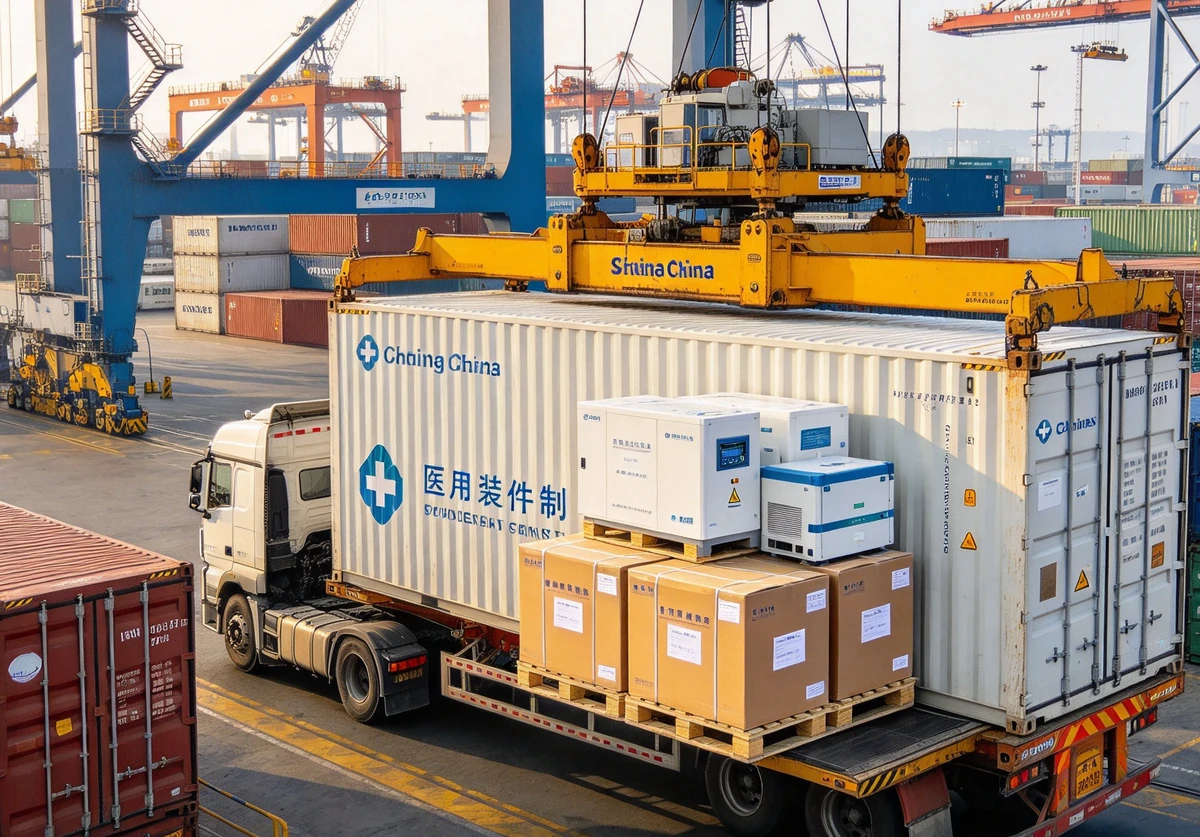
How to Import Medical Devices from China to Brazil: The Complete Process
In Brazil, medical equipment is regulated as produtos para saúde (health products), a category that runs from single-use disposables and IVD (in vitro diagnostic) reagents all the way to diagnostic imaging systems and prosthetics. That breadth matters. A box of gauze and a CT scanner follow wildly different import paths. For the full range of services on this corridor, see our freight shipping from China to Brazil route overview.
The cleanest way to plan is to run compliance and logistics as one parallel timeline rather than two separate checklists. We call it the “compliant and shippable” sequence:
| Stage | What Must Happen | Typical Lead Time |
|---|---|---|
| 1. Regulatory path | Appoint a BRH; classify device (Class I–IV) | 1–4 weeks |
| 2. Market authorization | Notificação (Class I/II) or Registro (Class III/IV) with ANVISA | 3–18+ months |
| 3. Quality certification | B-GMP / CBPF for Class III/IV | 6–12+ months |
| 4. Product certification | INMETRO (electromedical) and/or ANATEL (wireless) | 6–16 weeks |
| 5. Classification & docs | HS/NCM code, labels in Portuguese, packing list | 1–3 weeks |
| 6. Booking & export | Pick mode, consolidate, export clearance in China | 1–3 weeks |
| 7. Import licensing | LI, ANVISA Anuência Prévia, DUIMP via Siscomex | Days–weeks |
| 8. Clearance & delivery | RADAR importer clears, duty/tax paid, last-mile | 2–10 days |
Two paperwork problems kill more first shipments than anything else: a mismatch between the registered product and the shipped product, and a wrong NCM classification. Both tend to surface only at the port, which is the worst possible moment to find out.

Our Industry Insights — one pre-flight checklist saves weeks. Before we book anything for a medical client, we run a single gate: ANVISA registration number, BRH in place, Portuguese labeling ready (or a two-step label plan), INMETRO mark secured, NCM confirmed, and DG paperwork for any batteries. If any line is blank, we hold the booking. The clients who push back on this checklist are usually the same ones we later rescue from demurrage charges at Santos.
ANVISA Registration for Medical Devices: Classes, Pathways & Timelines
ANVISA (Agência Nacional de Vigilância Sanitária) is Brazil’s national health authority and oversees health products across roughly 12 regulatory categories. Every medical device sold in Brazil must pass through it. The governing rule is RDC 751⁄2022, which sorts devices into four risk classes:
| Class | Risk Level | Authorization Route | Notes |
|---|---|---|---|
| Class I | Low | Notificação (notification) | Simplified, declaration-based |
| Class II | Moderate | Notificação | Most home-use electromedical devices |
| Class III | High | Registro (full registration) | Technical dossier + B-GMP required |
| Class IV | Highest | Registro | May require clinical investigation data |
Classification is driven by intended use, invasiveness, duration of contact, and whether the device delivers energy or a medicinal substance. One detail trips up a lot of first-time exporters: Brazil’s four-class system does not map cleanly onto China’s three-class NMPA system. A device that is NMPA Class II can easily be ANVISA Class III, which forces the far heavier registro pathway. NMPA approval, on its own, carries no weight with ANVISA.
Foreign manufacturers cannot register directly. You must appoint a Brazilian Registration Holder (BRH), a legal entity established in Brazil that submits the dossier, holds the registration, and supports post-market obligations. For Class III and IV devices, B-GMP (CBPF) certification under RDC 665⁄2022 is mandatory, and a Chinese GMP certificate is not automatically accepted. Some manufacturers reduce the duplication through MDSAP or the reliance pathway under IN 290⁄2024.
Expect 6 to 18 months for a typical registration, and up to 18–36 months for complex Class IV devices (timelines vary by risk class and review pathway). Treat that as a planning input, and line up your compliance calendar before you commit to a shipment date.
Medical device import license in Brazil
Registration covers the product; import permission covers each shipment. These are separate steps. Every shipment still needs a Licença de Importação (LI) and, for health products, ANVISA’s Anuência Prévia (prior consent) routed through Siscomex, followed by the DUIMP single import declaration. If the LI is not approved before the cargo lands, the shipment simply sits. That is why we tell clients to never ship a single unit until the license clears.
Labeling and UDI
All devices commercialized in Brazil need labeling and an Instructions for Use (IFU) in Brazilian Portuguese, showing the manufacturer, the BRH, and the número de registro ANVISA. Because that number only exists after registration is granted, most brands register with draft label samples and produce the final commercial labels post-approval. Higher-risk devices also fall under UDI and traceability requirements introduced by RDC 591⁄2021.
INMETRO & ANATEL Certification: What Must Be Cleared Before You Ship
ANVISA approval is only half of the product-clearance picture. Electromedical equipment must also carry INMETRO certification under the ABNT NBR IEC 60601-1 family of standards. Certification runs through an accredited OCP and typically takes 6–16 weeks. In 2026, Brazil has recognized fewer Chinese test laboratories, so some devices need retesting in Brazil. Budget for that possibility early. The INMETRO mark must appear on the product label.
Devices with wireless connectivity (Wi-Fi, Bluetooth, cellular, or telemetry) additionally require ANATEL approval, usually 6–12 weeks. Patient monitors, infusion pumps with wireless modules, and connected diagnostic tools are the classic cases.
| Device Type | ANVISA | INMETRO | ANATEL | B-GMP |
|---|---|---|---|---|
| Single-use disposables | ✅ | — | — | Class III/IV |
| Diagnostic imaging (X-ray, CT) | ✅ | ✅ | — | ✅ |
| Patient monitors (wireless) | ✅ | ✅ | ✅ | ✅ |
| IVD reagents | ✅ | — | — | Per class |
| Battery-powered devices | ✅ | ✅ | If wireless | ✅ |
Incomplete INMETRO or ANATEL documentation has a predictable consequence: the shipment gets pulled into the Siscomex red channel for manual inspection. That inspection is measured in weeks, not hours.
Air Freight vs Sea Freight: Choosing the Right Mode for Medical Devices
Mode selection for medical cargo should follow the device, not the calendar. A field ICU monitor and a pallet of gloves do not belong on the same flight.
| Device Category | Recommended Mode | Why |
|---|---|---|
| Diagnostic imaging, hospital beds, capital equipment | Sea FCL / OOG | Oversized, heavy, shock-sensitive; air cost would be prohibitive |
| Urgent diagnostic cartridges, consumables | Air freight | Fast, high value density |
| IVD reagents, temperature-sensitive kits | Temperature-controlled air | Shortest exposure to heat and humidity |
| Bulk disposables, PPE, low-value volume | Sea LCL or FCL | Cost-driven |
Sea freight remains the backbone. FCL (a full 20GP/40GP/40HQ container) gives you a sealed, exclusive box, which matters when you do not want another shipper’s cargo triggering an inspection of yours. LCL prices per CBM and suits loads under roughly 13–15 CBM, though medical cargo shares space with strangers and carries more moisture and handling risk. For a CT or MRI unit, you are in OOG/project cargo territory: flat racks, route surveys, and lifting plans.
Air freight moves from PVG, CAN, SZX, or HKG to São Paulo’s GRU, Campinas VCP, or Rio’s GIG. Reference rates run about $5.40–$8.00 per kg for 100 kg+ shipments, billed on the greater of actual or volumetric weight ((L × W × H in cm) ÷ 6,000). A bulky, lightweight case can bill far above its scale weight.

How long does it take to ship medical equipment from China to Brazil?
Sea freight takes 30–45 days port to port depending on origin and destination gateway; air freight takes 5–10 days door-to-door. The total lead time, however, is dominated by compliance. A five-day flight means nothing if your ANVISA registration or INMETRO mark is still pending.
Cold Chain Shipping for Temperature-Sensitive Medical Equipment & Reagents
Certain IVD reagents, diagnostic kits, and temperature-sensitive consumables have strict storage windows, and one excursion can destroy both the product value and your standing with regulators. The question is which protection level matches your volume and sensitivity:
| Cargo | Cold-Chain Solution | Monitoring |
|---|---|---|
| Small reagent shipments | Validated thermal packaging + phase-change or dry-ice coolants | Data logger |
| Medium volumes | Temperature-controlled air (active containers) | Continuous IoT |
| Full-container volumes | Reefer FCL with set-point control | IoT + telemetry |
| Mixed pallets | Insulated LCL with thermal blankets | Data logger |
Continuous IoT temperature and humidity monitoring is worth the cost on this lane. The trans-equatorial voyage is long, ports are hot and humid, and a logged, unbroken temperature record is your evidence that the device stayed in spec. That evidence protects you with the customer and in any post-market audit.

Real-Life Scenario — the excursion that never should have happened. Last October, a São Paulo distributor airfreighted about 800 kg of IVD reagents (one pallet, declared value near US$40,000) from Guangzhou in standard packaging to save on cost. During a transshipment, the pallet sat three hours on a hot tarmac, and the data logger showed a spike beyond the validated range. Brazilian regulations left no room to argue: the entire pallet was quarantined and destroyed. The replacement shipment used validated thermal packaging with a data logger, adding a few hundred dollars in freight and avoiding a US$40,000 write-off. For temperature-sensitive medical cargo, the packaging basically is the product.
Packaging, Handling & Cargo Insurance for High-Value Medical Cargo
Medical equipment is unforgiving cargo. Imaging electronics dislike shock and vibration. Optics hate humidity. Disposable devices live or die by the integrity of their sterile barrier.
- Shock and vibration: custom wooden crates with foam lining, shock indicators, and center-of-container stowage for sensitive electronics.
- Moisture and mold: desiccant packs, moisture barriers, and vacuum wrapping for optics traveling across the equator.
- Sterile integrity: keep sterile-barrier packaging intact; do not open it for inspection without a protocol in place.
- Pallet and wood standards: use US GMA 48×40 pallets and ISPM-15 heat-treated wood, or risk rejection at the port.
- Battery-powered devices: lithium batteries must be declared and documented under UN38.3 and MSDS rules, and shipped as Class 9 dangerous goods by air or ocean.
For high-value medical freight, full-risk marine cargo insurance should be standard, not optional. One dropped crate of imaging equipment can cost more than every shipment you send that year. If your devices are electronics-heavy, our guide to how to ship electronics and gadgets from China covers battery declarations and packaging in detail.
How Much Does It Cost? Shipping Medical Devices from China to Brazil (Landed Cost)
Freight is rarely the number that decides whether a medical import is profitable; the tax stack is. To keep figures honest, every rate here carries a basis: port-to-port, September 2026 market basis, excluding Brazilian duty and taxes.
| Landed-Cost Line | Basis | Notes |
|---|---|---|
| Base ocean/air freight | Port-to-port | Sea FCL or air per chargeable kg |
| Origin charges | THC + documentation + ISPS | Fixed per shipment |
| AFRMM | 8% of ocean freight | Long-haul rate under BR do Mar |
| Destination charges | THC / CFS | Frequently underestimated |
| II (Import Duty) | CIF value, by NCM | Varies widely; some medical goods reduced |
| IPI | CIF + II | Product-dependent |
| PIS/COFINS | CIF value | Federal social contributions |
| ICMS | CIF + federal taxes | State VAT; some health goods reduced |
| Customs brokerage | Per shipment | Despachante aduaneiro |
| Inland delivery | By destination | Last mile |
HS codes and NCM classification for medical devices in Brazil
Brazil does not use the generic 6-digit HS code for duty. It uses the 8-digit NCM, Mercosur’s common nomenclature. Medical cargo typically falls under 9018 (medical, surgical, dental instruments), 9019 (mechano-therapy, massage, respiratory), 9021 (orthopedic, prosthetic, hearing), 9022 (X-ray and imaging), and 9402 (medical/surgical furniture). Misclassify and you invite a hold of 5–15 days plus storage and fines on top of the wrong duty.

Real-Life Scenario — modeling the tax stack before booking. For a 40HQ of diagnostic equipment shipped Yantian to Santos in mid-2026 (about 4,000 units, declared value near US$120,000), we built a line-by-line model: freight, AFRMM at 8%, destination THC, Siscomex fees, II by NCM, IPI, PIS/COFINS, ICMS, brokerage, and inland delivery to São Paulo. The ocean freight came to roughly a third of the total landed figure. Seeing that full picture let the client set a realistic retail price and, just as importantly, confirm the correct NCM before the container ever loaded. Our team has been modeling China–Brazil medical freight this way since 2013, and the tax stack still surprises first-time importers every year.
Cost-cutting levers: consolidate multiple suppliers at one Chinese warehouse through our warehouse services, switch to FCL above the breakeven, validate the NCM early, choose your destination gateway by inland math, and avoid booking into peak-season surcharge windows.
Door-to-Door & DDP Shipping to Brazil: What Works and What Doesn’t
Door-to-door service handles factory pickup, export clearance, main freight, Brazilian customs clearance, duty and tax payment, and final delivery under one quote.
DDP (Delivered Duty Paid) goes a step further by bundling duty and taxes into the price, which is why it appeals to e-commerce sellers and SMEs without a Brazilian entity. Medical cargo, however, faces a hard constraint that generic DDP promises tend to ignore: Brazil requires a legitimate importer of record with RADAR registration. A foreign seller cannot nationalize goods in its own name, and ANVISA-controlled products cannot simply be pushed through a “cheap DDP” channel.
| Incoterm | Who Pays Duty & Taxes | Importer of Record | Best For |
|---|---|---|---|
| FOB | Buyer | Buyer | Experienced importers controlling cost |
| CIF | Buyer | Buyer | Buyers who want the supplier to book freight |
| DAP | Buyer | Buyer | Buyers who can clear locally |
| DDP | Seller / forwarder | Managed partner | SMEs, e-commerce, no local CNPJ |
For regulated medical devices, we usually recommend CIF or FOB with your own Brazilian customs broker. It keeps the import license valid, ensures taxes are paid correctly, and avoids the customs gridlock that “everything can go DDP” forwarders eventually run into. When DDP does work, it relies on a licensed partner holding a valid importer of record.
For city-level delivery, remember that the gateway shapes inland cost: Santos for São Paulo and the largest consuming market, Navegantes/Itajaí for southern Brazil, and Manaus via the Zona Franca de Manaus free-trade zone, a special-tariff route that matters for electronics-heavy medical goods. Amazon FBA and Mercado Livre sellers of compliant medical accessories can also use DDP air or sea, provided labeling and registration are already in place.
FAQ
Does my medical device need ANVISA registration before I can ship it? Yes. ANVISA authorization (notificação or registro) must be in place before the device can be imported and sold, and each shipment needs an import license with ANVISA’s prior consent.
What is a BRH, and do I need one? A Brazilian Registration Holder is a Brazil-established entity that holds your registration with ANVISA. Foreign manufacturers cannot register directly, so every importer needs one.
Can I ship medical devices to Brazil under DDP? Sometimes, but DDP requires a legitimate importer of record with RADAR, and regulated devices cannot bypass ANVISA. For medical cargo, CIF or FOB with your own broker is usually safer.
Which freight mode is best for medical equipment? Capital equipment moves by sea FCL or OOG; urgent and temperature-sensitive cargo moves by air. Match the mode to the device’s value density and sensitivity.
Do all medical devices need INMETRO certification? No. INMETRO applies mainly to electromedical equipment. Wireless devices also need ANATEL approval.
Can I ship battery-powered medical devices by air to Brazil? Yes, with proper UN38.3 test summaries, MSDS, and Class 9 dangerous goods handling and declarations.
Conclusion
A successful medical shipment from China to Brazil is mostly decided before the vessel sails. Get ANVISA authorization, B-GMP, INMETRO or ANATEL clearance, and the NCM code right, then protect the cargo in transit and let the clearance unfold on schedule. Do that, and the freight itself becomes the easy part.
This is the work Sinoshipment has done since 2013 from Shenzhen: one transparent quote covering sea FCL/LCL, air, temperature-controlled, door-to-door, and Amazon FBA services from China to Brazil, with no hidden fees after the quote. Tell us the device and the destination city, and we will map the compliant, cost-effective route for you.