How to Ship Electronics and Gadgets from China: The Complete 2026 Guide (Air & Sea Freight, DDP, Amazon FBA)
· By SinoShipment
You’ve sourced the perfect batch of Bluetooth earbuds from Shenzhen. The price is right, the MOQ works, and your supplier swears shipping will be “no problem.” Three weeks later, your shipment is stuck at customs, your freight forwarder is asking for battery documentation you’ve never heard of, and your launch date just evaporated.
Unfortunately, this isn’t an edge case — it’s the norm. Electronics account for over 40% of China’s total export value, yet nearly 30% of electronics shipments face customs delays, cargo damage, or compliance rejections. Battery misclassification alone triggers fines exceeding $15,000 per violation under IATA Dangerous Goods Regulations. And even if your product contains zero batteries, wireless capability, vague commercial invoices, and poor packaging can still derail your supply chain.
This guide gives you everything you need to know about how to ship electronics and gadgets from China: how to classify your products correctly, navigate lithium battery regulations and 2026 compliance updates, prepare documentation that clears customs on the first attempt, choose the right shipping mode for your budget and timeline, and deliver your goods door-to-door across the USA, Europe, the Middle East, Australia, and beyond. Whether you’re a first-time importer, an Amazon FBA seller, or a B2B wholesaler, this is the framework that transforms electronics shipping from a gamble into a repeatable process.
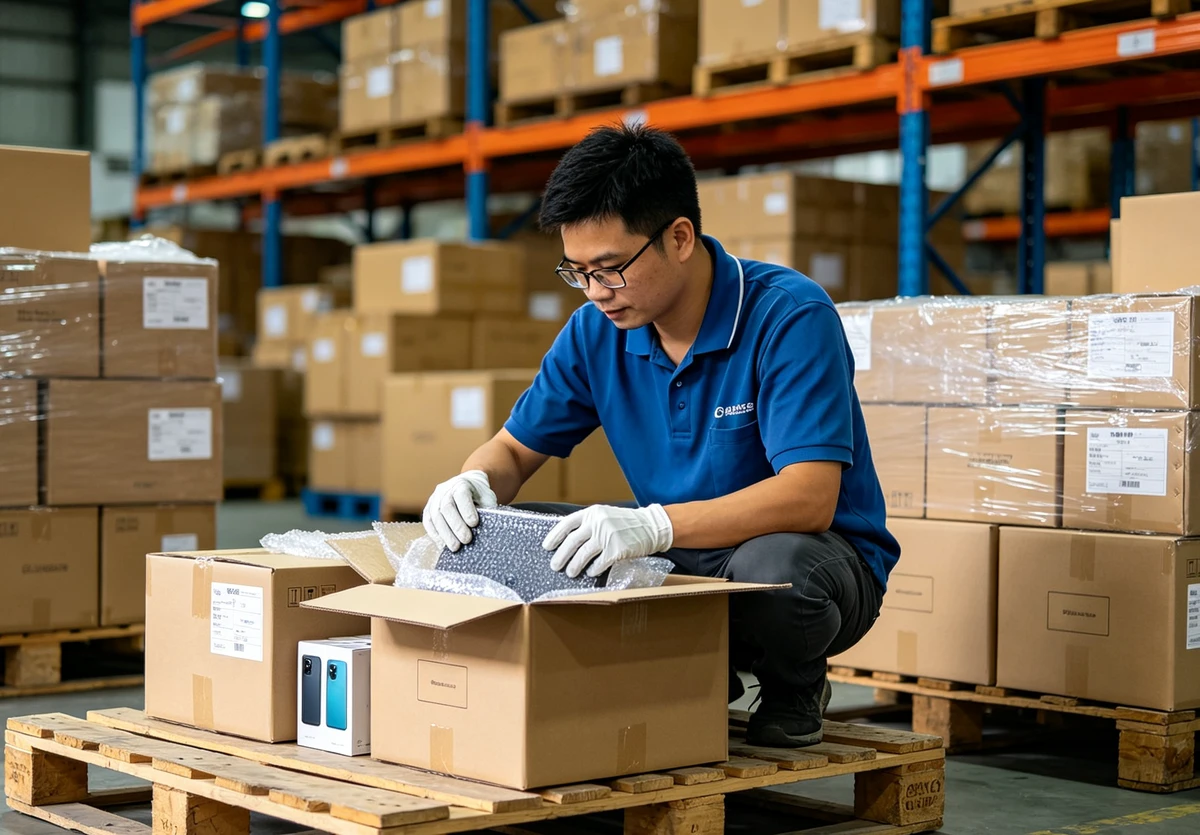
1. Understanding Your Electronics: Battery Classifications, UN Numbers & 2026 Regulatory Updates
Every electronics shipment from China starts with one question: does your product contain a battery? The answer determines whether you’re shipping general cargo or Dangerous Goods (DG) — and the consequences of getting it wrong are severe.
Lithium Battery UN Numbers
International authorities classify lithium batteries as Class 9 Miscellaneous Dangerous Goods under the IMDG Code (sea) and IATA DGR (air). Before booking any shipment, you must identify your product’s correct UN Number:
| UN Number | What It Covers | Example Products | Regulatory Path |
|---|---|---|---|
| UN3480 | Standalone lithium-ion batteries | Power banks, loose 18650 cells, replacement laptop batteries | Fully Regulated — Cargo Aircraft Only |
| UN3481 | Lithium-ion batteries contained in or packed with equipment | Smartphones, laptops, Bluetooth earbuds, smartwatches | Section II (simplified) or Fully Regulated |
| UN3090 | Standalone lithium-metal batteries (non-rechargeable) | Coin cells, primary battery packs | Fully Regulated |
| UN3091 | Lithium-metal batteries packed with or contained in equipment | Watches, key fobs, RFID tags | Section II or Fully Regulated |
UN3480 shipments — standalone batteries like power banks — always require a full Dangerous Goods Declaration (DGD), UN-certified packaging, and must fly on cargo-only aircraft. UN3481 devices (battery inside equipment) may qualify for the simplified Section II pathway if the cell is ≤20Wh, the battery ≤100Wh, and the package net quantity ≤5kg.
Non-Battery Electronics: Still Regulated
Even without batteries, electronics face regulatory obligations. Products with radio frequency capability (Bluetooth, Wi-Fi, cellular) fall under FCC jurisdiction in the USA and CE Radio Equipment Directive in the EU. Electromagnetic compatibility (EMC) compliance is required globally. Certain advanced components — encryption modules, military-grade sensors — may trigger dual-use export controls that require additional licensing from Chinese authorities.
2026 Regulatory Updates You Must Know
Relying on a 2025 shipping guide? You’re already at risk. Four regulatory changes define 2026 compliance:
- IATA SoC ≤30% Mandate: All UN3481 devices with batteries >2.7Wh and UN3556 vehicles >100Wh must ship at 30% State of Charge or below via air transport. This is mandatory under FAA/PHMSA enforcement — exceeding the limit causes cargo rejection, not a warning.
- IMDG Code Amendment 42-24: For ocean freight, all MSDS documents must reference Amendment 42-24 in Section 14 (Transport Information). Outdated MSDS forms will get your container rejected at the terminal.
- Marine Transport Test Report Validity: This report (海运鉴定报告) is valid only for the current calendar year. A factory-provided report from December 2025 will be rejected for a January 2026 shipment.
- Ningbo Port DG Pre-Screening: All Class 9 lithium battery shipments via Ningbo require UN38.3 submitted one week before vessel arrival. Shenzhen and Shanghai are expected to follow.
Our Industry Insight: We’ve personally seen containers held at Yantian Port for two weeks because a factory provided the previous year’s Marine Transport Test Report. The demurrage fees alone exceeded $800. Our compliance team now requires all battery suppliers to renew their UN38.3, MSDS, and Marine Transport Test Reports by November 1 — before the calendar-year cutoff creates a bottleneck. If you’re planning Q4 or Q1 shipments and haven’t verified your documentation currency, you’re betting your supply chain on paperwork that’s already expired.
2. Essential Documentation & Certifications for Shipping Electronics from China
Successful customs clearance for electronics from China depends on having the right paperwork — on both the export and import sides. Most guides cover destination documents; few explain what happens at the Chinese border.
China Export Documentation
Before your electronics leave China, you need four core documents:
- Commercial Invoice: Must include product name, model number, HS code, unit value, total value, and country of origin. “Electronic accessories” is not a valid description — U.S. Customs and Border Protection (CBP) will flag vague invoices for inspection.
- Packing List: Per-carton weight (kg), dimensions (cm), and quantity. Accuracy here determines whether your freight forwarder can book the right container or if you’ll pay for unused space.
- China Export Customs Declaration: Filed electronically through China Customs’ integrated platform. Your forwarder handles this, but incorrect HS codes or undervalued declarations trigger holds.
- Certificate of Origin: A Form A (Generalized System of Preferences) or Form E (China-ASEAN FTA) can reduce destination import duties by 3–15%, depending on the trade agreement.
Battery Compliance Documents
For any product containing lithium batteries, these are non-negotiable:
- MSDS (Material Safety Data Sheet): Issued by a certified third-party testing lab, updated to IMDG Amendment 42-24. Specifies chemical composition, handling procedures, and emergency response.
- UN38.3 Test Report: The global safety passport for battery transport. Proves the battery design passed thermal cycling, vibration, shock, forced discharge, and altitude simulation tests. Valid for 5 years.
- Dangerous Goods Declaration (DGD): Mandatory for UN3480/UN3090 standalone batteries. Filed with the carrier and port authority.
- Dangerous Goods Packaging Certificate: Confirms your outer packaging meets UN-specification standards (1.2-meter drop test pass).
Destination Market Certifications
| Certification | Region | What It Covers | Mandatory? |
|---|---|---|---|
| FCC (Part 15 / FCC ID) | USA | EMC emissions + RF authorization | Mandatory for wireless |
| CE Marking + DoC | EU / EEA | Safety, EMC, health, environmental protection | Mandatory |
| UKCA | United Kingdom | Post-Brexit replacement for CE marking | Mandatory |
| RoHS | EU / Global | 10 hazardous substance restrictions | Mandatory in EU |
| WEEE | EU | Electronic waste recycling registration | Mandatory in EU |
| RCM | Australia / NZ | Safety + EMC + energy efficiency | Mandatory |
| SABER | Saudi Arabia | Product conformity certification | Mandatory |
| G-Mark (GCC) | Gulf States | Safety, EMC, energy efficiency | Mandatory |
| UL | USA | Electrical safety | Voluntary but expected by Amazon/Walmart |
Common HS Codes for Electronics
| Product | HS Code |
|---|---|
| Smartphones | 8517.12 |
| Laptops & Tablets | 8471.30 |
| Power Banks / Li-ion Batteries | 8507.60 |
| Bluetooth Speakers | 8518.22 |
| LED Monitors & Displays | 8528.71 |
| Smartwatches & Wearables | 8517.62 |
| PCBs & Circuit Boards | 8534.00 |
| Gaming Consoles | 9504.50 |
Our Industry Insight: We had a client whose Shenzhen supplier swapped a power management IC mid-production without notifying anyone. The replacement chip had a different EMI signature, which invalidated the CE EMC test report. The shipment arrived at Rotterdam and was rejected at customs — the entire container was re-exported at the client’s expense. The lesson? Freeze your Bill of Materials before certification testing, and audit against the certified BOM before every shipment. A 2-cent component change can cost tens of thousands in logistics failure.
3. How to Package Electronics for International Shipping: ESD, Moisture & Shock Protection
How to package electronics for international shipping isn’t about finding the cheapest box — it’s about controlling three threats that destroy electronics in transit.
The Three Silent Killers
Electrostatic Discharge (ESD): A microchip can be destroyed by as little as 100 volts of static discharge — and you won’t see it happen. ESD damage causes latent failures that surface weeks or months after delivery, triggering warranty claims you can’t trace back to transit conditions. Anti-static shielding bags are mandatory for component-level electronics.
Moisture: Ocean freight containers regularly exceed 90% internal humidity from condensation. Salt spray at port terminals accelerates corrosion on connectors, PCB traces, and metal housings. Any sea freight shipment over two weeks needs moisture barrier packaging with silica gel desiccants.
Impact & Vibration: During a 30-day ocean transit, cargo experiences continuous low-frequency vibration, forklift impacts during loading/unloading, and container stacking compression. Products with glass displays, delicate connectors, or heavy internal components (transformers, heat sinks) are most vulnerable.
Packaging by Product Type
| Product Type | ESD Protection | Moisture Control | Shock Protection | Recommended Solution |
|---|---|---|---|---|
| PCBs / Circuit Boards | Critical | Critical | Important | ESD shielding bag + desiccant + anti-static bubble wrap + double-wall box |
| Smartphones / Tablets | Recommended | Important | Critical | Anti-static foam insert + sealed poly bag + molded tray + double-wall box |
| LED Screens / Monitors | Recommended | Minor | Critical | EPE foam corner protectors + wooden crate + palletized & strapped |
| Power Banks | Important | Important | Important | UN-spec packaging + individual terminal insulation + ≤10kg/carton |
| Bluetooth Earbuds / Small Gadgets | Minor | Important | Important | Retail packaging + master carton with cushioning fill + stretch-wrapped pallet |
The 6-Step Packaging Protocol
- ESD Protection: Wrap each unit in an anti-static shielding bag. For bare ICs, use a Faraday bag with full EMI/RFI shielding.
- Moisture Barrier: Add silica gel desiccant (~5–10g per cubic foot). For long-haul sea freight, vacuum-seal in a moisture barrier bag with a humidity indicator card.
- Shock Absorption: Maintain a minimum 5 cm of cushioning between every product face and the outer box wall. Use EPE foam for uniform shapes, foam-in-place for irregular ones.
- Structural Integrity: Single-wall C-flute cartons for loads under 10kg, double-wall BC-flute for 10–25kg, plywood crates (ISPM 15 certified) for anything heavier or higher-value.
- Labeling: Every package needs “Fragile — Handle with Care,” orientation arrows on two sides, anti-static warnings, and — if batteries are present — the Class 9 Lithium Battery hazard label plus the Lithium Battery Handling Mark.
- Palletization: Standard 1,200 × 1,000 mm pallet. Stretch-wrap with 50% overlap, 3–4 revolutions. Polyester strapping (two per direction) for heavy loads.
For shipments above $10,000 in value, add ShockWatch or TiltWatch indicators to create carrier accountability and document mishandling.
4. Shipping Methods Compared: Air Freight vs Sea Freight vs Rail vs Express
Choosing the right shipping method comes down to balancing four variables: cost, speed, volume, and battery classification. Here’s how the options stack up for electronics freight from China. Your choice of sea freight or air freight will determine your cost structure, transit time, and DG compliance pathway:
| Shipping Mode | Transit Time | Cost | Best For | Electronics-Specific Notes |
|---|---|---|---|---|
| Sea Freight FCL | 25–40 days | $1,500–$2,500 per 40HQ | Bulk B2B, heavy electronics, >15 CBM | Container desiccants essential; salt-spray corrosion risk |
| Sea Freight LCL | 25–40 days | $60–$120 per CBM | Medium volume (2–15 CBM) | Isolate from incompatible DG cargo; extra fragile labeling |
| Air Freight | 5–10 days | $5–$8 per kg | Urgent, high-value, lightweight | DG declaration mandatory; SoC ≤30% for batteries (2026) |
| China-Europe Rail | 15–22 days | $3–$5 per kg | Balanced speed/cost to EU | Lower vibration than truck; temperature monitoring recommended |
| Express Courier | 3–7 days | $7–$12 per kg | Samples, small e-commerce parcels | Battery quantity/size limits; dimensional weight pricing applies |
The Shenzhen Port Advantage
Shenzhen isn’t just a city — it’s the logistics nerve center of the global electronics supply chain. Yantian Port handles the majority of South China’s FCL electronics exports with direct sailings to Los Angeles (12–14 days on premium services), Rotterdam, and Jebel Ali. Shekou Port is the LCL consolidation hub for mixed electronics shipments. Shenzhen Bao’an Airport (SZX) handles domestic air freight, while Hong Kong International Airport (HKG) — a 45-minute truck from Shenzhen — provides the widest international air cargo network in Asia for high-value electronics.
Shipping from a Shenzhen-based forwarder means same-day factory pickup in Dongguan, Huizhou, or the Huaqiangbei electronics district, with container loading at Yantian the same evening.
Shipping Mode Decision Framework
Ask these four questions in order: Does your product contain a standalone battery (UN3480)? If yes → you need cargo-only air freight or DG-approved sea freight. How fast does it need to arrive? <7 days → air or express. 2–4 weeks → sea with buffer. **What's your volume?** <2 CBM → LCL or express. >15 CBM → FCL. What’s your destination? EU → consider China-Europe rail as a mid-point. Middle East → Jebel Ali sea freight is the cost-efficient default.
5. Destination Compliance: Shipping Electronics to USA, Europe, Middle East & Australia
United States
For shipping electronics from China to USA, the regulatory checklist includes: FCC Part 15 (mandatory for all electronic devices emitting radio frequency), FCC ID (unique identifier printed on wireless products), UL certification (technically voluntary but functionally required by Amazon, Walmart, and Best Buy), and a Customs Bond for formal entries over $2,500. Air Freight from China to USA typically delivers in 5–10 days, while Shipping from China to USA by Sea takes 25–40 days but costs significantly less per unit. For larger volumes, FCL Shipping from China to USA provides the lowest per-unit freight cost.
European Union + United Kingdom
For shipping electronics from China to Europe, the compliance stack is deeper: CE Marking with a Declaration of Conformity (covering EMC 2014/30/EU, Low Voltage 2014/35/EU, and Radio Equipment 2014/53/EU directives), RoHS compliance (10 restricted substances), WEEE registration in each EU member state where you sell, REACH verification (SVHCs below 0.1% w/w), and an EORI number for all commercial imports. For containerized shipments to key European markets, see our guides on Container Shipping from China to France and Shipping from China to Germany by Sea. The UK now requires separate UKCA marking post-Brexit with its own VAT registration — for air freight options, see Air Freight from China to UK.
Country-specific nuances matter. France operates the DELTA customs clearance system — your forwarder must be registered on this platform. French import VAT operates under automatic liquidation ( autoliquidation ), meaning you declare and deduct VAT simultaneously rather than paying upfront. For Amazon FBA deliveries in France, warehouses require CARP (Carrier Appointment Request Portal) booking — unannounced trucks are turned away. Belgium offers the ET 14.000 VAT Deferment license for bonded warehouse operations, a popular entry point for EU-wide distribution.
Our Industry Insight: For France specifically, we’ve found that B2B deliveries consistently require tail-lift trucks for palletized electronics. Many industrial estates and retail stockrooms in France lack loading docks. If your forwarder doesn’t pre-book a tail-lift vehicle, the driver will refuse delivery and you’ll incur re-delivery fees plus storage charges. This single detail — a €50 tail-lift surcharge versus a €300 failed delivery — has caught more first-time importers than any customs regulation.
Middle East
Saudi Arabia enforces SABER certification for all imported electronics, processed through the FASAH single-window clearance platform. King Abdulaziz Port in Dammam is the primary sea freight gateway — for urgent shipments, read our guide on Air Freight from China to Saudi Arabia. The G-Mark (GCC) covers Gulf Cooperation Council countries for safety, EMC, and energy efficiency. UAE — especially Dubai — functions as a regional distribution hub, with Jebel Ali Port offering free zone storage that defers customs duties until goods enter the mainland market.
Australia & Canada
Australia requires RCM compliance (Safety + EMC + Energy), and importers must navigate BMSB seasonal restrictions (September–May) requiring container fumigation or heat treatment. For air freight options down under, see our guide on Air Freight from China to Australia. BICON biosecurity checks apply if electronics contain wood, plant fibers, or biological materials. GST applies to imports regardless of value.
For Canada, CBSA enforces provincial GST/HST at clearance, and Amazon FBA deliveries require liftgate trucks for palletized shipments — a detail that mirrors the French B2B challenge. For ocean freight options to Canada, see our guide on Shipping from China to Canada by Sea. Consumer electronics sold in Canada need bilingual (English/French) labeling.
6. Incoterms for Electronics: DDP vs FOB vs CIF
DDP shipping for electronics from China has become the preferred choice for importers who want one invoice covering the entire chain. But whether DDP actually saves you money depends on your import structure.
| Incoterm | Who Handles Export? | Who Handles Freight? | Who Pays Import Duties? | Risk Transfer Point | Best For |
|---|---|---|---|---|---|
| EXW | Buyer | Buyer | Buyer | Seller’s factory gate | Experienced importers with own China logistics |
| FOB | Seller | Buyer | Buyer | Onboard vessel at origin port | Importers with own forwarder and customs broker |
| CIF | Seller | Seller | Buyer | Destination port | Importers wanting freight coverage but own clearance |
| DDP | Seller | Seller | Seller | Named place, cleared | First-time importers, Amazon FBA sellers, landed-cost predictability |
When DDP Makes Sense
DDP is the right choice when you don’t have an in-country customs broker, when you’re shipping to Amazon FBA and need guaranteed clearance and delivery appointments, or when your supply chain team is lean and you want a single point of accountability. Under DDP, your Chinese freight forwarder handles everything: China export clearance, international freight, import customs clearance, duties and taxes, and final delivery. One invoice replaces four separate contracts.
When FOB/CIF Makes Sense
FOB or CIF gives you more control — and more responsibility. If you already have relationships with destination-country customs brokers, if you’re consolidating cargo from multiple suppliers into single containers, or if freight cost volatility is a top concern and you want to negotiate carrier contracts directly, FOB puts you in the driver’s seat.
Real Cost Scenario: 500 Bluetooth Earbuds from Shenzhen to Los Angeles
| Cost Element | FOB (You Control Freight) | DDP (Forwarder Handles All) |
|---|---|---|
| Factory-to-port trucking (Shenzhen → Yantian) | Included by seller | Included |
| China export clearance | Included by seller | Included |
| Ocean freight (shared LCL, 1.5 CBM) | ~$180 (your booking) | $165 (forwarder’s contracted rate) |
| US import customs clearance | ~$125 (your broker) | Included |
| US customs bond (single entry) | ~$75 | Included |
| Duties (Section 301, ~3.5% on $15,000 declared) | ~$525 (you pay directly) | ~$525 (forwarder pays, included in quote) |
| MPF (Merchandise Processing Fee) | ~$30 | Included |
| ISF filing | ~$35 | Included |
| Last-mile delivery (L.A. warehouse) | ~$200 (your arrangement) | $185 (forwarder’s trucking network) |
| Total Landed Cost | ~$1,170 + your time | ~$875 all-in |
| Your Time Investment | 6–8 hours coordination | 1 email |
The DDP route saves money in this scenario because the forwarder’s contracted rates beat spot-market pricing, and you’re not paying separate brokerage fees. The gap widens when you factor in the cost of your own time.
7. Amazon FBA Electronics Shipping from China: Requirements & Hazmat Compliance
For Amazon FBA electronics shipping from China, compliance is ruthless. Amazon’s Dangerous Goods (Hazmat) review process is automated, and an ASIN flagged as non-compliant can be suppressed — meaning zero sales — until you provide acceptable documentation. For a complete walkthrough of FBA prep, labeling, and delivery from China, see our dedicated Amazon FBA service page.
FBA Battery Limits
- Standard FBA: Accepts products with batteries up to 100Wh. This covers most consumer electronics — smartphones, tablets, Bluetooth speakers, laptops.
- FBA Hazmat Program: Accepts up to 300Wh per unit, but requires a separate application and is subject to limited storage slot availability. Products like portable power stations and e-bikes fall here.
- Above 300Wh: Rejected by FBA entirely. You’ll need a third-party logistics (3PL) warehouse for fulfillment.
Amazon Dangerous Goods Portal
Before your listing goes live, you must upload two documents to the Amazon Seller Central Dangerous Goods Portal: your UN38.3 Test Summary and your MSDS. If these documents don’t reference the exact ASIN, product name, and battery model — or if the battery specifications don’t match across documents — Amazon will reject the submission. This is the most common cause of preventable ASIN suppression for electronics sellers.
FBA Inbound Logistics Workflow
A professional Shenzhen freight forwarder handling DDP-to-FBA follows this sequence: factory pickup → FBA prep at the forwarder’s warehouse (FNSKU labeling, box labels, pallet labels, poly-bagging if required) → China export clearance → sea or air freight (typically LCL sea for first-time FBA shipments, 25–35 days to USA) → US import clearance and duty payment → CARP delivery appointment booked with the Amazon warehouse → truck delivery and warehouse check-in.
Common FBA rejection reasons include missing hazmat review, incorrect FNSKU labels, cartons exceeding the 22.7 kg (50 lb) weight limit without “Team Lift” labeling, and unannounced deliveries without a CARP appointment.
8. How to Choose the Right Electronics Freight Forwarder from China
Not all freight forwarders are equipped for electronics. A forwarder who handles furniture and textiles brilliantly may have zero experience with Class 9 Dangerous Goods documentation, battery-specific airline bookings, or FCC compliance verification.
8 Qualities of an Electronics-Specialized Freight Forwarder
- IATA DGR and IMDG Code certified staff — not just a forwarding license, but individuals trained in dangerous goods handling
- Battery-specialized shipping lanes — dedicated routing agreements with carriers who accept DG cargo, not “we’ll try our best”
- Pre-shipment compliance audit — reviews your product specs, battery configuration, and certification status before booking
- Physical Shenzhen or Guangzhou warehouse — for consolidation, FBA prep, repackaging, and quality inspection
- Transparent all-in landed cost quotes — freight + fuel surcharge + DG handling + customs clearance + duties + delivery, not just a per-kg rate
- Destination-country customs brokerage network — direct filing capability, not subcontracted to unknown third parties
- Cargo insurance options tailored for electronics — not just standard marine insurance with electronics exclusions
- Real-time tracking and a named account manager — not a WeChat group with 15 anonymous coordinators
Red Flags to Watch For
A freight quote significantly below market rate is almost always missing DG handling surcharges, destination charges, or customs clearance fees. Forwarders who can’t explain the difference between UN3480 and UN3481 don’t understand your cargo. No physical China address? Your goods are being handled by a middleman reselling capacity from an actual forwarder.
Why Shenzhen-Based Forwarders Have the Edge
Over 90% of China’s consumer electronics manufacturing happens within a 100-kilometer radius of Shenzhen — spanning Huaqiangbei, Dongguan, Huizhou, and the Pearl River Delta. A Shenzhen-based forwarder can provide same-day factory pickup, has established relationships with Yantian and Shekou port authorities, and handles DG documentation at a volume that builds genuine expertise. A forwarder in Beijing or Shanghai simply does not see the same daily density of electronics shipments.
9. Cargo Insurance, Risk Management & Cost-Saving Strategies
Electronics are among the highest-value-per-kilogram cargo categories in international freight. A single pallet of smartphones can exceed $100,000 in declared value — yet many importers rely on carrier liability coverage that caps at $500 per shipment or $2 per kilogram. Securing proper cargo insurance tailored to electronics is not optional — it’s a prerequisite for protecting your investment against theft, damage, moisture, and ESD-related claims that standard policies routinely exclude.
Electronics-Specific Insurance Needs
Standard cargo insurance falls into two categories. All-Risk (Institute Cargo Clauses A) covers theft, damage, loss, and general average — this is the minimum for electronics. Named Perils (Clauses B/C) covers only specified risks and should never be used for electronics shipments.
Beyond standard coverage, electronics importers should verify that their policy includes: ESD damage coverage (many policies exclude “invisible damage”), glass breakage for displays and screens, moisture and condensation damage for sea freight, and theft at the full declared value (electronics are a high-theft commodity).
How to Value Your Shipment
The standard formula is CIF value + 10% to cover incidental costs. But for high-value electronics with tight margins, consider insuring at CIF + 20–30% to cover replacement cost, air freight for rush replacements, and lost sales margin during the replacement cycle. The premium difference — typically 0.3% to 0.5% of declared value — is negligible compared to being underinsured by $20,000.
Five Cost-Saving Strategies That Don’t Compromise Quality
- Optimize packaging before production, not after — form-fitting inserts and right-sized cartons reduce dimensional weight by 15–25%.
- Consolidate LCL shipments — combining 3–4 smaller shipments into one saves 30–50% versus shipping each separately.
- Ship off-peak — avoid August through October (pre-holiday rush) and the two weeks before Chinese New Year (CNY), when container spot rates spike 40–80%.
- Negotiate annual contract rates — if you ship consistently, a 12-month contract with a Shenzhen forwarder typically yields 10–20% savings over spot bookings.
- Model DDP vs FOB total landed cost, not freight rate alone — a cheap freight quote often hides destination charges that make it more expensive than an all-in DDP rate.
Real-Life Scenario: A client importing 2,000 smart home devices to Germany was comparing two forwarders. Forwarder A quoted $3.80/kg FOB sea freight. Forwarder B quoted $5.20/kg DDP door-to-door. On the surface, Forwarder A looked 27% cheaper. But when we modeled the full landed cost — adding German import clearance (€180), customs broker fees (€220), VAT disbursement, trucking from Hamburg to the Munich warehouse (€450), and the client’s own time managing three separate vendors — Forwarder B’s DDP total was actually 11% lower. The lesson: compare landed cost, not freight cost.
10. Conclusion: Your Electronics Shipping Action Plan
You now have the complete framework for shipping electronics and gadgets from China. Here’s your action plan:
- Classify your product before you produce. Battery type (UN3480 vs UN3481) determines your shipping channel, documentation requirements, and cost structure. Get this wrong and everything downstream breaks.
- Get documentation right 48 hours before pickup. Verify that your battery specs match across the commercial invoice, packing list, UN38.3 report, and MSDS. One mismatch in model numbers can hold your shipment for weeks.
- Package for the worst-case scenario. ESD protection, moisture barriers, and 5 cm of cushioning on every face aren’t optional — they’re the difference between a working product and an insurance claim.
- Match shipping mode to product, not budget. The cheapest freight quote rarely produces the lowest landed cost. Model the full door-to-door cost under at least two Incoterms before deciding.
- Know your destination’s rules. FCC for the USA, CE for the EU, SABER for Saudi Arabia, RCM for Australia — the certification you need depends entirely on where your goods are going.
- Choose DDP if you’re a first-time importer or FBA seller. The predictability of one invoice covering the entire chain saves your time, your margin, and your sanity.
- Insure at replacement value plus 10% minimum. Standard carrier liability is not insurance — it’s a disclaimer with a dollar cap.
- Work with a Shenzhen-based electronics forwarder. When your forwarder handles electronics daily — not occasionally — DG documentation isn’t a special request. It’s the default.
In 10+ years of shipping electronics from Shenzhen to over 100 countries, we’ve learned one truth: compliance isn’t a cost — it’s the cheapest insurance policy you’ll ever buy. A $500 UN38.3 test prevents a $15,000 fine. A $50 moisture barrier bag prevents a $5,000 corrosion claim. The investments you make in getting it right before cargo moves are always cheaper than the consequences of getting it wrong after.
Whether you’re shipping your first pallet of Bluetooth earbuds or managing a multi-container consumer electronics supply chain, Sinoshipment provides transparent DDP, air freight, and sea freight solutions from our Shenzhen hub — with the DG expertise and global destination coverage that generalist forwarders simply don’t have. Contact our electronics logistics team for a free, no-obligation landed cost quote, and let’s get your gadgets moving.