Amazon FBA Sea Freight from China to Australia: The Complete 2026 Guide (FCL, LCL & DDP)
· By SinoShipment
Amazon FBA sea freight from China to Australia is the most cost-effective way for private-label sellers and e-commerce brands to keep Amazon’s Australian fulfilment centres stocked without eroding their margins. With the right FCL or LCL strategy, transparent DDP quoting, and accurate FBA prep, you can move inventory from Shenzhen, Ningbo, or Shanghai to Sydney, Melbourne, or Brisbane in roughly 18–30 days door-to-door.
This guide covers everything you need to plan, price, and execute a successful sea freight shipment to Amazon FBA Australia in 2026: shipping modes, current costs, transit times, customs and GST, biosecurity rules, FBA prep, and how to choose a reliable FBA freight forwarder China to Australia.
What Is Amazon FBA Sea Freight from China to Australia?
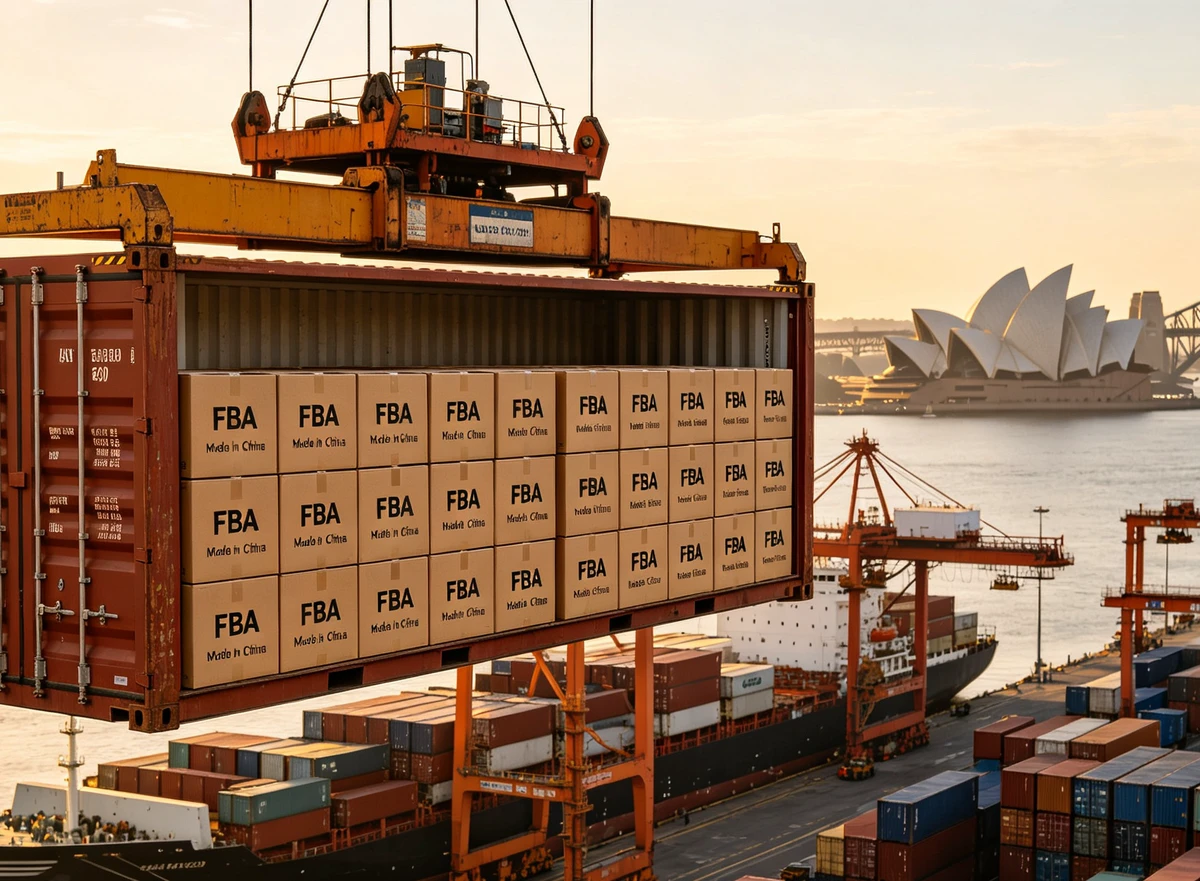
Amazon FBA sea freight from China to Australia is a door-to-door ocean logistics service that moves seller inventory from Chinese factories or ports to Amazon fulfilment centres across Australia. Unlike generic sea freight, FBA shipments must satisfy Amazon’s receiving rules for cartons, pallets, labels, and carrier appointments.
A complete service usually includes factory pickup, China export clearance, ocean freight from ports such as Yantian, Shekou, Ningbo, or Shanghai, Australia import customs clearance and GST handling, and final-mile delivery to warehouses such as BWU1, MEL1, BNE1, or PER2.
Because the handoffs are complex, most sellers work with a forwarder that understands both the China export side and the Amazon Australia inbound side. Sinoshipment, headquartered in Shenzhen since 2013, manages this lane end-to-end, from supplier pickup through FBA delivery. This service sits within our broader Freight Shipping from China to Australia route network.
Who Should Use Sea Freight for Amazon FBA Australia?
Sea freight is ideal when your priority is landed cost, not speed. Consider it if you fit any of these profiles:
- High-volume restockers shipping 2 CBM or more per batch.
- Bulky or heavy product sellers (furniture, home goods, fitness equipment).
- Private-label brands with predictable 30–45-day replenishment cycles.
- Multi-supplier buyers who can consolidate cargo in China before shipping.
Sea freight is usually not the right choice for urgent restocks, product launches with hard deadlines, or lightweight high-margin items where air freight’s speed pays for itself. Many experienced sellers run a hybrid model: a small Air Freight from China to Australia shipment for immediate stock, followed by a larger sea shipment for cost.
Sea Freight Options: FCL vs. LCL for Amazon FBA Australia
The first decision is whether to book a full container or share one.
FCL (Full Container Load)
FCL means you reserve an entire container for your cargo. Common sizes are 20GP, 40GP, and 40HQ.
FCL is usually the best value when your shipment exceeds 15–20 CBM. Benefits include:
- Faster port handling and fewer touchpoints.
- Lower per-unit shipping cost.
- Less risk of damage or loss from other shippers’ cargo.
- Full control over loading, pallet layout, and unloading.
For a complete breakdown of full-container options on this lane, read our dedicated FCL Shipping from China to Australia guide.
LCL (Less than Container Load)
LCL lets you pay only for the space you use inside a shared container. It works well for 1–15 CBM shipments.
At a consolidation warehouse in Shenzhen or another hub, your cargo is combined with other Australia-bound shipments into one container. On arrival, the container is deconsolidated in Australia before final delivery.
LCL advantages:
- Lower upfront cost for small volumes.
- Flexible for multi-supplier orders.
- No need to wait until you can fill a container.
LCL drawbacks:
- Longer transit time due to consolidation and deconsolidation.
- Higher per-CBM cost than FCL at larger volumes.
- Slightly higher handling risk.
FCL vs. LCL Decision Table
| Factor | FCL (20GP/40HQ) | LCL |
|---|---|---|
| Best volume | >15–20 CBM | 1–15 CBM |
| Cost basis | Per container | Per CBM or per ton |
| Typical ocean transit | 12–20 days | 15–25 days |
| Door-to-door time | 18–30 days | 20–35 days |
| Handling risk | Lower | Moderate |
| Best for | Bulk restocks, full control | Testing products, smaller batches |
If your volume is close to 15 CBM, request both FCL and LCL quotes. The cheaper option often depends on the current LCL rate and destination handling charges. For a broader comparison of container services on this lane, see our guide to Container shipping from china to Australia.
Amazon FBA Sea Freight Costs from China to Australia (2026)
Pricing changes with fuel, capacity, season, and port pair, but the ranges below are representative for mid-2026.
Indicative Rate Ranges
| Service | Cost Range (USD) | Notes |
|---|---|---|
| FCL 20GP | $1,100 – $2,700 | Varies by origin port and seasonality |
| FCL 40GP/40HQ | $2,200 – $5,400 | Best for high-volume restocks |
| LCL | $60 – $150 per CBM | Depends on cargo density and destination |
| Door-to-door DDP | Add 30–60% on top of ocean freight | Covers GST, duty, customs, trucking, appointment |
A single-CBM LCL shipment door-to-door to a Melbourne FBA warehouse might land between $500 and $900 all-in, while a 20GP FCL shipment can range from $3,000 to $5,500 door-to-door depending on the origin and GST liability.
What Drives Your Final Quote
Several variables move the needle:
- Origin port: Yantian/Shekou in South China often offer faster Australia service than northern ports.
- Destination warehouse: Final-mile trucking to Perth or regional centres costs more than Sydney or Melbourne.
- Cargo type and HS code: Some products attract higher duty or require special documentation.
- Seasonality: Peak season (August–October) and BMSB season can add 15–25% to rates.
- FBA prep needs: Labelling, palletizing, inspection, and repacking add cost but reduce refusal risk.
Hidden Costs to Watch
Unexpected charges can blow up a budget. Ask your forwarder to confirm whether these are included:
- Destination terminal handling charges (DTHC).
- Quarantine inspection or fumigation fees.
- Amazon warehouse refusal or redelivery charges.
- Demurrage or detention if documents are delayed.
- Remote area surcharges for certain warehouses.
Always request an itemized DDP quote so you know exactly what is covered.
Transit Times: How Long Does Sea Freight Take from China to Amazon FBA Australia?
For a general comparison of all shipping modes on this lane, see How Long Does Shipping Take from China to Australia.
Typical Ocean Transit Times
| Origin Port | Sydney / Melbourne / Brisbane | Notes |
|---|---|---|
| Shenzhen / Yantian / Shekou | 12–20 days | Frequent direct sailings to Australia |
| Guangzhou / Nansha | 14–21 days | Strong for South China manufacturing |
| Ningbo / Shanghai | 14–22 days | Good for East China suppliers |
Door-to-Door Timeline
| Stage | Duration |
|---|---|
| Factory pickup + consolidation | 3–7 days |
| Export clearance + port loading | 1–3 days |
| Ocean transit | 12–22 days |
| Australia customs clearance | 2–5 days |
| Final-mile delivery + Amazon receiving | 3–7 days |
| Total door-to-door | 18–35 days |
FCL shipments generally sit at the lower end of the range; LCL shipments at the higher end due to consolidation and deconsolidation.
Factors That Delay Sea Freight
- Port congestion in China or Australia.
- Peak season space shortages (August–October).
- Chinese New Year factory and port closures.
- BMSB season inspections (September–April).
- Incorrect documents or HS codes.
- Amazon appointment delays or warehouse capacity limits.
Build a 5–7 day buffer into your inventory planning to avoid stockouts.
Step-by-Step: How to Ship from China to Amazon FBA Australia by Sea
Step 1 — Create Your Amazon Shipment Plan
Log into Amazon Seller Central and create a shipment plan. Amazon will assign a fulfilment centre and generate:
- FBA shipment ID
- Carton labels (one per carton)
- Pallet labels (if palletized)
Never ship to an old warehouse code from memory. Always use the address and reference from the current shipment plan.
Step 2 — Choose Your Incoterm
For most Amazon sellers, DDP (Delivered Duty Paid) is the simplest option. Your forwarder handles export clearance, ocean freight, Australian customs, GST/duty payment, and delivery to the FBA warehouse.
| Incoterm | Seller Responsibility | Best For |
|---|---|---|
| DDP | Minimal; forwarder handles taxes and delivery | Most Amazon FBA sellers |
| DDU / DAP | Seller pays GST/duty locally; forwarder delivers | Sellers with an Australian broker |
| FOB | Seller manages ocean freight and import side | Experienced importers |
| EXW | Seller arranges everything from factory door | Advanced importers with full control |
If you do not have an Australian entity or broker, DDP is usually the safest path.
Step 3 — Coordinate Supplier Pickup and China Export
Your forwarder collects cargo from the factory or receives it at a consolidation warehouse. Sinoshipment operates pickup and consolidation services across South China, leveraging our warehouse services for labelling, inspection, and consolidation before export.
Required China export documents include:
- Commercial Invoice
- Packing List
- Export Customs Declaration
- Bill of Lading (B/L)
Step 4 — Book Ocean Freight and Track
Choose FCL or LCL based on volume. Your forwarder books space with the shipping line, arranges loading, and provides a container or booking reference for tracking.
Step 5 — Australia Import Clearance and GST Payment
On arrival, your broker or forwarder submits:
- Commercial Invoice
- Packing List
- Bill of Lading
- Packing Declaration
- Certificate of Origin (if claiming ChAFTA)
- Fumigation certificate (if wooden packaging)
GST is 10% of the taxable importation value, generally calculated as goods value + freight + insurance + duty. Under DDP, the forwarder pays this on your behalf and includes it in the all-in quote.
Step 6 — Final-Mile Delivery to Amazon FBA
The forwarder arranges an approved carrier and books a delivery appointment. Cartons or pallets must match Amazon’s current receiving requirements exactly, or the warehouse may refuse the load.
Amazon FBA Prep & Labelling Requirements for Australia
Incorrect prep is one of the top reasons Amazon rejects inbound shipments. Here is what you need to get right.
Product-Level Labels
- FNSKU labels must be applied to every sellable unit if you use Amazon barcode settings.
- Ensure the barcode is scannable and not folded over edges.
- Cover existing manufacturer barcodes unless you have enabled commingling.
Carton-Level Labels
- FBA shipment labels from Seller Central: one per carton.
- Country-of-origin marking: “Made in China” should appear on each carton.
- Carton labels must be flat, clear, and placed on a flat surface.
Special Labels
- Suffocation warning for poly bags with openings 5 inches or larger.
- Heavy package label for cartons over 22.5 kg (50 lbs).
- Fragile / This Way Up labels where applicable.
Pallet Requirements
- Pallets must be ISPM-15 heat-treated and stamped.
- Standard pallet size: 1.0 m × 1.2 m is commonly accepted in Australia.
- Maximum pallet height is usually 1.8 m including pallet.
- Cartons must be stretch-wrapped and stable.
Some Amazon Australia warehouses accept loose cartons for LCL deliveries; others require palletized loads. Confirm the requirement in your shipment plan.
FBA Prep Checklist for Australia
| Checkpoint | Action Required |
|---|---|
| Shipment plan | Confirm warehouse code and labels in Seller Central |
| FNSKU labels | Applied to every sellable unit |
| Carton labels | One FBA shipment label per carton |
| Country of origin | “Made in China” on each carton |
| Carton weight | Under 22.5 kg unless heavy-label applied |
| Pallets | ISPM-15 heat-treated, correct size and height |
| Documents | Commercial Invoice, Packing List, B/L, Packing Declaration, COO |
| Special cargo | MSDS/UN38.3 for batteries; fumigation for wooden packaging |
Getting prep done in China is almost always cheaper and faster than fixing problems after arrival in Australia.
Australian Customs, GST, and ChAFTA for Amazon Sellers
Accurate customs clearance is the foundation of a smooth import process. The sections below explain the main taxes and documentation requirements.
GST on Imports
Australia charges 10% GST on most imported goods. The taxable value includes the goods value, international freight, insurance, and any applicable duty.
Amazon may collect GST on marketplace transactions, but that is separate from import GST due at customs. Under a DDP arrangement, your forwarder pays import GST and includes it in your invoice.
Import Duties and ChAFTA
Thanks to the China-Australia Free Trade Agreement (ChAFTA), many China-origin goods enter Australia at 0% duty if you provide a valid Certificate of Origin.
To claim the benefit:
- Ask your Chinese supplier to provide a ChAFTA Certificate of Origin or a declaration of origin.
- Ensure the HS code on the certificate matches the HS code declared to Australian customs.
- Submit the certificate with your import entry.
Without the certificate, standard duty rates may apply, which can range from 0% to 10% or more depending on the product.
Required Documents
| Document | Purpose |
|---|---|
| Commercial Invoice | Valuation and customs entry |
| Packing List | Cargo detail and Amazon receiving |
| Bill of Lading | Proof of shipment and title |
| Packing Declaration | Biosecurity and wood packaging statement |
| Certificate of Origin | ChAFTA duty preference |
| Fumigation Certificate | Required for non-ISPM-15 wooden packaging |
ABN and GST Registration
You do not need to be an Australian resident to import, but registering for an Australian Business Number (ABN) and GST makes customs clearance smoother and lets you claim GST credits on business imports. Most DDP forwarders can guide non-resident sellers through this.
Biosecurity, BMSB Season, and Australian Import Compliance
Brown Marmorated Stink Bug (BMSB) Season
Australia’s BMSB seasonal measures typically run from September to April. During this period, high-risk cargo arriving by sea may be subject to mandatory inspection, treatment, or documentation checks.
Targeted risk goods include:
- Machinery and vehicle parts.
- Tiles, ceramics, and stone.
- Wood and bamboo products.
- Packaging materials such as wooden crates and pallets.
If your shipment is selected for inspection, expect additional costs and 2–10 days of delay.
BICON and DAFF Requirements
Use the BICON (Biosecurity Import Conditions) database to check import conditions for your specific product. The Australian Department of Agriculture, Fisheries and Forestry (DAFF) enforces these rules strictly.
Common triggers for biosecurity holds:
- Wooden packaging without ISPM-15 treatment.
- Food, animal, or plant-based ingredients.
- Soil, plant debris, or pest contamination on packaging.
ISPM-15 and Fumigation
All wooden pallets, crates, and dunnage must be ISPM-15 compliant. If not, you may need a fumigation certificate or face quarantine treatment fees, which can exceed several hundred dollars.
Product Safety and ACCC Compliance
Amazon Australia sellers must also comply with Australian Consumer Law and product safety standards enforced by the ACCC. Electronics, toys, children’s products, and batteries often require specific certifications or labelling.
Amazon SEND vs. Using an Independent Freight Forwarder
What Is Amazon SEND?
Amazon SEND is Amazon’s partnered carrier program. Sellers can book air or ocean freight directly within Seller Central for China-to-Australia FBA shipments. It is convenient for simple, single-supplier shipments.
When Amazon SEND Makes Sense
- You want a fully integrated Seller Central workflow.
- Your shipment is straightforward with minimal prep needs.
When an Independent Forwarder Wins
- You source from multiple suppliers and need consolidation.
- You want custom FBA prep, inspection, or labelling in China.
- You need DDP pricing with transparent GST and duty handling.
- You have complex cargo, battery shipments, or special compliance needs.
Sinoshipment offers independent forwarder advantages from its Shenzhen base: supplier management, in-house FBA prep, multi-supplier consolidation, and dedicated China–Australia lane expertise.
Choosing the Right China-to-Australia FBA Freight Forwarder
What to Look For
- Proven experience on the China–Australia trade lane.
- In-house FBA prep and consolidation in China.
- Transparent DDP quotes that include GST, duty, and final-mile delivery.
- Real-time tracking and proactive customs support.
- Understanding of BMSB, ChAFTA, and Amazon appointment rules.
Red Flags
- Quotes that omit destination handling or GST.
- No experience with Amazon pallet or carton requirements.
- Inability to explain BMSB season or Certificate of Origin processes.
- Slow communication when issues arise.
A good forwarder should feel like an extension of your operations team, not just a freight booker.
Seasonal Shipping Calendar for Amazon FBA Australia
| Period | What to Expect | Action |
|---|---|---|
| January–February | Chinese New Year shutdowns, tight capacity | Book 4–6 weeks before CNY |
| March–April | Gradual capacity recovery | Good window for standard restocks |
| May–August | BMSB season preparation | Confirm ISPM-15 and documents |
| September–November | Peak season, rates rise 15–25% | Book Q4 inventory by early November |
| December–January | Holiday + EOFY demand, slower receiving | Build extra buffer |
Planning around these cycles protects your margins and your IPI score.
Real-World Case Studies
Case Study 1: Electronics Restock, Shenzhen to Sydney BWU1
A seller needed 8 CBM of smart home devices restocked before a promotion. We booked LCL sea freight from Shenzhen to Sydney under DDP.
- Ocean transit: 16 days
- Customs + final delivery: 4 days
- Total door-to-door: 20 days
- Total landed cost: approximately $1,450
The key lesson: consolidating a mid-size shipment in Shenzhen and completing FBA prep before export avoided damage and reduced per-unit cost versus express air.
Case Study 2: Home Goods FCL, Ningbo to Melbourne MEL1
A home décor brand shipped a 20GP container from Ningbo to Melbourne. The supplier provided a ChAFTA Certificate of Origin, reducing duty to 0%.
- Ocean transit: 16 days
- Door-to-door: 18 days
- Ocean freight: approximately $1,100
- Total landed cost: approximately $3,200 including GST and delivery
The key lesson: FCL plus valid origin documentation delivered the lowest per-unit landed cost.
Case Study 3: Multi-Supplier Consolidation, Shenzhen to Brisbane BNE1
A seller sourced from three suppliers near Guangzhou and Shenzhen. We collected cargo at each factory, consolidated it at our Shenzhen warehouse, applied FBA labels, and shipped as one LCL lot to Brisbane.
- Consolidation + prep: 5 days
- Ocean transit: 18 days
- Customs + delivery: 5 days
- Total door-to-door: 28 days
The key lesson: combining multiple suppliers cut admin work, reduced handling damage, and lowered per-unit freight cost.
Common Mistakes and How to Avoid Them
- Shipping to an outdated warehouse code: Always download the latest shipment plan from Seller Central.
- Wrong or missing labels: Have your forwarder double-check FNSKU and carton labels before export.
- Non-compliant pallets: Use only ISPM-15 heat-treated pallets for Australia.
- Undervaluing goods: Australian customs audit valuations; under-declaring can lead to penalties and holds.
- Late booking: CNY and peak season require 4–6 weeks of lead time.
- No cargo insurance: Sea freight is generally safe, but insurance protects against loss, damage, or container incidents.
FAQ — Amazon FBA Sea Freight from China to Australia
How long does sea freight take from China to Amazon FBA Australia?
Typically 18–30 days door-to-door for FCL and 20–35 days for LCL, depending on origin port, customs, and Amazon appointment availability.
What is the cheapest way to ship from China to Amazon FBA Australia?
For shipments over 2 CBM, LCL sea freight is usually cheapest. For volumes above 15–20 CBM, FCL becomes the most cost-effective option.
Do I need an ABN or GST registration to import to Amazon FBA Australia?
Not strictly required to ship, but an ABN and GST registration make clearance easier and allow GST credit claims. Most DDP forwarders can assist non-resident sellers.
What is DDP shipping for Amazon FBA Australia?
DDP (Delivered Duty Paid) means the forwarder handles export clearance, ocean freight, Australian import customs, GST/duty payment, and delivery to the FBA warehouse.
Can I ship directly from my Chinese supplier to Amazon Australia?
Yes, but your supplier must understand Amazon’s labelling, carton, pallet, and appointment requirements. Most sellers use a forwarder to manage the process.
What documents do I need for sea freight to Amazon FBA Australia?
Commercial Invoice, Packing List, Bill of Lading, Packing Declaration, Certificate of Origin (for ChAFTA), and fumigation certificate if wooden packaging is not ISPM-15 compliant.
How do I avoid BMSB delays?
Ship outside BMSB season if possible, use ISPM-15 pallets, avoid untreated wood, and ensure your Packing Declaration is accurate.
What happens if Amazon rejects my shipment?
Common reasons include incorrect labels, non-compliant pallets, quantity mismatches, or delivery without an appointment. The carrier may need to redeliver, often at extra cost.
Is cargo insurance necessary for FBA sea freight?
Highly recommended. Insurance typically costs 0.3–0.5% of cargo value and covers loss or damage during transit.
When should I book sea freight for Q4 inventory?
Aim to have cargo on the water by September and delivered to Amazon by early November to avoid peak-season rate spikes and warehouse congestion.
What is the difference between FCL and LCL for Amazon FBA?
FCL is a full container for your cargo only, best for large volumes. LCL shares container space with other shippers, best for smaller shipments.
Conclusion: Ship Smarter with a China-Based FBA Freight Partner
Amazon FBA sea freight from China to Australia is the most economical way to keep your Australian listings in stock when you plan ahead. The keys to success are choosing the right container mode, preparing labels and pallets to Amazon’s standards, understanding GST and ChAFTA, and building seasonal buffers for CNY and BMSB season.
Working with a forwarder that operates inside China gives you a real advantage: local supplier coordination, in-house FBA prep, faster consolidation, and direct relationships with the ports that serve Australia best. Sinoshipment has been helping sellers ship from China to global Amazon marketplaces since 2013, with full coverage across our Freight Shipping from China to Oceania network.
Ready to get started? Contact Sinoshipment today for a tailored quote on your next Amazon FBA sea freight shipment from China to Australia.