China to South Africa: Air Freight vs Sea Freight Complete Guide (2026)
· By SinoShipment
South Africa is China’s largest trading partner in Africa, but choosing the right shipping method remains the biggest challenge for importers trying to balance cost and speed. Delays at the Port of Durban, fluctuating air freight rates to Johannesburg, and complex SARS customs clearance procedures (like the SAD 500 form) can quickly erode profit margins for both B2B buyers and Amazon FBA sellers. If you are trying to figure out the cheapest way to ship from China to South Africa without sacrificing reliability, this is the only guide you need. We break down China to South Africa : Air Freight vs Sea Freight with real 2026 rates, precise transit times, and a definitive decision matrix to help you optimize your supply chain.
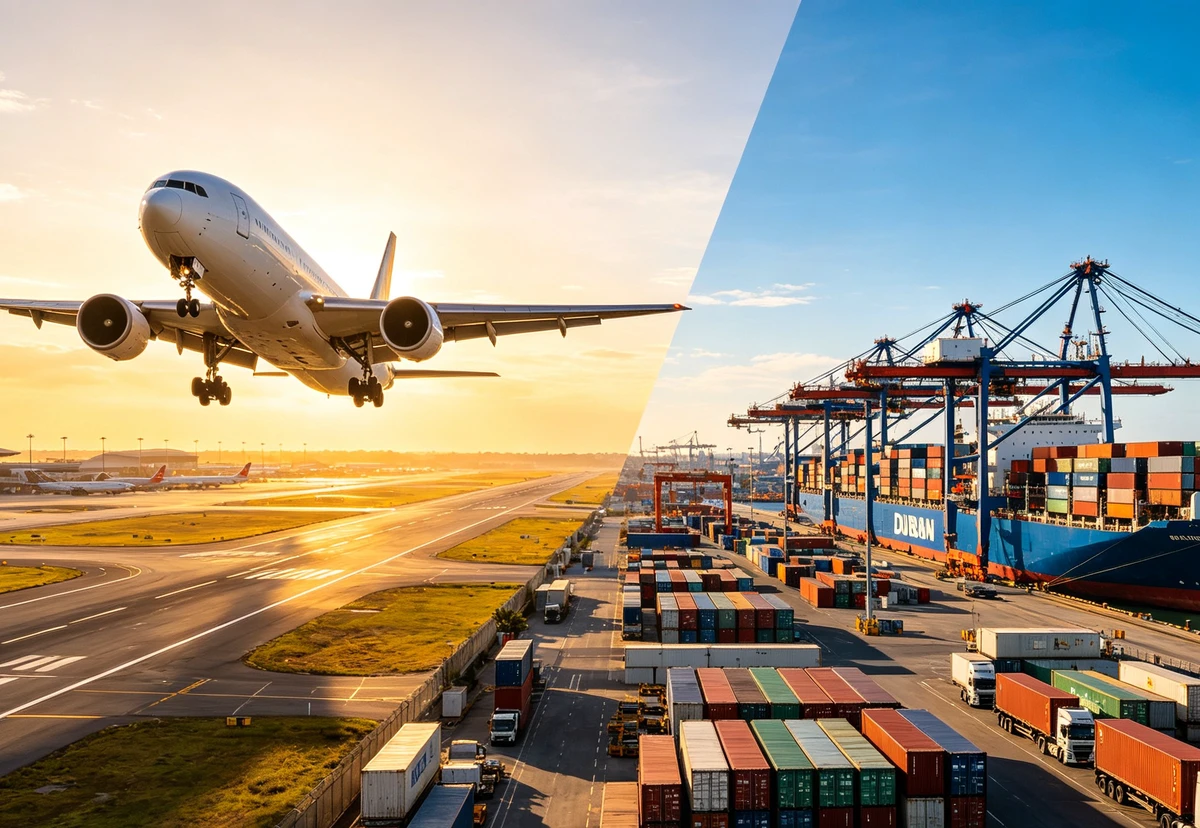
1. Air Freight vs Sea Freight: The Core Differences
Before diving into the numbers, it is crucial to understand how these two primary shipping methods operate on the China-to-South Africa trade lane.
Air Freight Overview: Air freight is the undisputed champion of speed. It is ideal for high-value goods, urgent replacement parts, perishable items, or low-volume shipments (typically under 150 kg). The vast majority of air cargo from major Chinese hubs (like Shenzhen, Shanghai, and Guangzhou) lands at O.R. Tambo International Airport (JNB) in Johannesburg, which serves as the primary distribution hub for the entire Southern African region.
Sea Freight Overview: Ocean shipping is the backbone of international trade and the most economical choice for bulk cargo. Sea freight is categorized into two main types:
- FCL (Full Container Load): You rent an entire 20ft or 40ft container. Best for large volumes.
- LCL (Less than Container Load): Your goods share a container with other importers’ cargo. Best for medium-sized shipments.
The main arrival ports for sea freight are the Port of Durban (the busiest in sub-Saharan Africa), the Port of Cape Town, and Port Elizabeth.
2. Transit Times: How Long Does It Really Take?
When calculating your supply chain lead times, you must look beyond the pure “flight time” or “sailing time.” A true door-to-door timeline must account for cargo consolidation, export customs in China, and import clearance in South Africa. (For a quick summary, read our post on how long does shipping take from China to South Africa).
Air Freight Timeline
The standard transit time for air freight from China to JNB is 5 to 10 days. This includes:
- 1-2 days for cargo booking and Chinese export customs.
- 1-3 days of actual flight transit (depending on direct vs. connecting flights).
- 2-5 days for SARS (South African Revenue Service) customs clearance and airport handover.
Sea Freight Timeline
If you are asking about the transit time sea freight China to Durban, expect significantly longer lead times:
- FCL Shipping: 25 to 35 days. This covers the ocean voyage from ports like Shenzhen or Shanghai to Durban or Cape Town, plus standard port discharge and customs procedures.
- LCL Shipping: 30 to 40 days. LCL takes slightly longer because the freight forwarder must consolidate your cargo into a shared container in China before departure, and deconsolidate (unpack) the container at a Container Freight Station (CFS) in South Africa upon arrival.
Factors Affecting Speed: Keep in mind that severe port congestion at Durban, peak shipping seasons (like the pre-Christmas rush), and whether your carrier uses a direct route or transships via Singapore can all impact your final delivery date.
3. Cost Breakdown: The Cheapest Way to Ship
Shipping costs fluctuate based on fuel prices, seasonality, and carrier capacity. Here are the realistic rate estimates for 2026.
Air Freight Rates
Air freight rates from China to Johannesburg are generally calculated based on “chargeable weight”—which is the greater of the actual gross weight or the volumetric (dimensional) weight. For a more comprehensive breakdown, see our guide on Air Freight from China to South Africa.
- Standard Cost: Typically $4.50 to $8.50 per kg for shipments over 100 kg.
- Express Courier (DHL/FedEx): For small parcels under 50 kg, express door-to-door couriers charge between $9.00 and $16.00 per kg, delivering in just 3-7 days.
Sea Freight Costs
For heavy or bulky items, sea freight is vastly cheaper. You can explore full strategies in our guide on Shipping from China to South Africa by Sea.
- FCL Costs: A standard 20ft container usually costs between $1,500 and $2,600, while a 40ft container ranges from $2,600 to $4,500.
- LCL Costs: LCL is charged per Cubic Meter (CBM). Rates typically range from $80 to $160 per CBM.
Our Industry Insights
Watch out for Hidden Fees! A surprisingly low sea freight quote might only cover the basic ocean freight under CIF or FOB Incoterms. You must factor in destination Terminal Handling Charges (THC), documentation fees (like the bill of lading / airway bill issuance), SARS clearance fees, and inland trucking surcharges from Durban to your warehouse. Always ask your freight forwarder China to South Africa for an all-in quote.
Quick Cost Comparison Table
| Shipping Method | Estimated Cost (2026) | Transit Time | Best For |
|---|---|---|---|
| Air Freight | $4.50 - $8.50 / kg | 5 - 10 Days | Urgent, high-value, < 150 kg |
| Sea Freight (LCL) | $80 - $160 / CBM | 30 - 40 Days | Medium volume, 1 - 15 CBM |
| Sea Freight (FCL) | $1,500 - $4,500 / Container | 25 - 35 Days | Large volume, bulk orders |
4. The Decision Matrix: Which Should You Choose?
Still debating LCL vs FCL shipping China to South Africa or whether to bite the bullet on air freight? Use this decision matrix:
- The Weight & Volume Break-even Point: As a general rule of thumb, if your cargo weighs less than 150-200 kg (or is under 1-2 CBM), air freight might actually be cheaper or comparable to LCL sea freight once destination port handling minimum charges are applied. For anything over 2 CBM, sea freight wins on cost.
- Cargo Type: High-margin electronics, fashion apparel, and perishable goods demand air freight. Heavy machinery, solar panels, furniture, and bulk raw materials must go by sea.
- Urgency vs. Margin: Calculate the cost of an inventory stockout. If paying $2,000 extra for air freight saves a $20,000 B2B contract, air freight is the logical choice.
5. Navigating South Africa Customs (SARS)
Perhaps the most daunting aspect of customs clearance South Africa imports from China is dealing with the South African Revenue Service (SARS). Strict compliance is non-negotiable.
Essential Documents
To avoid goods being detained at the port, ensure your supplier provides:
- A signed Commercial Invoice detailing the exact HS codes and declared value.
- A precise Packing List.
- The original Bill of Lading or Airway Bill.
- A Certificate of Origin (which may grant preferential tariff treatment).
SARS Requirements: The SAD 500 and Importer’s Code
Every commercial import into South Africa requires a South Africa customs documentation (SAD 500) form to be filed. More importantly, if you are importing more than three times a year or the value exceeds ZAR 150,000, you are legally required to register for an Importer’s Customs Code South Africa with SARS. Without this code, commercial shipments cannot clear customs.
Import Duties and Taxes
Import duties and taxes South Africa (SARS) are calculated based on the product’s HS code. Furthermore, a standard Value Added Tax (VAT) of 15% is applied to almost all imported commercial goods. The VAT is calculated on the “Added Tax Value” (ATV), which is the customs value plus a 10% uplift, plus any applicable duties.
6. DDP Shipping & Local Delivery (B2B vs Amazon FBA)
To bypass the headache of customs, many buyers opt for DDP shipping from China to South Africa. DDP (Delivered Duty Paid) means the freight forwarder handles everything: export, freight, import clearance, duty payments, and final delivery.
B2B Local Delivery
Door to door shipping from China to South Africa is highly convenient but requires careful inland logistics planning. Transporting goods via truck from the Port of Durban up to Johannesburg involves security considerations and specific vehicle requirements. For example, if you are delivering to a private address or a warehouse without a loading dock, you must request a truck with a liftgate (tail lift) in advance.
Real-Life Scenario
The Amazon FBA Dual-Clearance Challenge
We recently helped a Shenzhen electronics seller expand into the South African market. Delivering directly to Amazon FBA warehouses in South Africa requires strict adherence to Amazon’s palletizing and labeling standards. Furthermore, because Amazon will not act as the Importer of Record (IOR) or pay duties on your behalf, you must use a specialized DDP “dual-clearance” (双清包税) service. We cleared the goods under our own local entity’s Importer Code, paid the 15% VAT and duties upfront, and arranged a dedicated truck to seamlessly inject the cargo into the FBA fulfillment center.
7. FAQ
What is the cheapest way to ship from China to South Africa?
For large shipments (over 2 CBM or 200 kg), sea freight (FCL or LCL) to the Port of Durban or Cape Town is significantly cheaper than air freight.
Do I need an Importer’s Customs Code for small shipments?
If you are importing for personal use, under three times a year, and the value is under ZAR 150,000, you can use the generic SARS code (70707070). For ongoing commercial imports, you must register for your own Importer’s Code.
How is volumetric weight calculated for air freight to JNB?
Airlines use the formula: (Length x Width x Height in cm) / 6000. You will be billed on this volumetric weight if it exceeds the actual physical weight of the boxes.
Can Sinoshipment handle both ocean freight to Durban and final inland delivery?
Yes. We provide end-to-end logistics, including ocean freight, SARS customs clearance, duty payment, and secure inland trucking to your door in Johannesburg, Pretoria, or anywhere else in South Africa. As experts in freight shipping from China to South Africa, we ensure your cargo arrives safely and on time.
8. Conclusion
Choosing between China to South Africa : Air Freight vs Sea Freight ultimately comes down to your cargo volume, budget, and timeline. Air freight to Johannesburg offers unmatched speed (5-10 days) for urgent or high-margin goods, while sea freight to Durban or Cape Town (25-40 days) remains the undisputed king of cost-efficiency for bulk imports.
Navigating the complexities of SARS clearance, the SAD 500 form, and inland trucking doesn’t have to be stressful. Stop guessing your landed costs and risking port delays. Partner with Sinoshipment, a professional freight forwarder from China with over a decade of global logistics experience. Contact us today for a transparent, customized Air or Sea freight quote tailored to your specific South African supply chain needs.