How to Ship Auto Parts & Tires from China to Saudi Arabia: The Complete 2026 Guide (Sea, Air & DDP)
· By SinoShipment
Shipping auto parts and tires from China to Saudi Arabia is one of the most lucrative yet challenging logistics routes in the Middle East. With Saudi Arabia’s booming automotive aftermarket, driven by high SUV and pickup truck ownership (Toyota Hilux, Land Cruiser, Ford Ranger), the demand for Chinese components has never been higher. However, a single mistake—choosing the wrong shipping mode, missing a SABER certificate, or poor packaging—can turn a profitable shipment into a costly disaster.
As a Shenzhen-based freight forwarder, we’ve handled thousands of automotive shipments to the Gulf—everything from urgent ECU air freight to full container loads of tires. This guide covers our proven process for freight shipping from China to Saudi Arabia. You’ll learn exactly how to ship auto parts from China to Saudi Arabia step-by-step, master the specific regulations for shipping tires from China to Saudi Arabia, and understand the real landed cost so you can quote your customers with confidence.
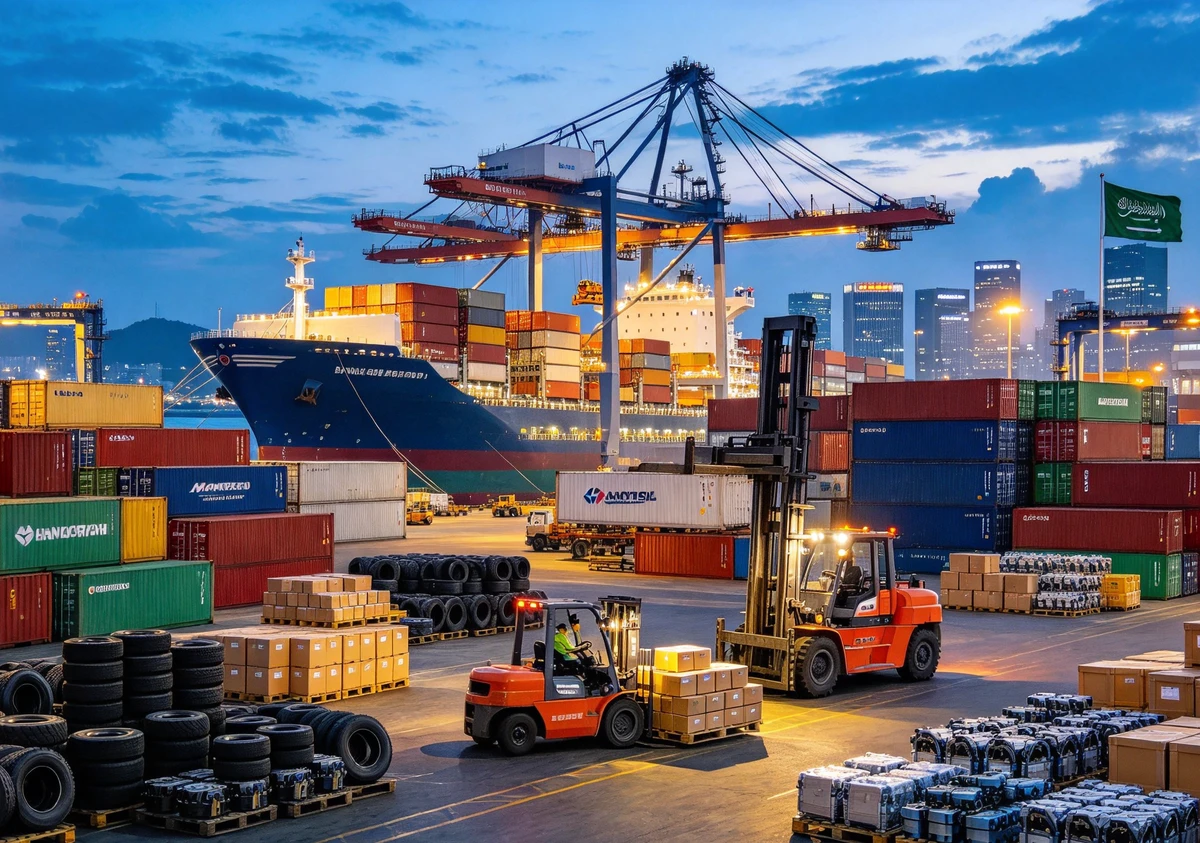
1. Why Ship Auto Parts & Tires from China to Saudi Arabia?
China dominates the global auto parts manufacturing landscape. From precision OEM replacement parts in Guangzhou and Zhejiang to massive tire factories in Shandong and Jiangsu, the supply chain is unmatched. For Saudi importers, this means access to high-quality components at factory-direct prices with scalable MOQs.
But what exactly are you shipping? The term “auto parts” covers a vast range:
- Fragile items: Headlights, chrome trims, windshields, ECU modules
- Volumetric cargo: Bumpers, body kits, fenders, alloy wheels
- Heavy/dense cargo: Engines, transmissions, brake calipers
- Bulk commodities: Tires (HS Code 4011) and standard spare parts (HS Code 8708.99)
Each category demands a different logistics strategy. Unlike consumer electronics, auto parts shipments are time-sensitive—downtime for a Saudi repair shop means lost revenue. This is why experienced importers don’t just look for the cheapest freight rate; they balance cost, cargo protection, customs compliance, and delivery reliability.
2. How to Ship Auto Parts from China to Saudi Arabia: The Step-by-Step Process
Success starts long before the container is sealed. Here’s the exact workflow we use to move automotive cargo from Chinese factories to Saudi warehouses:
- Supplier & Order Readiness: Confirm your Incoterm (EXW, FOB, CIF, or DDP). This determines who controls the freight. Collect packed carton dimensions, weights, and OEM part numbers.
- Determine HS Codes Early: Misclassification is the #1 cause of customs delays. Use the most specific subheading under 8708 (e.g., 8708.30 for brakes and brake pads, 8708.70 for road wheels, 8708.80 for suspension parts); 8708.99 serves as the catch-all for other miscellaneous parts. Use 4011 for pneumatic tires.
- Choose the Right Mode: Air for urgent ECUs/sensors; Sea for tires, bumpers, and wheels (volumetric/weight logic).
- Multi-Supplier Consolidation: If sourcing from multiple factories (e.g., filters from Guangzhou, wheels from Zhejiang), consolidate into one Shenzhen warehouse. We re-label, palletize, verify SKUs, and supervise loading.
- Start SABER/SASO Conformity Before Shipping: Open product registration and commission testing while production runs. Testing and PCoC issuance take days to weeks—never start after the ship sails.
- Export Clearance & Booking: Your supplier or forwarder handles the China export declaration. Confirm booking cut-offs.
- International Transport: Ocean (FCL/LCL) or air, with routing matched to your destination gateway.
- Saudi Customs Clearance (ZATCA/Fasah): File entry, present SCoC + documents, pay duty & 15% VAT. This step requires precise documentation and local expertise—learn more about our customs clearance services.
- Last-Mile Delivery: Inland trucking to Riyadh, Jeddah, Dammam, or the Eastern Province.

3. Shipping Tires from China to Saudi Arabia: Regulations & Logistics
Tires are a special beast. They’re dense, heavy, low-value-per-kg, and stack poorly—frankly, they’re a pain to ship by air. They “cube out” containers quickly, filling the space long before hitting the weight limit. Air freight is rarely economical for tires; sea freight is the default.
Physical Handling & Loading
Proper container stuffing is critical. Tires should be strapped and staged to prevent shifting during the long sea transit. Moisture protection is non-negotiable for the humid Gulf route.
The Compliance Gap Most Guides Miss
This is where many guides fall short. Saudi Arabia tire import regulations are strict. You cannot clear tires without:
- GSO/GCC Tire Standards: Compliance with Gulf standard specifications.
- SASO Conformity: A tire test report from an ISO/IEC 17025-accredited lab covering load index, speed rating, tread pattern, rolling resistance, and temperature resistance.
- SABER PCoC → SCoC: The conformity route requires a Product Certificate of Conformity (valid ~1 year) and a Shipment Certificate of Conformity for every consignment.
- New Labeling Rules: Note SASO Circular 247, effective October 1, 2026, mandating supplier name and CR marking on regulated products (applies to products under ten specific technical regulations, including certain automotive equipment).
HS Code 4011 specifically covers pneumatic tires, and its duty/VAT treatment differs from standard parts.
Our Industry Insight: We recently handled a shipment for a Riyadh distributor who tried to clear tires without the proper GSO test report. The cargo sat at Jeddah Islamic Port for 12 days, accruing demurrage. We stepped in, fast-tracked the SABER PCoC using pre-collected lab data, and cut the remaining clearance time to 48 hours. The lesson: pre-clear SABER in China, not in Saudi Arabia.
FCL vs. LCL for Tires
For FCL shipping tires from China to Saudi Arabia, a 20GP container is often the sweet spot for mid-sized orders. It offers better protection and lower per-unit cost than LCL shipping auto parts from China to Saudi Arabia once you exceed roughly 12–15 CBM (some forwarders recommend 10–12 CBM as the tipping point, depending on origin and destination fees). Shipping car tires to Saudi Arabia for retail? Ensure SKUs are clearly labeled for onward distribution.
4. Sea Freight vs Air Freight: Choosing Your Shipping Method
Choosing the right mode is about matching cargo characteristics to cost and speed.
| Shipping Method | Transit Time (Port-to-Port) | Best For | Cost Logic | Protection Level |
|---|---|---|---|---|
| Sea Freight (FCL) | ~18–28 days | Bulk, heavy, volumetric (tires, engines, body kits) | Flat container rate (20GP/40HQ) | High (sealed container) |
| Sea Freight (LCL) | ~25–35 days | Small-to-mid orders (1–10 CBM) | Per-CBM pricing + destination fees | Medium (shared container) |
| Air Freight | 3–7 days | Urgent, high-value (ECU, sensors) | Chargeable weight (max of actual vs volumetric) | High |
| Express Courier | 2–6 days | Samples, documents | Highest per-kg | High |
How Long Does It Take to Ship Auto Parts from China to Saudi Arabia?
- To Jeddah Islamic Port: 18–25 days (sea), 3–5 days (air)
- To King Abdulaziz Port (Dammam): 20–28 days (sea), 3–7 days (air)
- To Riyadh (via dry port): Add 2–3 days inland trucking.
For urgent ECUs, sensors and small high-value components, Air Freight from China to Saudi Arabia is the fastest option. For detailed scheduling benchmarks, see our guide on How Long Does Shipping Take from China to Saudi Arabia.
Air freight uses chargeable weight (L×W×H cm ÷ 6000). A carton of lightweight but bulky grilles will be billed as if it were much heavier.
For smaller orders sharing container space, review our China to Saudi Arabia LCL Container Shipping guide to understand per-CBM pricing and destination fees.

5. Saudi Arabia Tire Import Regulations & SABER/SASO Compliance
SABER is the electronic platform run by SASO (Saudi Standards, Metrology and Quality Organization). It is the non-negotiable gate for regulated products.
- PCoC (Product Certificate of Conformity): ~Valid 1 year. Platform fee ~SAR 500.
- SCoC (Shipment Certificate of Conformity): Issued per shipment. Fee ~SAR 350–500.
The workflow we run in practice:
- HS-code eligibility check
- Lab testing (accredited)
- PCoC registration
- SCoC per consignment
- Customs verification
Documentation Checklist:
- Commercial Invoice (accurate HS code)
- Packing List
- Bill of Lading (B/L) or Air Waybill (AWB)
- Certificate of Origin (Form A/CO)
- SASO CoC / SABER PCoC + SCoC
- Insurance Certificate
- MSDS (for batteries)
Beyond the paperwork, timing is everything. Start the SABER process while your cargo is still in production—not when the vessel is already at sea.

6. Auto Parts Shipping Cost from China to Saudi Arabia: The Landed-Cost Breakdown
Now let’s talk numbers—because this is where most quotes fall apart. The ocean line item is just one piece of the puzzle. The real landed cost formula is:
Product Cost + Origin Handling + International Transport + Destination/CFS Charges + Clearance + Duty/VAT + Inland Delivery
- Duty: Commonly 5–15% by HS code.
- VAT: 15% on (CIF + Duty).
- ZATCA Service Fee: ~0.15% of CIF (capped at 500 SAR).
Indicative Worked Example (as of 2026): A 1 CBM shipment of brake pads (CIF $500) might incur approximately $25 duty at 5% (assuming classification under HS 8708.30) plus $78.75 VAT—plus freight and other fees. Actual duty rates vary by specific HS subheading (5–15%). A full 20GP of tires will have a completely different cost structure. Prices move weekly; always request a dated, itemized quote.
The Cheapest Way to Ship Auto Parts from China to Saudi Arabia
Consolidate multi-supplier cargo into one FCL. Use the LCL vs FCL tipping point (typically 12–15 CBM, depending on origin and destination fees). Book before peak seasons (Aug–Oct, pre-CNY, Ramadan).
DDP Shipping Auto Parts from China to Saudi Arabia
For a complete breakdown of all-inclusive door-to-door service, see our DDP Shipping from China to Saudi Arabia guide.
DDP is ideal for e-commerce sellers without a Saudi CR (Commercial Registration). Your forwarder acts as importer of record, handles VAT, and delivers door-to-door.
Real-Life Scenario: A Noon seller in Jeddah used a suspiciously cheap DDP quote for LED headlights. Saudi customs flagged the undervalued declaration. The cargo was seized, and the seller faced a 30% penalty on the true value. Honest valuation is cheaper than shortcuts.

7. Customs Clearance for Auto Parts in Saudi Arabia: Documents, Duties & Risk Control
ZATCA (Zakat, Tax and Customs Authority) manages clearance via the Fasah platform.
- Process: Declaration → Inspection → Valuation → Classification → Duty/VAT Payment → Release.
- Pre-clearance: File 3–7 days before arrival to speed things up.
- Gateway Choice: Jeddah for western/central distribution; Dammam for the Eastern Province. During Ramadan/pre-Hajj, western congestion spikes—consider Dammam.
Risk Control: Accurate invoices, detailed packing lists, correct HS codes, and consistent descriptions are your best defense against revaluation and delays.
8. Packaging, Damage Prevention & Buyer Personas
Packaging Guide:
- Fragile: Corner protection, vacuum wrapping, moisture barriers.
- Heavy: Reinforced pallets for forklift handling.
- Tires: Stacking strategy, strapping, OD protection.

Buyer Personas:
- B2B Distributors: Use FCL and multi-supplier consolidation.
- Repair Shops/Fleets: Hybrid strategy—sea for bulk, air for urgent ECUs.
- E-commerce Sellers (Amazon.sa/Noon): Use DDP door-to-door with VAT handled. For Amazon sellers specifically, our Amazon FBA service streamlines inbound compliance and labeling.
9. Frequently Asked Questions
Do I need a Saudi import license to clear auto parts? Yes. You need a Commercial Registration (CR) linked to an import license, unless you use a DDP provider who acts as the importer of record.
Is SABER certification mandatory for tires? Absolutely. Tires (HS 4011) require GSO/SASO conformity and a SCoC for every shipment.
How much does it cost to ship a container of tires? It varies weekly. A 20GP from Shenzhen to Jeddah might range from $1,500–$3,000+ depending on the season, plus duty and 15% VAT.
Can I ship used auto parts to Saudi Arabia? Yes, but they face stricter scrutiny. Ensure they are clean, declared accurately, and not salvage-restricted items.
10. Conclusion: Partner with Sinoshipment
Shipping auto parts and tires from China to Saudi Arabia doesn’t have to be a gamble. Success comes down to a few key decisions: choosing the right mode, classifying your HS codes correctly, pre-clearing SABER/SASO (especially for tires), packing smart, and planning for the true landed cost.
At Sinoshipment, we’ve been moving automotive cargo from Shenzhen to Riyadh, Jeddah, and Dammam since 2013. With 5000+ clients served, direct carrier relationships for stable rates, and a dedicated Middle East compliance team, we handle everything from factory pickup to final delivery—under one transparent, no-hidden-fee quote. For bulk ocean shipments, explore our guide on shipping from China to Saudi Arabia by sea.
Ready to move your auto parts or tires? Contact Sinoshipment today for a free, no-obligation quote and expert SABER guidance.