How to Ship Solar Panels & Inverters from China to Pakistan: The Complete 2026 Guide (Cost, Customs & DDP)
· By SinoShipment
How to ship solar panels & inverters from China to Pakistan is really two logistics problems disguised as one: moving glass-fronted PV modules that hide invisible micro-cracks across the Arabian Sea, and clearing Pakistan’s pre-shipment conformity regime before your container ever leaves China. Get either half wrong, and a flawless order can still stall at Karachi.
Pakistan has imported more than 51 GW of Chinese solar modules in recent years, and over 95% of the country’s solar equipment now arrives from China. The importers who move this cargo profitably share one habit: they plan packaging, conformity, and landed cost together, before they book anything. Here is how to work in that order, from a Shenzhen or Ningbo loading dock to a warehouse in Lahore.
Why Ship Solar Panels & Inverters from China to Pakistan in 2026?
Three forces keep driving solar demand in Pakistan.
First, the economics flipped. Grid power tariffs have climbed more than 60% since 2022, while module prices collapsed into fractions of a cent per watt. For most households and factories, rooftop solar stopped being an environmental choice and became a straightforward financial one.
Second, demand is broad, not project-driven. Buyers range from residential rooftops and commercial/industrial rooftops to agricultural tube-well conversion, supported by net-metering rules and renewable incentives under the SIFC (Special Investment Facilitation Council). That breadth makes the lane repeatable month after month.
Third, China’s supply chain dominates. China produces roughly 80–85% of the world’s PV modules, led by Tier-1 brands such as LONGi, JinkoSolar, Trina Solar, JA Solar, and Canadian Solar, at $0.12–$0.18 per watt FOB. The same industrial belt also manufactures the inverters and batteries that complete a system.
| What “solar cargo” actually includes | HS Code | Why it ships differently |
|---|---|---|
| PV modules / panels | 8541.43 | Large but light; fragile glass; hides micro-cracks |
| Inverters (string, central, hybrid) | 8504.40 | Dense and heavy; static-sensitive electronics |
| Lithium battery storage | 8507.60 | Hazardous goods; UN38.3 and MSDS required |
| Mounting, cabling, accessories | 7308 / 8544 | Bulky, low-value; usually consolidated with the rest |
Our industry insight: the cheapest rate quote is rarely the cheapest shipment. On solar, the money is lost in cracked glass, demurrage at Karachi, and invoice revaluation — not in the ocean freight line. We price the whole chain, then protect it.
Sinoshipment, a freight forwarder based in Shenzhen and established in 2013, has handled China-to-Pakistan solar and electronics cargo for over a decade. That China-side presence matters: it is where pallet configuration, loading discipline, and conformity paperwork are won or lost. It is also what makes dedicated freight shipping from China to Pakistan a repeatable monthly lane rather than a one-off gamble.
How to Ship Solar Panels from China to Pakistan: Step by Step
Treat the whole move as a single timeline, not a stack of separate checklists.
| Step | What Happens | Who Drives It |
|---|---|---|
| 1. Order readiness | Confirm Incoterm (EXW/FOB/CIF/DDP); collect module dimensions, weights, pallet counts, wattage per SKU | Buyer + supplier |
| 2. HS classification | Lock HS codes early (8541.43 / 8504.40 / 8507.60) | Buyer + forwarder |
| 3. Conformity kickoff | Start PSI and CoC while production runs; secure Form P | Forwarder + agency |
| 4. Mode choice | Sea FCL for volume, LCL for 1–10 pallets, air for urgent samples | Forwarder |
| 5. Consolidation | Merge multi-supplier cargo in one China warehouse | Forwarder |
| 6. Packing & loading | Brick-pattern loading, dunnage, EPE corners, ISPM 15 crates | Forwarder |
| 7. Export clearance | File the China export declaration; confirm sailing cut-offs | Forwarder |
| 8. International transit | Ocean or air to Karachi Port or Port Qasim | Forwarder |
| 9. Pakistan clearance | File the Goods Declaration; pay duty and GST | Forwarder / broker |
| 10. Inland delivery | Truck to Lahore, Islamabad, Faisalabad, Multan, Sialkot | Forwarder |
The sequence matters because steps 2 and 3 take the longest to correct if left late. A wrong HS code on the commercial invoice is the single most common reason a solar container sits at the port for over a week. Step 5 is where professional warehouse services pay for themselves. Panels, inverters, and accessories from several factories are consolidated, re-palletized, and loaded under one roof in Shenzhen.
Panels, Inverters & Batteries: How Each Cargo Type Ships Differently
Treating “solar” as a single product is the first mistake we see. The keyword says panels and inverters, so let’s treat each as a first-class cargo.
| Cargo | Freight Driver | Fragility | Hazmat Rules | Default Mode |
|---|---|---|---|---|
| PV modules | Volume | High (glass, micro-cracks) | None | Sea FCL |
| Inverters | Weight | Medium (electronics) | None | Sea; air for restocks |
| Lithium batteries | Weight | Medium | UN38.3 + MSDS | Sea (air restricted) |
PV modules are large but relatively light, so freight is volume-driven. The killer is not visible breakage but hidden cell micro-cracks: hairline fractures that pass a visual check, then degrade output for months and void warranties.
Inverters (HS 8504.40) are dense and heavy per cubic meter, which makes freight weight-driven. That directly affects air chargeable weight and floor-loading limits in a shared container. On-grid, off-grid, and hybrid inverters with MPPT all share one weakness: static-sensitive electronics that need shock protection, moisture barriers, and original cartons. They are electronics first and foremost, so the packing discipline mirrors our guide to how to ship electronics and gadgets from China.
Lithium battery storage (HS 8507.60) is a different animal. It is hazardous goods: it requires a UN38.3 test report and MSDS, and it is heavily restricted on passenger and many freighter aircraft. For hybrid systems that pair an inverter with a battery bank, sea freight is the default route.
A case that still stings: a trader ordered 400 hybrid inverters and 12 lithium racks, then booked the whole lot by air to save two weeks. The batteries had no UN38.3 report, so the airline refused them at the ramp. The inverters flew; the batteries had to be re-booked by sea, and the customer’s installation crew sat idle. Split compliant and non-compliant SKUs before booking.
Inverters and accessories can share a container with modules, provided floor-loading limits and weight distribution are respected: heavy, dense items low and centered, fragile pallets on top and protected.
Sea Freight vs Air Freight vs LCL: Choosing Your Shipping Method
Sea freight is the workhorse for solar. It is the lowest cost per watt, and FCL (Full Container Load) keeps cargo sealed from origin to destination, which is the best protection money can buy for fragile panels. From China to Karachi or Port Qasim, ocean transit runs roughly 18–25 days, depending on the origin port and whether you take a direct sailing.
Air freight moves in 3–7 days at five to ten times the ocean cost. It earns its premium for urgent inverter replacements, samples, and high-value electronics. Pricing is by chargeable weight: the greater of actual weight or volumetric weight (L × W × H in cm ÷ 6000). A dense inverter pallet that weighs 700 kg can easily bill at 900 kg.
Express courier (2–6 days door-to-door) suits small, high-value parts, not full systems.
Speed has a price, and on bulky solar modules it rarely earns its keep.
| Mode | Relative Cost | Transit | Min Volume | Damage Risk | Best For |
|---|---|---|---|---|---|
| FCL sea | $ (lowest per watt) | 18–25 days to Karachi | 1 × 20ft | Low | Bulk orders, 200+ panels |
| LCL sea | $$ | 22–32 days | 1 CBM | Medium | Small orders, samples |
| Air | $$$$$ | 3–7 days | 50 kg | Low | Urgent, high-value |
| Express | $$$$ | 2–6 days | 1 carton | Low | Small parts, spares |
FCL vs LCL Shipping Solar Panels from China to Pakistan
The break-even sits at roughly 12–15 CBM or 6–10 pallets. Below that, LCL lets you pay only for the space you use. Above it, FCL wins on both cost and safety, because LCL cargo is handled at consolidation and de-consolidation warehouses, exactly where fragile panels get dropped.
How Long Does It Take to Ship Solar Panels from China to Pakistan?
Plan the full door-to-door timeline, not just the sailing. The same logic applies to air freight from China to Pakistan:
| Segment | Sea (FCL) | Air |
|---|---|---|
| Origin handling + export clearance | 3–5 days | 1–2 days |
| International transit | 18–22 days | 2–4 days |
| Pakistan clearance | 5–7 days | 1–3 days |
| Inland delivery | 1–3 days | 1–2 days |
| Total (indicative) | 27–37 days | 5–11 days |
Door-to-Door Solar Panel Shipping from China to Pakistan
Door-to-door bundles factory pickup, export clearance, freight, import clearance, duty/GST payment, and final delivery into one managed flow. For first-time importers without a local customs broker, it removes the biggest coordination risk — see the DDP section below.
The main origin ports are Shanghai, Ningbo, Shenzhen, and Qingdao; the destination gateways are Karachi Port (KPT) and Port Qasim (PQA). Notably, China-to-Pakistan routings run direct and do not transit the Strait of Hormuz, so this lane is insulated from the Gulf disruption that has reshaped Middle East routing — see our analysis of the Strait of Hormuz closure shipping impact.
Pakistan Solar Panel Import Regulations & Customs Clearance (PSI, CoC & Form P)
Pakistan’s conformity chain is the step most first-time importers underestimate.
- PSI (Pre-Shipment Inspection): booked roughly 5–7 days before sailing; the output is a Clean Report of Findings (CRF).
- CoC (Certificate of Conformity): issued by PSQCA or an accredited body, on an IEC 61215 / IEC 61730 basis.
- Form P: the China–Pakistan FTA certificate of origin that secures your tariff preference.
Panels need PSQCA-ready conformity; inverters and electronics may need their own certification; batteries need UN38.3 / MSDS.
At the destination, professional customs clearance runs through a Goods Declaration (GD) filed on WeBOC / Pakistan Single Window, followed by assessment (HS code and valuation), duty and tax payment, and examination or release. With complete documents, clearance typically takes 5–7 days.
Documentation checklist: Commercial Invoice with accurate HS codes · Packing List · Bill of Lading or AWB · Certificate of Origin / Form P · PSI report (CRF) · CoC · Insurance Certificate · Fumigation/ISPM 15 for wood packing · MSDS/UN38.3 for batteries.
Pakistan Solar Import Duty & Taxes in 2026 (Panels vs Inverters vs Batteries)
The duty position has genuinely changed, and much of what ranks online is outdated. As of 2026:
- PV modules carry 0% customs duty under renewable-energy SROs and GST around 10%; the proposed 18% increase was dropped from the final Finance Bill.
- Inverters, batteries, wiring, and cables are exempt from customs duty as part of a qualifying complete solar system under the Fifth Schedule of the Customs Act 1969 (portable-system batteries are capped at 50 Ah).
- FBR conditions in the 2026-27 Fifth Schedule (effective July 1, 2026) add new compliance and end-use verification requirements for solar panel imports (the tariff structure itself is unchanged).
| Item | HS Code | Customs Duty | GST (indicative) | Notes |
|---|---|---|---|---|
| Solar PV modules | 8541.43 | 0% | ~10% | Exempt under renewable-energy SROs |
| Solar inverters | 8504.40 | 0% | ~10–18% | Exempt as system component (Fifth Schedule) |
| Lithium batteries | 8507.60 | 0% (in a qualifying system) | Varies | UN38.3 / MSDS required |
| Mounting & cabling | 7308 / 8544 | 0% (system) | Varies | Confirm current tariff line |
From our desks: every one of these figures is a moving target. Pakistan’s solar tariff treatment changes with each Finance Bill, and 2025 figures (5% duty plus higher VAT) still surface in ranking articles. Date every quote “as of 2026,” and re-check the current FBR notification the week you ship.
Solar Panel Shipping Cost from China to Pakistan: The Landed-Cost Breakdown
The only number that matters is your landed cost — not the FOB price and not the freight quote in isolation.
| Cost Component | Typical Range | Notes |
|---|---|---|
| Product (FOB) | $0.12–$0.18/watt | Tier-1 modules |
| Inland trucking (factory → port) | $200–$600 | Higher from inland factories |
| Export clearance | $120–$300 | Documentation + declaration |
| Ocean freight (China → Karachi, 40ft) | ~$1,900–$2,300 | Indicative, late-2026 |
| CFS / loading | $250–$400 | Pallet handling at origin |
| Marine insurance | 0.3–0.5% of value | Cover ~110% of CIF |
| Import duty + GST | 0% + ~10% (panels) | Per 2026 position |
| Inland delivery | $300–$900 | To Lahore / Islamabad |
Worked example (panels): 500 × 550W monocrystalline modules total 275 kW. At $0.15/watt FOB, product is about $41,250; add ocean freight (~$1,500), insurance, and Pakistan charges, and the landed cost lands near $0.19–$0.20 per watt. Against retail prices of $0.28–$0.35/watt in Pakistan, that leaves a healthy margin.
Worked example (inverter-led): a pallet of hybrid inverters flips the logic. Because inverters are dense, ocean pricing becomes weight-driven, and air chargeable weight can exceed actual weight by 20–30%. Budget inverter freight by kilograms, not cubic meters.
The Cheapest Way to Ship Solar Panels from China to Pakistan
The cheapest option is rarely the lowest headline rate. What matters is the lowest total landed cost with zero rework: consolidate multi-supplier orders into one FCL, avoid peak shipping windows (August–October and the weeks before Chinese New Year), lock annual rates if you ship four or more containers a year, and keep a flexible sailing window so your forwarder can chase the best booking.
Container Loading, Packaging & Damage Prevention
Loading discipline is where solar shipments are protected or ruined.
| Container | Residential Panels | Commercial Panels |
|---|---|---|
| 20ft GP | 180–220 | 140–180 |
| 40ft GP | 380–500 | 320–400 |
| 40ft HC | 430–550 | 360–450 |
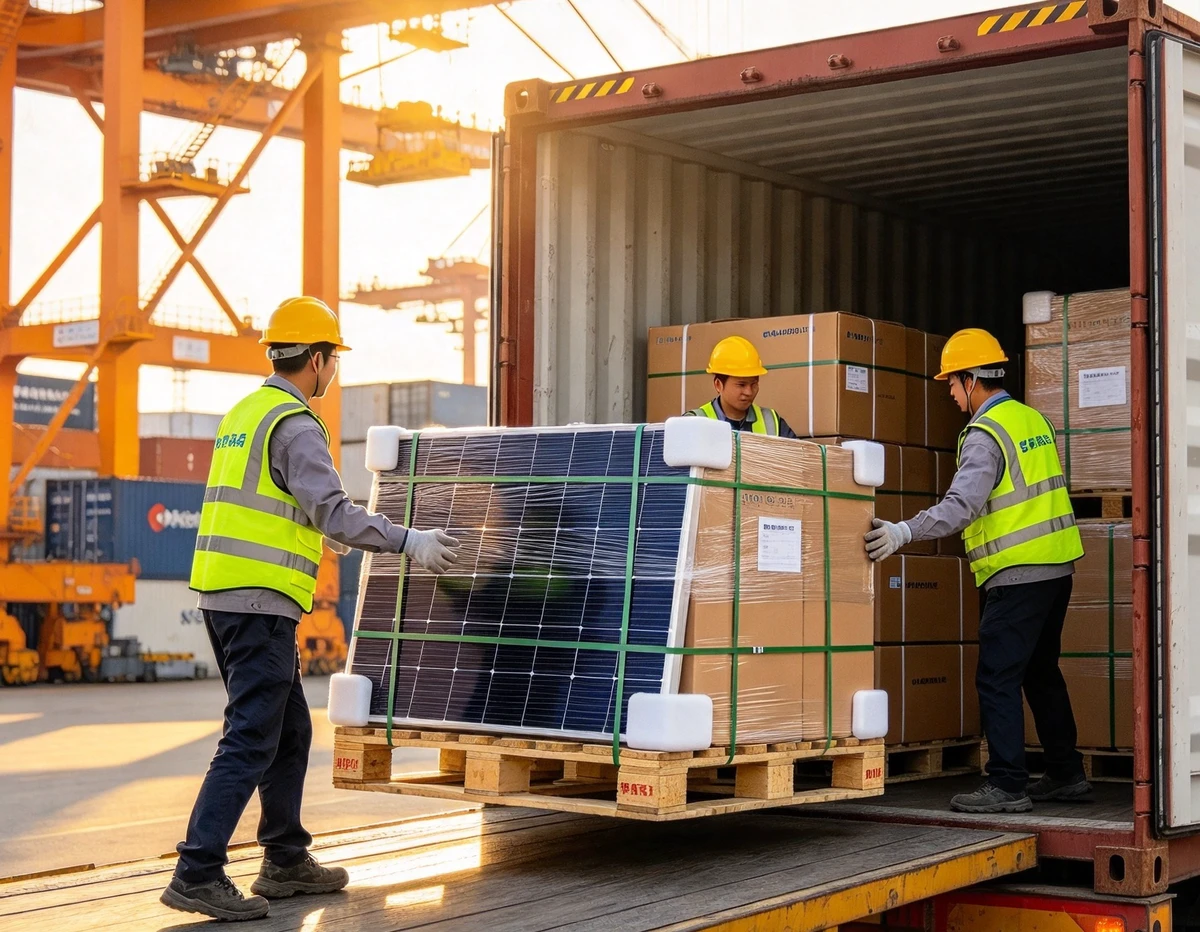
Panels fail in four ways: glass breakage, frame damage, pallet movement, and the expensive one — hidden cell micro-cracks. The packaging protocol that works combines EPE foam wrap and corner protectors, glass-to-glass stacking with separator sheets, plywood pallets rated above 1,000 kg, four to six steel or PET straps per pallet, reinforced ISPM 15 crates, and a vapor barrier with desiccant for the ocean leg.
At loading: protect the floor, use a brick-pattern offset layout, fill voids with inflatable dunnage bags, lash the first and last pallets to the container’s rings, and photograph the load before sealing the doors. In our own loading supervision at Yantian, those photos have settled more damage disputes than any clause in the contract. Back the load with all-risk cargo insurance covering roughly 110% of CIF value. It is the cheapest line on a solar shipment, and the one that pays out when a container is damaged.
DDP Shipping from China to Pakistan: Door-to-Door Delivery
Under DDP (Delivered Duty Paid), one party owns the entire chain. Sinoshipment collects from the factory, handles export clearance, books freight, clears Pakistan customs, pays duty and GST, and delivers to the final address — often without the buyer needing a local importer entity.
| Model | Who Handles Duty & Clearance | Best For |
|---|---|---|
| FOB / CIF | Buyer | Importers with their own broker |
| DDP | Forwarder (all-in) | First-timers, e-commerce, multi-supplier orders |
Be honest about the trade-off: a DDP quote carries built-in margin to absorb duty and valuation risk, so large importers with their own broker may still prefer FOB or CIF for control. For everyone else, DDP turns a five-vendor headache into a single point of contact.
Deliveries run from Karachi onward to Lahore, Islamabad/Rawalpindi, Faisalabad, Multan, and Sialkot, with sea transit of roughly 18–25 days to Karachi plus clearance and inland trucking.
Frequently Asked Questions
Do I need PSI and CoC to import solar panels into Pakistan? Yes. PSI produces a Clean Report of Findings before sailing, and a CoC confirms conformity. PSI is typically booked 5–7 days before loading; plan the CoC lead time in advance.
What is the HS code for solar panels and inverters? PV modules are 8541.43; inverters are 8504.40. They must be declared separately. Putting both on one line is a classic clearance delay.
How much does it cost to ship a container of solar panels from China to Karachi? Indicative 40ft ocean freight to Karachi/Port Qasim ran roughly $1,900–$2,300 in late 2026, before inland delivery and duties.
How long does shipping take from China to Pakistan? Sea is about 18–25 days port-to-port, 27–37 days door-to-door; air is 3–7 days transit.
Is it cheaper to ship solar panels by FCL or LCL? Below ~12–15 CBM (6–10 pallets), LCL is cheaper. Above that, FCL wins on cost and cargo safety.
What is Pakistan’s duty and GST on solar panels in 2026? Panels carry 0% customs duty with GST around 10%; system components are duty-exempt under the Fifth Schedule.
Can I ship hybrid inverters with lithium batteries from China? Yes, but batteries are hazardous goods. UN38.3 and MSDS are mandatory, and air carriage is heavily restricted. Sea is the default.
Can I import solar panels without a Pakistani importer entity? With DDP, the forwarder can act as the importer of record, making this possible for buyers without a local entity.
How do I avoid micro-crack damage and customs delays? Use a disciplined packaging and loading protocol, insist on loading photos, get HS codes and conformity right early, and book with a solar-experienced forwarder.
Do I need Form P to get China–Pakistan FTA tariff savings? Yes. Form P is the certificate of origin that unlocks the CPFTA preference. Without it, you leave duty savings on the table.
Conclusion
Shipping solar panels and inverters from China to Pakistan rewards planning over bargain-hunting. Get the fundamentals right: the right mode, accurate HS codes (8541.43 / 8504.40 / 8507.60), pre-cleared PSI/CoC, a valid Form P, disciplined packaging, and transparent landed-cost math, with one China-based forwarder owning the whole chain.
With 10+ years of China-to-global forwarding, a Shenzhen headquarters inside China’s export heartland, and 5,000+ clients served, Sinoshipment provides sea, air, Amazon FBA, warehousing, and DDP door-to-door across Pakistan, with solar-specific packing and loading supervision and no hidden fees.
Need to move solar panels or inverters from China to Pakistan? Request a free, no-obligation DDP quote from Sinoshipment and get PSI/CoC guidance in the same conversation.