Shipping Cost from Irkeshtam Port to Iran: The Complete 2026 Guide (TIR, Rail-Road & Freight Rates)
· By SinoShipment
If you are searching for the shipping cost from Irkeshtam Port to Iran, you have probably noticed that most guides online only talk about sea freight to Bandar Abbas or air freight to Tehran. That is a problem. Irkeshtam is China’s westernmost land border port and one of the fastest-growing gateways for cargo moving from China through Central Asia into Iran. Yet practical, up-to-date pricing information for this corridor is surprisingly hard to find.
In this guide, we break down realistic 2026 rates, explain how the route works, and show you how to avoid the compliance and documentation mistakes that delay shipments. Whether you are moving auto parts, machinery, or consolidated e-commerce cargo, you will leave with a clear picture of what shipping from Irkeshtam to Iran actually costs.
Quick Answer: Irkeshtam-to-Iran Shipping Costs and Transit Times
The table below gives indicative ranges for the main transport options. Exact rates must be quoted case-by-case because they depend on cargo details, pickup city, Incoterms, and seasonal demand.
| Mode | Route | Indicative Cost | Transit Time |
|---|---|---|---|
| TIR Full Truckload | China → Irkeshtam → Kyrgyzstan → Uzbekistan → Iran | Quote-only; TIR typically saves ~USD 300–500/shipment vs. conventional trucking | 15–20 days |
| Rail-Road Intermodal | Xi’an/Shanxi → Kashgar → Irkeshtam → Central Asia → Iran | ~USD 2,500–4,000 per FEU equivalent | 12–18 days |
| Sea Freight (benchmark) | Shanghai → Bandar Abbas | 20’GP: ~USD 1,050–1,650; 40’HQ: ~USD 1,400–2,100 | 18–30 days |
| Air Freight (benchmark) | China → Tehran Imam Khomeini (IKA) | ~USD 5.00–7.50/kg | 3–7 days |
For most importers, the real decision is between TIR road freight and rail-road intermodal. Sea freight is cheaper for bulk cargo but slower; air freight is fastest but expensive. The Irkeshtam corridor sits in the middle: faster than ocean, cheaper than air, and increasingly reliable.
What Is Irkeshtam Port and Why Does It Matter for China-Iran Freight?
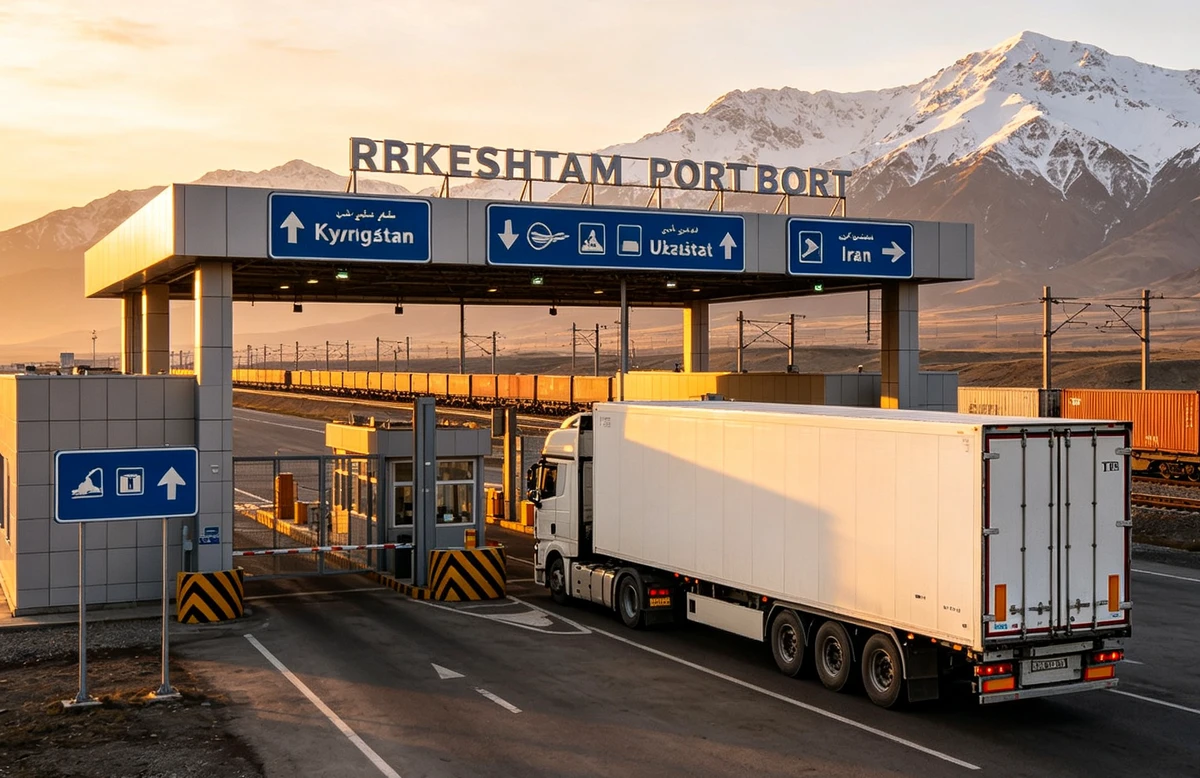
Irkeshtam Port is China’s westernmost land border crossing. It sits in Xinjiang, near Kashgar and Uluqat, and connects China with southern Kyrgyzstan. From there, cargo can move west through Osh, Bishkek, and Jalal-Abad, then continue into Uzbekistan and onward to Iran.
This matters because Irkeshtam is a key node on the China–Central Asia–West Asia Economic Corridor, part of the broader Belt and Road Initiative. For shippers who need something faster than the 20–30 day ocean route to Bandar Abbas but cheaper than air freight, the Irkeshtam land corridor is a genuine alternative.
Recent traffic data shows how quickly this gateway is growing:
- 2025: 295,257 cross-border truck crossings and roughly 3.3 million tons of cargo, up about 64% year-on-year.
- Q1 2026: 72,062 freight vehicle crossings and 801,000 tons of cargo, up roughly 72% year-on-year.
Those numbers come from Tianshannet, the official Xinjiang news outlet, and they reflect real demand from shippers moving goods overland to Central Asia, the Caucasus, and Iran.
How Irkeshtam Compares to Other China-Central Asia Gateways
| Gateway | Best For | Notes |
|---|---|---|
| Irkeshtam | South/west-bound cargo to Kyrgyzstan, Uzbekistan, Iran | Lower altitude than Torugart; year-round operation in most conditions |
| Torugart Pass | Direct Kyrgyzstan access | Higher altitude; more seasonal disruption |
| Khorgos / Alashankou | Northern routes to Kazakhstan, Russia, Europe | Rail-heavy; less direct for Iran-bound cargo |
| Kashgar (inland hub) | Consolidation point before Irkeshtam or Torugart | Growing rail-road intermodal services |
For Iran-bound cargo, Irkeshtam is usually the most logical exit point because the route naturally funnels cargo southwest toward Uzbekistan and Turkmenistan, both of which connect to northern Iran.
How Cargo Moves from Irkeshtam to Iran: Transport Modes Compared
There are four practical ways to move cargo from China to Iran. Only two of them use the Irkeshtam corridor directly.
TIR Road Freight (Full Truckload)
TIR stands for Transports Internationaux Routiers, an international customs transit system that lets sealed trucks cross multiple borders with a single customs declaration. China, Kyrgyzstan, Uzbekistan, and Iran are all TIR members, which makes this corridor a natural fit.
TIR works well for:
- Full truckload (FTL) palletized cargo
- Auto parts and machinery
- Project cargo and oversized loads
- Shipments that need faster transit than sea but lower cost than air
The main advantage is speed at the border. Instead of unloading, inspecting, and reloading cargo at every customs point, a TIR-sealed truck can pass through with minimal handling.
Rail-Road Intermodal
This mode combines rail for the long inland haul inside China with trucking through Irkeshtam and Central Asia. A typical pattern is:
- Rail from Xi’an, Shanxi, or another inland origin to Kashgar.
- Truck from Kashgar through Irkeshtam into Kyrgyzstan.
- Rail or truck onward through Uzbekistan and Turkmenistan into Iran.
In September 2025, Xinhua reported a new Shanxi–Kyrgyzstan–Uzbekistan rail-road service that switched to road at Kashgar, exited via Irkeshtam, and reached Andijan. The service cut transit time by six days and saved roughly 1,000 yuan per container compared with the older northern route through Horgos/Almaty/Tashkent.
Rail-road intermodal is best for:
- FCL containers that need faster transit than sea
- Consolidated cargo heading to Tehran, Mashhad, or other inland Iranian cities
- Cost-sensitive shipments that still need predictable timing
Sea Freight (Benchmark)
Sea freight remains the cheapest option for large volumes. The main route is from Chinese ports such as Shanghai, Ningbo, Shenzhen, and Guangzhou to Bandar Abbas or Chabahar in Iran.
- Transit time: 18–30 days depending on origin and transshipment.
- Cost: 20’GP ~USD 1,050–1,650; 40’HQ ~USD 1,400–2,100.
Sea freight makes sense when speed is not critical and you are moving bulk commodities, furniture, or other heavy cargo. Unlike ocean routes through the Strait of Hormuz, the Irkeshtam corridor is not exposed to maritime chokepoint disruptions such as those covered in our Strait of Hormuz Reopens update.
Air Freight (Benchmark)
Air freight from China to Tehran Imam Khomeini International Airport (IKA) is the fastest option.
- Transit time: 3–7 days.
- Cost: ~USD 5.00–7.50/kg for general cargo.
Air freight is best for urgent electronics, medical supplies, samples, or high-value lightweight goods. Keep in mind that regional conflict can push air rates higher; see our analysis of the Middle East Conflict Air Freight Rate Surge for context.
Mode Comparison Summary
| Mode | Speed | Cost Level | Best For | Reliability |
|---|---|---|---|---|
| TIR Road | Medium | Medium | FTL, auto parts, machinery, project cargo | High with an experienced forwarder |
| Rail-Road Intermodal | Medium | Medium-Low | FCL, consolidated containers, inland Iran delivery | Moderate-High |
| Sea Freight | Slow | Low | Bulk, FCL/LCL, cost-sensitive cargo | Moderate |
| Air Freight | Fast | High | Urgent, high-value, lightweight cargo | High |
Shipping Cost from Irkeshtam Port to Iran: Indicative Rates (2026)
Exact Irkeshtam to Iran trucking freight rates cannot be published as fixed prices. The corridor crosses multiple countries, uses different currencies, and depends on fuel prices, transit permits, and seasonal capacity. However, the following benchmarks will help you budget and negotiate.
TIR Full-Truckload Benchmarks
These are context benchmarks for China–Central Asia FTL movements. The onward leg to Iran adds cost depending on routing.
| Lane | Indicative FTL Cost (USD) |
|---|---|
| China → Kyrgyzstan | ~1,000–2,200 |
| China → Uzbekistan | ~1,800–3,200 |
| Uzbekistan → Iran (additional leg) | ~800–1,500 depending on destination |
For a full China → Iran movement via Irkeshtam and Uzbekistan, a reasonable working budget for FTL is USD 3,000–5,000 per truck, excluding duties and VAT at destination. High-value or time-sensitive cargo may pay a premium, while backhaul availability can sometimes reduce rates.
Rail-Road Intermodal Benchmarks
| Route | Indicative Cost | Notes |
|---|---|---|
| Shanxi → Kashgar → Irkeshtam → Uzbekistan | ~1,000 yuan/container less than northern route | Reported by Xinhua/SCIO, Sept 2025 |
| Full China → Iran multimodal (per FEU equivalent) | ~USD 2,500–4,000 | Includes rail, truck, and transit handling |
Per-Unit Guidance for Smaller Cargo
If you are not moving a full truck or container, your cargo will be consolidated.
| Cargo Type | Typical Pricing Unit | Indicative Range |
|---|---|---|
| LCL / loose road freight | Per ton·km | ~USD 0.10–0.25 |
| Consolidated small parcels | Per kg or per CBM | Quote once volume threshold reached |
| E-commerce consolidation | Per kg | Highly variable; depends on weekly volume to Iran |
The bottom line: for small shipments, the Irkeshtam to Iran logistics cost per kg only becomes competitive once you consolidate enough volume to fill a truck or container segment.
What Drives the Final Cost?
| Factor | How It Affects Cost |
|---|---|
| Cargo weight and volume | Determines whether FTL, LCL, or consolidation makes sense |
| Origin city in China | Inland rail/truck haul to Kashgar or Urumqi adds cost |
| Destination city in Iran | Tehran, Mashhad, and Bandar Abbas have different inland rates |
| TIR vs. conventional trucking | TIR reduces handling but adds carnet and guarantee fees |
| Fuel and currency | Fuel surcharge plus CNY/IRR/USD volatility |
| Seasonality | Chinese New Year, Ramadan, and harvest seasons push rates up |
| Iran customs duties and VAT | Adds to landed cost under DAP/DDU/DDP terms |
Typical Route Map and Transit Nodes (China → Irkeshtam → Iran)
Understanding the physical route helps explain why costs vary. Below is the standard path for a China-to-Iran shipment using the Irkeshtam corridor.
- Origin pickup — Shenzhen, Guangzhou, Shanghai, Ningbo, Qingdao, Xi’an, or another Chinese city.
- Inland haul or rail — Cargo moves to Kashgar or Urumqi, the main Xinjiang consolidation hubs.
- Exit China — Truck crosses at Irkeshtam Port (Torugart is an alternative in some cases).
- Transit Kyrgyzstan — Key cities: Osh, Bishkek, Jalal-Abad, Naryn.
- Enter Uzbekistan — Key cities: Tashkent, Andijan, Samarkand.
- Onward to Iran — Via Turkmenistan toward Mashhad, or direct road/rail south toward Tehran or Bandar Abbas.
- Final delivery — Under the agreed Incoterms: DAP, DDP, CIP, etc.
Transit Time by Leg
| Leg | Approximate Time |
|---|---|
| China origin → Kashgar/Urumqi | 3–7 days (rail or truck) |
| Kashgar → Irkeshtam → Kyrgyzstan | 1–3 days |
| Kyrgyzstan → Uzbekistan | 2–4 days |
| Uzbekistan → Iran border | 3–7 days |
| Iran customs + inland delivery | 3–7 days |
| Total door-to-door | 12–20 days |
Common Iranian Destinations
| Destination | Typical Access Route |
|---|---|
| Tehran | Road/rail via Turkmenistan or direct overland corridor |
| Mashhad | Direct road from Turkmenistan border |
| Isfahan | Inland haul from Tehran or southern corridor |
| Tabriz | Northwest Iran via Tehran corridor |
| Bandar Abbas | Overland from Tehran or sea from Chinese ports |
| Chabahar | Usually better served by sea from southern China |
| Anzali | Northern Iran via Tehran or Caspian corridor |
TIR Transport: How It Cuts Cost and Time at Irkeshtam
TIR is not just an acronym. It is the reason why the Irkeshtam corridor can compete with longer-established routes.
Under TIR, a truck is sealed at origin with a single customs declaration. The seal remains intact through each border until destination customs. This means:
- No re-loading at borders, reducing damage and labor costs.
- Fewer inspections because the transit guarantee is managed through the TIR system.
- Faster clearance — Irkeshtam has reported clearance efficiency improvements of over 200%, with some vehicle clearances completed in under one minute.
Real-World Example: March 2026 Pilot
On March 27, 2026, China’s first “Multimodal Transport + TIR” shipment exited via Irkeshtam. The cargo — auto parts — moved by rail from Xi’an to Kashgar, then by TIR truck through Irkeshtam into Uzbekistan. The total time from dispatch to exit at Irkeshtam was 11 days, saving an estimated 3–5 days compared with traditional methods.
This case matters because it shows the corridor is no longer experimental. It is a working option for time-sensitive manufacturing supply chains.
When to Choose TIR vs. Conventional Trucking
| Choose TIR If… | Choose Conventional Trucking If… |
|---|---|
| You have a full truckload | You have a partial load or flexible schedule |
| Cargo is high-value or time-sensitive | Documentation needs are simple |
| Your forwarder has TIR experience | You are shipping to a remote destination with limited TIR infrastructure |
| You want minimal handling | Cost is the only priority |
Documentation and Customs Clearance
Getting paperwork right is half the battle on the Irkeshtam-to-Iran route. One missing certificate can stop a truck for days. A forwarder that provides customs clearance support at both ends can prevent most of these delays.
China Export Documents
- Commercial Invoice
- Packing List
- Export Customs Declaration
- Bill of Lading (B/L) or Road Waybill / CMR
- Certificate of Origin (CO / Form A / Form E)
- Fumigation Certificate (if wooden packaging)
- MSDS / transport safety report (for battery, liquid, powder, or other regulated cargo)
Transit Documents Through Central Asia
- TIR Carnet (if using TIR)
- CMR Consignment Note
- Kyrgyzstan, Uzbekistan, and Turkmenistan transit permits
Iran Import Documents
- Commercial Invoice (detailed and matching the goods exactly)
- Packing List
- Certificate of Origin
- Bill of Lading / CMR
- Proforma Invoice
- Import license / Standard Certificate (for regulated products)
- Commercial ID (کارت بازرگانی) — the importer’s responsibility
Common Clearance Mistakes to Avoid
- HS code mismatches — make sure the classification matches both Chinese export and Iranian import requirements.
- Undervalued invoices — Iranian customs scrutinize values; under-declaring can lead to fines and seizures.
- Missing fumigation certificate — wooden pallets and crates often require treatment proof.
- Incomplete product descriptions — vague descriptions trigger inspections.
Compliance, Sanctions, and Risk Factors
Shipping to Iran requires more diligence than most trade lanes. The good news is that legitimate commercial trade in non-sanctioned goods continues. The key is working with a forwarder who understands the compliance landscape. For background on how geopolitical events affect this lane, read our analysis of How the May 2026 US-Iran Tensions Impact Shipping Costs from China.
Sanctions Screening
Before any shipment, verify that:
- The cargo is not dual-use or military-related.
- The consignee and carrier are not on restricted-party lists.
- The routing does not involve sanctioned entities or unusual transshipment requests.
Transit Country Considerations
Each country along the corridor has its own permit and customs requirements:
- Kyrgyzstan: TIR works well; local permits may still be needed for non-TIR cargo.
- Uzbekistan: Major transit hub; Tashkent and Andijan are common reload points.
- Turkmenistan: Transit permits can be bureaucratic; plan ahead.
- Afghanistan: Generally avoided due to security and infrastructure risks unless specifically required.
For a broader view of regional risks, see our Iran War Supply Chain Impact briefing.
Cargo Insurance
Given the multiple borders and handling points, cargo insurance is highly recommended. Typical coverage costs 0.3%–1% of cargo value. Options include:
- All-risk coverage — broadest protection.
- Total-loss-only coverage — cheaper but limited.
Operational Risks
| Risk | Mitigation |
|---|---|
| Altitude and weather at Irkeshtam (~3,000 m) | Avoid winter peak if possible; use weather-resistant packaging |
| Currency volatility (IRR, CNY, USD) | Lock rates where possible; quote in stable currency |
| Iranian banking complexities | Use established payment channels; consult your forwarder |
| Documentation delays | Pre-submit paperwork and use a forwarder with local agents |
How to Get an Accurate Shipping Quote from Irkeshtam to Iran
To receive a meaningful quote, prepare the following information before contacting a forwarder:
- Pickup address in China
- Delivery address in Iran
- Cargo description and HS code
- Weight, dimensions, and number of packages
- Preferred Incoterms: EXW, FOB, CIF, DAP, or DDP
- Expected shipping date
- Special requirements: batteries, dangerous goods, oversized cargo, temperature control
What a Transparent Quote Should Include
| Cost Line | What It Covers |
|---|---|
| Origin charges | Pickup, export customs, documentation |
| International freight | Truck, rail, or multimodal segment |
| Transit permits / TIR carnet | Kyrgyzstan, Uzbekistan, Turkmenistan transit costs |
| Destination charges | Iran import customs, duties, VAT, inland delivery |
| Insurance | Optional but recommended |
Incoterms Guidance
- DDP (Delivered Duty Paid): Easiest for the importer. The forwarder handles everything including duties and VAT. This is the most common choice for buyers without a local Iranian customs broker.
- DAP (Delivered at Place): The forwarder delivers to the destination, but the importer pays duties and VAT. Good if you have local clearance support.
- EXW / FOB / CIF: Give you more control but require strong partners in Iran to handle import clearance and inland transport.
Cost-Saving Tips for Shipping via Irkeshtam to Iran
- Consolidate at Xinjiang hubs. Combine smaller shipments in Kashgar or Urumqi to maximize truckload utilization.
- Use TIR. The reduced handling and faster clearance often offset the carnet cost.
- Book off-peak. Avoid Chinese New Year, Ramadan, and harvest-season bottlenecks.
- Compare multimodal vs. pure trucking. Rail-road intermodal can be cheaper and faster for containerized cargo.
- Optimize packaging. Reduce volumetric weight and maximize fill rates.
- Prepare documentation early. Delays caused by paperwork lead to storage and demurrage fees.
- Negotiate long-term contracts. Regular shippers can lock in better rates with reliable forwarders.
If you need storage or consolidation support before the Irkeshtam crossing, our warehouse services team can help coordinate inbound cargo from multiple suppliers.
How to Choose the Right Freight Forwarder for the Irkeshtam-Iran Route
Not every forwarder can move cargo through Central Asia to Iran. Look for these capabilities:
- Proven China–Central Asia–Iran corridor experience
- TIR operation capability and access to TIR carnets
- Local offices or agents in Kashgar/Urumqi, Kyrgyzstan, Uzbekistan, and Iran
- Sanctions-compliance screening and transparent routing
- Itemized quoting with no hidden fees
- Iranian customs brokerage support
Red Flags
- Rates that seem too good to be true
- No routing transparency or refusal to name carriers
- Requests to mis-declare cargo or values
- Inability to explain TIR, transit permits, or Iranian customs requirements
Why Sinoshipment
Sinoshipment is a China-based freight forwarder established in 2013, with more than 5,000 customers served across Middle East, European, American, African, Asian, and Oceanian markets. We provide door-to-door logistics solutions from China to Iran by sea, air, and land corridors, including dedicated freight shipping from china to iran support, with transparent quotes and no hidden fees. If you need a reliable partner for the Irkeshtam-to-Iran route, our team can arrange TIR road freight, rail-road intermodal, DDP delivery, and full documentation support.
FAQ: Shipping from Irkeshtam Port to Iran
How long does shipping from Irkeshtam to Iran take?
Door-to-door transit typically ranges from 12 to 20 days, depending on the mode, route, and customs processing.
How much does it cost to ship from Irkeshtam to Iran?
FTL trucking is quoted per shipment. Rail-road intermodal costs roughly USD 2,500–4,000 per FEU equivalent. Smaller cargo is priced per kg or CBM after consolidation.
What is the cheapest way to ship from China to Iran through Irkeshtam?
For containerized cargo, rail-road intermodal is usually the cheapest balanced option. For larger palletized loads, TIR full truckload tends to be most efficient.
Can I ship from Irkeshtam to Tehran?
Yes. Tehran is one of the most common final destinations, reached via road through Turkmenistan or direct rail/road corridors.
Can cargo continue from Irkeshtam to Bandar Abbas?
Yes, but most Bandar Abbas-bound cargo moves more cheaply by sea from Chinese ports. Overland delivery to Bandar Abbas is usually only chosen when part of a broader multimodal plan.
Is TIR available for Irkeshtam shipments?
Yes. China, Kyrgyzstan, Uzbekistan, and Iran are all TIR members, and TIR operations through Irkeshtam are expanding rapidly.
What documents are needed for Irkeshtam-to-Iran shipping?
Commercial Invoice, Packing List, Certificate of Origin, B/L or CMR, TIR Carnet if applicable, and Iran import license or Standard Certificate for regulated goods.
What are the main risks?
Sanctions compliance, transit permit delays, currency volatility, winter weather at altitude, and documentation errors.
Do I need cargo insurance for this route?
Highly recommended. Typical coverage costs 0.3%–1% of cargo value.
How do I get a quote?
Provide your origin, destination, cargo details, HS code, and desired Incoterms to an experienced forwarder. Sinoshipment can provide a transparent, itemized quote for TIR road, rail-road intermodal, or DDP service.
Conclusion
The shipping cost from Irkeshtam Port to Iran depends on cargo type, routing, and service level, but the corridor itself is now a mature alternative to sea and air freight. For shipments that need faster-than-ocean, cheaper-than-air transit, TIR road freight and rail-road intermodal through Irkeshtam are worth serious consideration.
Key takeaways:
- TIR road freight takes 15–20 days and is ideal for full truckloads and project cargo.
- Rail-road intermodal takes 12–18 days and costs roughly USD 2,500–4,000 per FEU equivalent.
- Accurate quotes require cargo details, HS code, origin, destination, and Incoterms.
- Compliance and documentation are critical — choose a forwarder with real Central Asia–Iran experience.
If you are ready to explore the Irkeshtam-to-Iran route, contact Sinoshipment for a transparent, itemized quote tailored to your cargo.