Afghanistan Customs Clearance for China Imports: The Complete 2026 Guide (Process, Documents, Duties & Tips)
· By SinoShipment
Afghanistan imported over $1.2 billion in goods from China in 2025 — and Afghanistan customs clearance for China imports is where every one of those shipments was won or lost. A container that reaches Karachi in twenty days can still sit at Torkham for two more weeks over one mismatched document.
Most border delays trace back to documentation errors made in China — not problems at the border itself. This guide fixes that: the authorities, the Jawaznama license, the six-step process, required documents, duty rates, inspections, DDP versus self-clearance, and the seasonal traps that cost shippers real money. Rates are current as of September 2026; verify before shipping. Sinoshipment Logistics has handled customs clearance at Torkham, Islam Qala, Hairatan, and Kabul airport for over a decade — this guide reflects what actually happens there.
Understanding Afghanistan Customs Clearance: The Basics
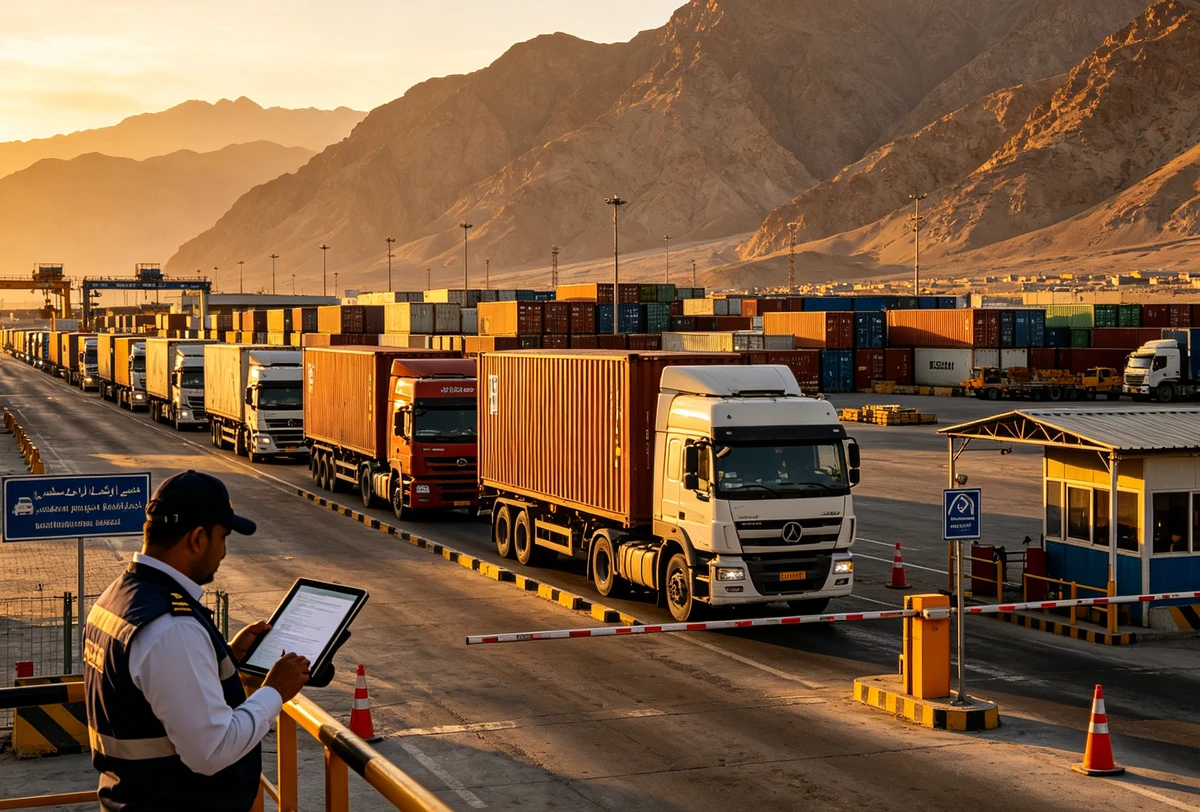
Afghanistan is landlocked — no seaport exists — so every commercial shipment clears customs at least twice: once in the transit country and once at the Afghan border. And cargo that’s legal in Afghanistan can still be blocked under Pakistani or Iranian transit rules. For the full routing picture — corridors, transit gateways, and freight costs — see our Freight Shipping from China to Afghanistan overview.
Four authorities shape everything:
| Authority | Role in Your Clearance |
|---|---|
| Afghanistan Customs Department (ACD) | Under the Ministry of Finance: assesses declarations, collects duties and VAT, runs inspections |
| ASYCUDA World | The electronic platform every formal declaration is filed through |
| ASQA (formerly ANSA) | Enforces product standards, labeling, and Halal compliance |
| MoCI | Issues the Jawaznama import license |
Cargo enters through five gateways: Torkham (Pakistan → Kabul/east), Chaman–Spin Boldak (Pakistan → Kandahar/south), Islam Qala (Iran → Herat/west), Hairatan (Uzbekistan → Mazar-i-Sharif/north), and Kabul International Airport (KBL) for air freight.

Jawaznama: The Afghanistan Import License, Explained
The Jawaznama is the commercial import license issued by the Ministry of Commerce and Industry (MoCI). Without a valid one covering your exact product category, formal commercial clearance is impossible.
All commercial importers need one; individuals and foreign companies generally can’t hold one directly — which matters if you’re a Chinese exporter selling to an Afghan buyer (see the DDP section). Personal effects below certain thresholds are exempt.
The application path: business registration → tax ID (TIN) → MoCI application → fee payment → issuance, typically 3–10 business days based on industry experience, valid one year and renewable. Common rejections: incomplete registration, consignee name mismatches, or product categories outside the approved scope. No Jawaznama? Your options are DDP through a licensed partner or an Afghan import agent — both covered below.
How to Clear Customs in Afghanistan: The Complete Step-by-Step Process
Total typical time: 5–15 days from border arrival on a smooth path.
- Pre-arrival document preparation (2–5 days before arrival). Your broker pre-reviews the document set, pre-classifies HS codes, estimates duties, and confirms Jawaznama validity. Fix discrepancies now — it’s cheapest before arrival.
- Arrival & ASYCUDA declaration (Day 1). Cargo arrives at Torkham, Islam Qala, Hairatan, or KBL; the broker files the import declaration in ASYCUDA World with the complete document set attached.
- Assessment & valuation (1–2 days). ACD checks declared value against its reference price database and assesses duty. Undervaluation is the fastest route to a physical inspection.
- Inspection (if selected, 1–5 days). Risk-based profiling routes cargo to green, yellow, or red channels — covered in the inspection section below.
- Duty & VAT payment (1 day). Pay in AFN or USD; ACD issues the release order. Speed matters — Torkham detention runs $80–$150 per day.
- Release & last-mile delivery (1–3 days). Present the release order, load out, truck to the final destination, and sign the POD.

Documents Required for Customs Clearance in Afghanistan from China
Documents are where clearances are won. The core set:
| Document | Key Requirements | Common Errors |
|---|---|---|
| Commercial Invoice | True value; buyer/seller names must match the Jawaznama | Undervaluation, currency mismatch |
| Packing List | Weights and contents must reconcile with the invoice | Weight discrepancies, vague descriptions |
| B/L or Air Waybill | Consignee must exactly match the Jawaznama holder | Consignee mismatch, missing original B/L |
| Certificate of Origin | Form A or China–Afghan format preferred | Missing, expired, wrong product description |
| Jawaznama | Valid and covering the exact product category | Expired license, wrong category |
| HS Code Declaration | Accurate 8-digit code; determines the duty rate | Misclassification |
| Insurance Certificate | Typically 110% of cargo value | Missing or insufficient coverage |
| Fumigation Certificate | Wooden packaging needs an IPPC stamp | Missing IPPC mark |
Category add-ons: food requires a Health Certificate, Halal Certificate, and phytosanitary certificate; pharmaceuticals need Ministry of Health pre-approval and GMP certification; chemicals need a bilingual MSDS and UN number pre-classification; lithium electronics need a UN38.3 test report (battery compliance is covered in our How to Ship Electronics and Gadgets from China guide); cosmetics need ASQA registration. Certified Dari/Pashto translations of invoices and product labels reduce border questioning.
Sinoshipment tip: We pre-screen every document against a 47-point checklist before cargo leaves China — cutting clients’ border clearance time by an average of 40% in 2025.
Afghanistan Customs Duty and Taxes on Chinese Goods
Duties are assessed on the CIF value (cost + insurance + freight) at the Afghan border point. Declare below ACD’s reference prices and you’ll face valuation challenges, back-duties, and near-certain inspection. Most consumer goods fall in a 2.5%–16% band, though Afghanistan has raised duties on select categories recently — steel rebar and plastic footwear now sit near 30%:
| Product Category | Indicative Duty |
|---|---|
| LED lights & solar panels | ~5% |
| Pharmaceutical raw materials | ~5% |
| General machinery | 5–10% |
| Food & beverages | 2.5–10% |
| Textiles & fabrics | ~8% |
| Motorcycles | ~15% |
| Plastic footwear | ~25–30% |
| Steel rebar | ~30% |
Treat these as directional — Afghan tariff rates have been adjusted upward on several categories in 2025–2026, so confirm the exact rate against your 8-digit HS code in the current Afghan tariff schedule before quoting landed costs.
VAT is a flat 10% on (CIF + duty). Worked example: $10,000 CIF at 5% duty →$500 duty; VAT = 10% × $10,500 = $1,050; total import taxes $1,550, before logistics.

The fees nobody quotes you: brokerage $150–$400 per clearance; border handling $50–$200; Torkham detention $80–$150/day; Pakistan transit charges (bonded carrier surcharge, APTTA documentation); and empty container return — Afghanistan hasn’t signed international container interchange agreements, so you pay the round trip.
For HS codes, check the WCO database and the Afghan tariff schedule. Classic mistakes include electronics-with-batteries coded as pure electronics, and machinery “parts” that classify as complete machines by function. Ambiguous products can get a binding ruling from ACD.
Prohibited and Restricted Goods: What You Can’t Import
Prohibited outright: narcotics and controlled substances; weapons, ammunition, and military equipment without special permits; pornographic and anti-Islamic materials; counterfeit currency and stamps; precursor chemicals for explosives or drugs; used tires and used medical equipment (select categories); gambling devices.
Restricted — permits required: pharmaceuticals (Ministry of Health approval), food (ASQA registration + Halal certificate), cosmetics and personal care (ASQA), medical devices, telecommunications equipment, precious metals and stones, and live animals, plants, and seeds.
The Pakistan transit trap: via Karachi, roughly 18 categories — including certain electronics, pharmaceuticals, chemicals, and textiles — cannot transit Pakistan to Afghanistan without a special Pakistani license. Your cargo can be perfectly legal in Afghanistan and still stopped at Karachi; our guide to Freight Shipping from China to Pakistan covers the transit leg’s documentation. If your product is on the list, look at Bandar Abbas — see Best Ports & Gateways for Iran Shipping — or Central Asia rail. Via Iran, run a sanctions screening first — certain goods, carriers, and payments touching Iran create problems far beyond customs.
Non-compliance means confiscation, fines, forced re-export at your cost, and importer blacklisting — which raises your inspection rate on every future shipment.
Customs Inspection in Afghanistan: Types, Triggers, and How to Respond
ACD routes shipments through three channels:
| Channel | What Happens | Share |
|---|---|---|
| Green | Document-only review | ~30% |
| Yellow | X-ray/scan, no opening | ~40% |
| Red | Partial or full physical exam | ~30% |
Red-channel inspections are triggered by: no customs history, high-risk categories (electronics, pharmaceuticals, chemicals, high-value goods), declared values below reference prices, HS mismatches or vague descriptions, random selection, inconsistent documents, or flagged supplier patterns.
To lower your inspection rate: keep documents consistent across shipments, build customs history through regular compliant imports, pre-classify HS codes, use specific descriptions (never “parts” or “accessories”), declare realistic values, and keep labels compliant in Dari/Pashto where ASQA requires.
If selected, make cargo accessible and well-labeled, attend with your broker, and expect 1–5 days plus surcharges, handling, and possible lab sampling. Disagree with an assessment? Your broker can file a formal objection with ACD.
Case study: A Dongguan machinery client’s 40HQ was flagged at Torkham because the packing list read “machine parts” instead of “CNC milling machine components, HS 8458.91.” Corrected documentation plus an expedited inspection cut the delay to 3 days versus the typical 7–10.
Air Freight vs. Sea Freight Customs Clearance: Key Differences
Air freight into Kabul (KBL) clears in 3–7 days door-to-door with no third-country transit customs: cargo flies direct or via a Middle East hub and clears at the airport on an Air Waybill. Trade-offs: stricter security screening, weight and size limits, air-restricted commodities (batteries, liquids, powders), and heavier scrutiny on high-value, low-weight cargo.
Sea freight plus land (Karachi, Bandar Abbas, Central Asia rail) involves two customs events — transit-country clearance plus the Afghan border — moving under APTTA (Pakistan), Iranian transit rules, or TIR Carnet (Central Asia). Longer dwell raises demurrage risk, but bulk economics win: $150–$350/CBM for LCL or $4,500–$9,000 per 40HQ DDP.
| Factor | Air (KBL) | Sea + Land |
|---|---|---|
| Door-to-door | 3–7 days | 18–40 days |
| Clearance events | One | Two |
| Cost | $4–$12/kg | $150–$350/CBM; $4,500–$9,000/40HQ |
| Best for | Urgent restock, samples, <500 kg | Bulk, machinery, FCL |
Choose air when missing a date costs more than the freight premium.
DDP vs. Self-Clearance: Choosing the Right Approach
DDP (Delivered Duty Paid): the forwarder handles everything — China export declaration, transport, transit customs, Afghan import clearance, duty and VAT payment, and last-mile delivery. Best for first-time importers, anyone without a Jawaznama, buyers wanting one predictable landed cost, and shipments under roughly $50,000. The 15–25% premium — based on our operational experience — usually beats the hidden costs it eliminates: underestimated brokerage, detention exposure, and coordination failures. Typical rates and routings are covered in our China to Afghanistan DDP Shipping guide.
Self-clearance (DAP/DDU): the forwarder delivers to the Afghan border or airport; you handle the declaration, duty payment, inspection coordination, and last-mile. It fits experienced importers with an established broker and valid Jawaznama — and builds the customs history that lowers inspection rates over time.
Hybrid / agent model: an Afghan licensed agent acts as importer of record, clears the goods, and transfers them to you under a local sale agreement — common for Chinese exporters without an Afghan presence. Get legal review of title transfer and tax treatment.
Commercial vs. personal effects: returning Afghans, foreign residents, NGOs, and diplomats may qualify for duty exemptions on used personal effects — typically requiring a passport, residence permit, detailed inventory, and proof of ownership. Commercial cargo always needs the full Jawaznama plus duties; hiding new goods in a personal shipment invites reclassification and penalties.
Four questions to decide: (1) Hold a valid Jawaznama covering this product? No → DDP or agent model. (2) Have a trusted, ASYCUDA-registered broker? No → DDP. (3) One-off shipment where predictability beats cost? Yes → DDP. (4) Recurring lane where you want to build customs history? Yes → self-clearance with broker support.
Seasonal Calendar and Risk Management
Winter (December–February): heavy snow closes the Torkham and Salang mountain passes; delays of 5–15 days are possible — or shift to the northern corridor via Uzbekistan, which barely notices winter weather (see China to Uzbekistan Road Freight).
Ramadan and Eid: staffing drops during Ramadan (dates shift every year), the pre-Ramadan import surge congests every border, and the post-Eid backlog routinely adds 1–2 weeks. Shipping Eid retail stock? Send 4–6 weeks before Ramadan.
Karachi monsoon (July–September): port congestion and monsoon road damage on the Torkham highway feed border backlogs — the season where cargo insurance (0.3–0.8% of declared value) earns its keep.
Holidays and politics: Nowruz (March 21), Independence Day (August 19), Eid al-Adha, and Ashura bring customs closures; Torkham has shut repeatedly amid Pakistan–Afghanistan tensions. Your forwarder’s local agents are the best early-warning system.

Mitigation checklist: buffer 10–15 days into sea + land commitments; pre-clear documents before cargo arrives; keep an emergency line to your broker; carry insurance at 0.3–0.8% of value; line up an alternative corridor; keep digital and physical copies of every document. If delay hits anyway: get a same-day status read from your broker, verify detention accrual and free time, escalate through your forwarder’s local network, file a formal ACD complaint if the delay looks unjustified, then reroute future shipments.
FAQ
How long does customs clearance take in Afghanistan for goods from China?
Typically 5–15 days from border arrival for sea + land; air freight clears at KBL in 1–3 days. Season, inspection selection, and document quality drive the variance.
Can I import from China to Afghanistan without an import license?
Yes — via a DDP service where the forwarder acts as importer of record, or an Afghan licensed import agent. Both add cost but remove the Jawaznama requirement.
What documents are absolutely required?
Commercial invoice, packing list, B/L or AWB, certificate of origin, Jawaznama (for commercial cargo), and an HS code declaration — plus category certificates for food, pharma, chemicals, and cosmetics.
What is the VAT rate for imported goods?
A flat 10% on (CIF + duty). Example: $10,000 CIF at 5% duty → $500 duty + $1,050 VAT = $1,550.
What is ASYCUDA World and do I need to use it?
Afghanistan’s electronic customs declaration system, run by ACD. Your broker files through it — you don’t need direct access, but confirm your broker is ASYCUDA-registered.
What happens if my shipment is selected for physical inspection?
Expect 1–5 extra days. Keep cargo accessible, labeled, and matching the documents; inspection fees apply. Let your broker manage the paperwork.
How much does Afghan customs clearance cost in total?
Duties (2.5%–30% by category) + 10% VAT + $150–$400 brokerage + $50–$200 border handling + potential detention at $80–$150/day.
Can I clear personal effects through Afghan customs?
Yes — returning Afghans and foreign residents may qualify for duty exemptions on used personal items, typically with passport, residence permit, inventory list, and ownership proof.
What’s the difference between DDP and DDU for Afghanistan imports?
DDP: the forwarder clears and pays all duties; goods arrive at your door. DDU: the forwarder delivers to the border; you clear and pay.
Why is my cargo stuck at Torkham?
Usually incomplete documentation, Jawaznama mismatches, inspection backlogs, or a temporary border closure. Contact your broker, escalate through your forwarder’s local network, and watch detention fees.
Do I need Halal certification for food products to Afghanistan?
Yes — mandatory. Use recognized certifiers (China Islamic Association, Shandong Islamic Association) to avoid extra documentation demands; ASQA enforces compliance.
What are the most common reasons for clearance delays?
Documentation errors (~40%), HS misclassification (~25%), undervaluation flags (~15%), seasonal congestion (~10%), and security or political disruptions (~10%) — nearly all preventable in China, before the cargo ships.
Conclusion
Afghanistan customs clearance for China imports is complex — landlocked geography, layered jurisdictions, a mandatory license, real seasonal risk — but manageable with preparation. The clearances that go smoothly all have one thing in common: the paperwork was right before the cargo left China. Get your documents consistent, your HS codes correct, your Jawaznama valid (or your DDP partner reliable), your declared values honest, and your calendar aligned with winter, Ramadan, and the monsoon. That’s where most delays are born — and where they get killed.
Ready to ship from China to Afghanistan? Sinoshipment’s licensed customs partners in Kabul, Herat, and Mazar-i-Sharif handle everything from document preparation to duty payment — the same 47-point checklist that cuts border clearance time by an average of 40%. Reach out for a free consultation and corridor-specific quote.
Written by the Sinoshipment Logistics freight team — Shenzhen-based since 2013, 5,000+ customers across 100+ countries, with a decade of hands-on China–Afghanistan clearance experience.