Freight Costs from China to Australia: The Complete 2026 Guide (FCL, LCL, Air & DDP)
· By SinoShipment
How much should you really budget for freight costs from China to Australia? Ask three forwarders and you may get three very different answers — $1,300, $1,500, or $2,160 for the same 20ft container. The gap isn’t a scam; it’s a question of quote scope, origin port, and season. But if you don’t know what to ask, that gap becomes an expensive surprise on your final invoice.
Australia also layers on costs that catch first-time importers off guard: destination terminal charges among the highest in the world, a 10% GST, and biosecurity rules (including seasonal BMSB treatment) that can hold your cargo at the border. This guide breaks down every cost element — sea, air, express, and door-to-door DDP — with 2026 pricing, two complete landed cost examples, and the questions to ask before you book.
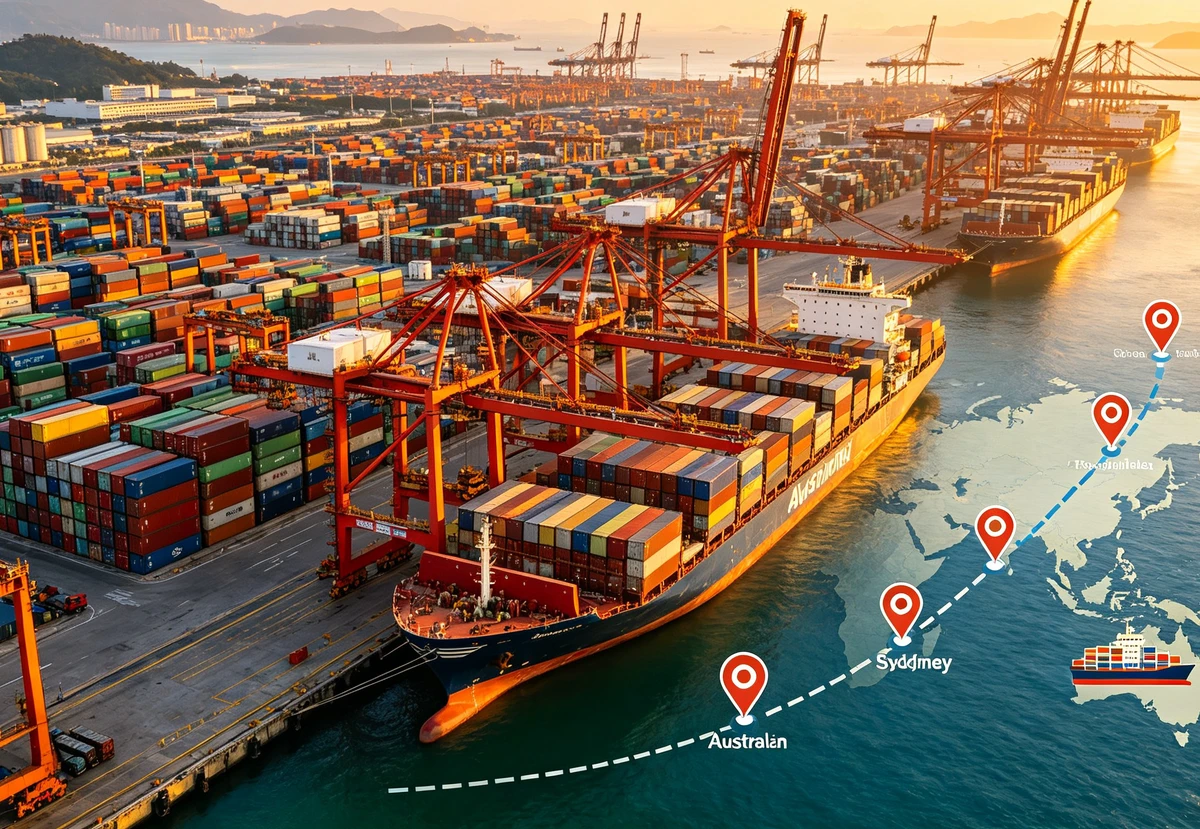
Freight Costs from China to Australia: 2026 Price Overview
Here are the current planning ranges across all five shipping modes, based on September 2026 market rates from major Chinese gateways (Shenzhen, Guangzhou, Shanghai, Ningbo) to Australia’s east-coast ports (Sydney, Melbourne, Brisbane). If you’re still deciding on your route, our dedicated guide to freight shipping from China to Australia covers ports, carriers, and booking strategy in more detail.
| Shipping Mode | Typical Cost Range (USD) | Door-to-Door Transit | Best For | Main Hidden Risk |
|---|---|---|---|---|
| FCL 20ft | $1,300 – 2,200 | 20–35 days | Cargo above 13–15 CBM | Destination terminal charges |
| FCL 40ft / 40HC | $2,300 – 3,800 | 20–35 days | Bulk orders, light bulky cargo | Peak-season space crunch |
| LCL (per CBM) | $35 – 150 | 25–40 days | 1–15 CBM trial orders | Destination fees can exceed AUD 100/CBM |
| Air Freight (per kg) | $3.7 – 8.00 | 3–7 days | High-value, urgent restocks | Volumetric weight pricing |
| Express (DHL/FedEx/UPS) | $6 – 14 | 2–5 days | Under 150 kg, samples | GST & duty billed separately |
Note: These are port-to-port market ranges. Actual quotes vary by origin port, carrier, and season, and are typically valid for only 2–3 weeks. South China origins (Shenzhen, Guangzhou) usually run $200–600 cheaper per container than northern ports (Shanghai, Qingdao), while Western Australia (Fremantle) adds $500–800 versus east-coast destinations.

What Determines Your Shipping Cost from China to Australia?
Six factors explain why quotes for the “same” shipment differ so much — and where you can actively save money.
Origin and Destination Ports
South China to east-coast Australia is the cheapest and fastest corridor, with frequent direct sailings from Shenzhen (Yantian) and Guangzhou (Nansha) to Sydney, Melbourne, and Brisbane. Northern ports carry a premium of several hundred dollars per container due to longer sailing distances and fewer weekly services.
Chargeable Weight vs. Actual Weight
Carriers price air freight by chargeable weight — whichever is greater between actual weight and volumetric weight (typically length × width × height ÷ 5,000 in cm). Ship cotton and you pay for space; ship stainless steel and you pay for weight.
Container Size Economics
A 20ft container holds roughly 28 CBM; a 40ft High Cube fits about 68 CBM. A 40ft typically costs only 1.6–1.8× a 20ft while carrying more than twice the volume — its cost per CBM lands 15–25% lower.
The FCL/LCL Crossover Point
On the China–Australia lane, the crossover sits at roughly 13–15 CBM. Beyond that, a full 20ft container is usually cheaper and faster than LCL, because Australian LCL destination charges are among the world’s highest.
Seasonality and Fuel Surcharges
Rates climb 20–40% before Chinese New Year (January–February) and during the Q3–Q4 peak season, when carriers apply a Peak Season Surcharge (PSS). The BAF (Bunker Adjustment Factor) adjusts monthly with fuel prices.
Incoterms: Who Pays for What
Under FOB, you control ocean freight and destination charges — you pick the forwarder. CIF looks convenient, but the seller’s cheap agent often inflates Australian port fees to recover their margin. DDP is the hands-off option: one all-in quote through to your door.
Sea Freight Costs from China to Australia: FCL & LCL Breakdown
Sea freight remains the backbone of China–Australia trade. Here’s how the costs actually stack up. For a deeper look at schedules, vessel options, and seasonal patterns, see our complete guide to shipping from China to Australia by sea.
20ft FCL Container: Itemized Cost Breakdown
| Cost Element | Typical Cost | Charged By |
|---|---|---|
| Ocean freight (port-to-port) | $800 – 1,400 | Shipping line |
| Origin charges (haulage, THC, export docs) | $150 – 300 | Chinese port / forwarder |
| Destination terminal handling (DTHC) | AUD 400 – 700 | Australian terminal |
| Customs brokerage | AUD 100 – 250 | Customs broker |
| Inland trucking to warehouse | AUD 350 – 900 | Local carrier |
| Cargo insurance (optional) | 0.3–0.5% of cargo value | Insurer |
If you’d rather hand the paperwork to a specialist, our customs clearance service handles both China export declarations and Australian import entries.
Not sure whether insurance is worth it for your shipment? Our cargo insurance guide explains coverage types, claim processes, and how to decide.
Total landed range: $1,300–2,200 per 20ft container to the east coast, excluding duty and GST.
The LCL “Cheap Rate” Trap
LCL ocean rates look irresistible — and that’s the trap. Sometimes as low as $10–35/CBM, but on this lane, the destination side is where costs multiply: Port Service Charges (AUD 120–150/CBM), deconsolidation fees (AUD 60–120/CBM), and per-shipment minimums. A $50/CBM quote can easily become $400/CBM once your goods land in Sydney or Melbourne.
Our Industry Insight: We routinely run FCL-versus-LCL comparisons for clients at 13–15 CBM, and the FCL option wins on total cost in the majority of cases — it also arrives 5–7 days faster because there’s no consolidation or deconsolidation wait.
Sea Freight Transit Times by Port Pair
| Origin (China) | Destination (Australia) | Port-to-Port Transit |
|---|---|---|
| Shenzhen (Yantian) | Brisbane | 12–18 days |
| Shanghai | Sydney | 14–20 days |
| Ningbo | Melbourne | 15–21 days |
| Guangzhou (Nansha) | Adelaide | 16–22 days |
| Qingdao | Fremantle | 18–25 days |
Air Freight and Express Shipping Costs from China to Australia
Air freight pricing follows a simple rule: the heavier your shipment, the lower your per-kg rate. For mode-by-mode rate analysis on this lane, read our dedicated overview of air freight from China to Australia.
| Weight Bracket | Rate Range (USD/kg) | Typical Use |
|---|---|---|
| +45 kg | $6.00 – 9.50 | Samples, small batches |
| +100 kg | $4.50 – 8.00 | E-commerce restocks |
| +500 kg | $3.80 – 6.00 | Mid-volume cargo |
| +1,000 kg | $3.70 – 5.00 | Bulk air freight (Sept 2026 low) |
For express shipping via DHL, FedEx, or UPS, expect $6–14/kg depending on weight bracket, with 2–5 day delivery. Remember: GST and import duty are billed separately before doorstep delivery.
Our Industry Insight: The cheapest shipping method isn’t always sea freight. For cargo under 150 kg, express or air can beat LCL on total cost once you factor in Australia’s fixed destination fees — and it arrives in days, not weeks. For goods valued above $15/kg or with margins above 40%, air freight often wins even at higher volumes once you count inventory holding costs and stockout risk.
One compliance note: battery-powered electronics require MSDS and UN38.3 certification for air transport. Missing paperwork means airport detention — costly in both time and money.
Import Duty, GST, and Incoterms: The Full Tax Picture
Australia’s Import Tax Trio
- Customs Duty: Standard rate is 5% of FOB value — but under the China-Australia Free Trade Agreement (ChAFTA), the vast majority of goods enter at 0% with a valid Certificate of Origin (Form F). Always request this document from your supplier; it’s free paperwork worth real money.
- GST (10%): Calculated on the Value of Taxable Import — customs value + freight + insurance + duty. Not just the product price. GST-registered businesses can generally claim it back as an input credit.
- Import Processing Charge (IPC): AUD 50–152 per shipment for electronic lodgement (up to $192 for documentary lodgements). Formal declaration is generally not required for goods under the AUD 1,000 low-value threshold.
Typical Duty Rates by Category
| Product Category | Duty Rate | Plus GST |
|---|---|---|
| Electronics | 0–5% | 10% |
| Clothing & apparel | 5–10% | 10% |
| Machinery | 0–5% | 10% |
| Furniture | 0–5% | 10% |
| Toys | 0% | 10% |
Which Incoterm Should You Choose?
- FOB (recommended): You control the freight and choose your own forwarder — no inflated destination fees.
- CIF (risky): The supplier’s cheap agent often bills you inflated Australian port charges to recover their margin.
- DDP (easiest): One all-in quote covering pickup, freight, clearance, duty, GST, and delivery. Ideal for Amazon FBA sellers and small businesses without a customs broker.
BMSB and Biosecurity Compliance Costs: What Most Guides Don’t Tell You
Australia runs some of the world’s strictest biosecurity controls, managed by the Department of Agriculture (DAFF). The one that hits China-Australia shippers hardest is the Brown Marmorated Stink Bug (BMSB) seasonal measure.
BMSB Seasonal Measures
From September through April, targeted goods shipped from China — including machinery, furniture, and metal components — must undergo approved treatment (fumigation or heat treatment) before departure or on arrival.
China risk status: For the 2025–26 season, China is classified as an “emerging risk country”, which means random inspections apply rather than 100% mandatory off-shore treatment. However, DAFF may upgrade China to full “target risk” status in future seasons, which would require mandatory off-shore treatment for all targeted goods.
What It Costs
| Compliance Item | Typical Cost | Consequence If Ignored |
|---|---|---|
| BMSB fumigation at origin (off-shore) | AUD 150 – 300 per container | DAFF holds cargo; on-shore treatment AUD 400 – 1,200+ plus demurrage |
| BMSB treatment required on arrival (on-shore) | AUD 400 – 1,200 per container | Demurrage, storage, and re-inspection fees can exceed AUD 1,000 total |
| ISPM 15 wooden packaging compliance | Usually included in packing | Seizure or re-export of untreated pallets |
| BICON permit / pre-departure documentation | AUD 0 – 100 administrative | Multi-day border delays |
Important distinction: Off-shore treatment (at origin) costs AUD 150–300, but if your cargo arrives without required treatment, on-shore treatment in Australia ranges AUD 400–1,200+ before counting demurrage and storage. Always confirm treatment requirements before departure.
Our Industry Insight: BMSB season overlaps almost exactly with the pre-Chinese-New-Year shipping rush. If you’re planning September–April shipments, build treatment time into your lead time and confirm your forwarder handles BMSB documentation as standard — not as an afterthought.
Real Landed Cost Examples: Two Full Calculations
Price ranges are useful; actual numbers are better. Here are two recent shipment profiles we’ve managed.
Example 1: B2B Furniture Importer — 20ft FCL, Shenzhen to Sydney (FOB)
A Melbourne-based furniture wholesaler recently shipped a 20ft container of flat-pack dining tables (25 CBM, 8.2 tonnes, declared value $18,500) from a Shenzhen factory to their Sydney warehouse.
| Cost Element | Amount |
|---|---|
| Ocean freight + origin charges | $1,300 |
| DTHC + customs brokerage | AUD 700 |
| Inland delivery | AUD 500 |
| Duty (ChAFTA Form F applied) | $0 |
| GST (10% of CIF + duty) | ~AUD 2,700 |
| Total landed cost | ~AUD 7,000 |
Example 2: Amazon FBA Seller — 500 kg Home Goods, Guangzhou to Melbourne (DDP Air)
Air DDP at $6.20/kg all-in: ~$3,100 total, door-to-door in 6 days — versus roughly $2,400 sea DDP with a 32-day lead time. For this seller’s restock cycle, the air premium of $700 was cheaper than a two-week stockout. For seller-specific routing, labeling, and inbound requirements, see our guide to Amazon FBA sea freight from China to Australia.
6 Proven Ways to Reduce Your Freight Costs from China to Australia
- Know your FCL/LCL crossover. Past 13–15 CBM, always price a full container before defaulting to LCL.
- Consolidate multiple suppliers. Merge orders from several factories into one FCL at a Shenzhen or Guangzhou warehouse services consolidation point — three LCL shipments become one, saving hundreds in repeated fixed fees.
- Use ChAFTA. A Form F Certificate of Origin turns 5% duty into 0% at zero cost.
- Book off-peak. March–June bookings usually save 20–30% versus the CNY and Q4 rushes.
- Optimize packaging. Reducing volumetric weight directly cuts air freight — even one carton matters.
- Demand an all-in quote. A DDP door-to-door price locks your total cost with no destination surprises.
FAQ
How much does it cost to ship a 20ft container from China to Australia in 2026?
Between $1,300 and $2,200 port-to-port including standard origin and destination charges, excluding duty and GST. South China origins and off-peak bookings sit at the lower end.
How long does shipping take from China to Australia?
Sea freight runs 12–22 days port-to-port (door-to-door 20–40 days depending on FCL or LCL). Air freight takes 3–7 days; express 2–5 days. For a port-by-port breakdown, see our detailed guide on how long shipping takes from China to Australia.
What is the cheapest way to ship from China to Australia?
It depends on volume. Over 15 CBM: FCL sea freight. Between 1–15 CBM: compare LCL’s total cost against FCL — Australia’s destination charges often flip the answer. Under 150 kg: air or express is frequently cheaper overall once fixed fees are counted.
Do I have to pay import duty on goods from China?
With a valid ChAFTA Certificate of Origin, most goods enter duty-free. GST at 10% applies regardless (and is claimable for GST-registered businesses).
What is BMSB treatment and what does it cost?
BMSB seasonal measures apply September–April to targeted goods from China. Off-shore fumigation costs roughly AUD 150–300 per container, while on-shore treatment in Australia can reach AUD 400–1,200+ — far more than the demurrage and re-inspection bill if un-treated cargo is held at the border.
Get Your Exact Freight Cost from China to Australia
Ranges get you started; your real cost depends on cargo volume, origin city, destination port, and timing. Sinoshipment has helped 5,000+ importers move cargo from China to Australia since 2013 — with transparent, all-in quotes and no hidden destination fees.
Share your shipment details and we’ll send a custom quote within one business day.