How to Ship Electric Vehicles from China to the UAE: The Complete 2026 Guide (Costs, RoRo vs Container & UN3556 Rules)
· By SinoShipment
Two importers buy the same BYD Atto 3 from the same Shenzhen factory in the same month. One lands it in Dubai for about $27,300. The other pays $29,250. Same corridor — Xiaomo to Jebel Ali, 20–25 days whichever mode you book — so the gap isn’t the voyage. Knowing how to ship electric vehicles (EVs) from China to the UAE means getting three decisions right before the cars leave the factory yard: the UN number on the dangerous goods declaration, the state of charge (SoC) at handover, and whether the car rides the deck of a RoRo carrier or sits inside a container.
Quick answer: Chinese EVs reach the UAE either as roll-on cargo on a car carrier or inside a container. RoRo is the cheapest per unit but wants volume; a single car is best in a 20HQ, and two to four cars share a 40HQ on racking. Allow 20–32 days on the water and four to eight weeks from factory floor to Dubai plates. At Jebel Ali you pay 5% duty on the CIF value, then 5% VAT on the duty-inclusive value. Since 1 January 2026 lithium-ion cars are declared as UN3556, not UN3171, and carriers cap the battery at roughly 30% charge. Get ECAS certification moving before you order the cars; it’s assessed per model and takes 15–90 working days.
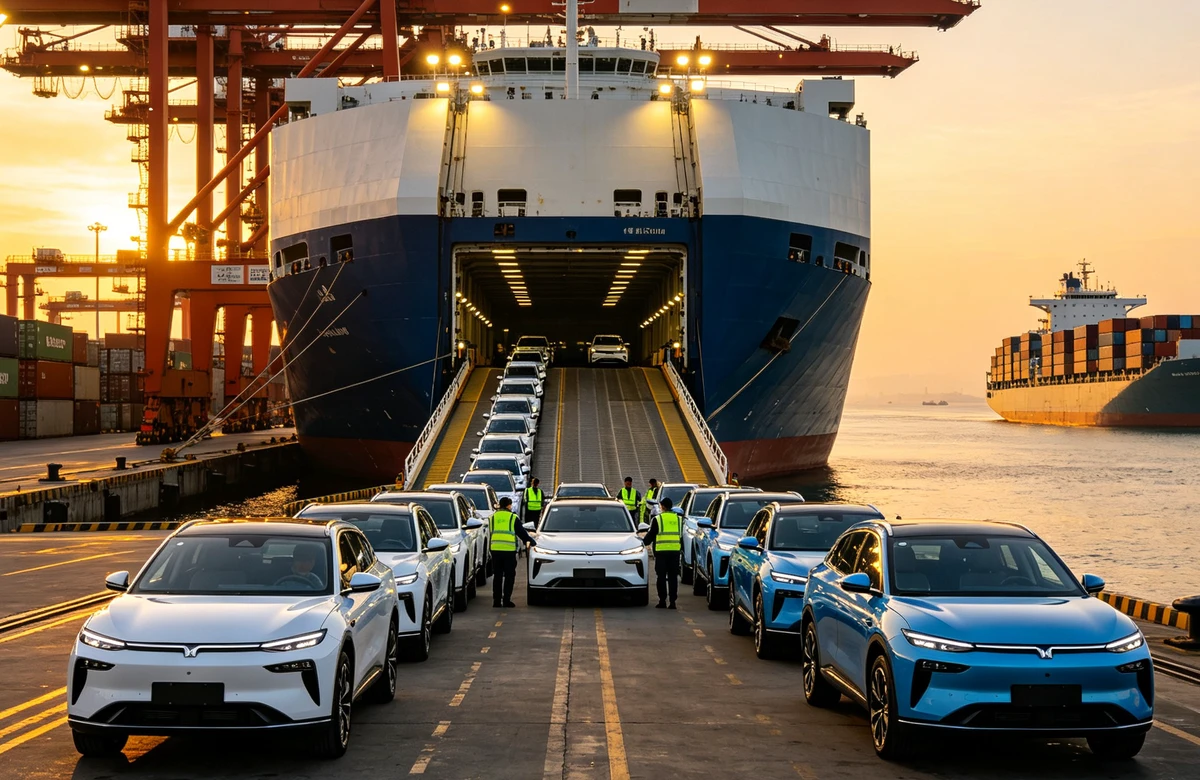
How to Ship an EV from China to the UAE: RoRo vs Container (2026 Methods)
Chinese EVs leave for the UAE on two routine channels: RoRo car carriers and containers. Both work. They’re priced, protected and scheduled so differently that the choice moves landed cost more than the car does.
The route has ten stages, and the first one is a paperwork decision. Confirm GCC hot-climate spec and settle who holds the ECAS certificate three to four months before the cars are booked. Then the origin side: factory collection on a DG-rated car carrier (1–3 days), PDI with SoC set to roughly 30% and filmed (1–2 days), export declaration and Class 9 DGD (1–2 days), the lithium filing to the carrier about seven days before sailing, and yard delivery for stuffing, lashing or RoRo handover (2–3 days). The sail itself runs 20–32 days. Then the UAE side: discharge and clearance through Mirsal II with duty and VAT paid (4–10 days), the ECAS/GCC conformity check (1–5 days), and finally inspection, registration (Mulkiya), plates and delivery (4–8 days). It’s the sequence we follow for shipping cars from China to Nigeria; on this lane every unit carries a live lithium pack.
Of the delayed EV shipments we’ve had to rescue, nearly all were already late at stage one: the certificate simply hadn’t been settled with a named UAE holder before the cars were ordered. Approval runs per model, so it can’t be fixed at the port.
| RoRo / PCTC | 20HQ container | Shared 40HQ + racking | |
|---|---|---|---|
| Best for | 20+ units | 1 unit | 2–4 units |
| Reference freight | $700–$1,300 per car | $1,700–$2,600 per box | $2,500–$3,800 per box ($1,250–$1,900 per car at two units, $625–$950 at four) |
| Damage exposure | Open decks: paint, glass, accessories | Lowest — enclosed | Lowest — enclosed |
| Battery monitoring | Ventilated decks allow thermal imaging | Sealed box; hard to inspect or fight a fire | Sealed box |
| Booking lead time | 15–20 days (3–6 weeks in the Q4 peak) | 7–14 days | 7–14 days |

Rule of thumb: one high-value car goes in a 20HQ; two to four share a 40HQ with racking; twenty or more, with a PCTC berth at the far end, go RoRo; flagship cars get split across both; buses and pickups ride on flat racks. A 20HQ takes one car. A 40HQ takes two on the floor, or three to four on a steel racking system once you’ve checked vehicle length and height. The loading economics of a standard box are set out in our guide to fcl shipping from china to UAE. Strap the chassis, never the battery tray, and use nylon straps rather than chains. Lock the charge-port flap, pack the cables separately, select P with the parking brake on, then either disconnect the 12V or enable Transport Mode. New cars need a CCC or conformity certificate plus OEM authorization, or a parallel-import route. Used cars need VIN verification, mileage records and an SoH report; the age ceiling is set emirate by emirate, and in practice most of them work to ten years. Check that number with your broker before you buy, because the emirates do revise it.
2026 EV Battery and Dangerous Goods Rules: UN3556, IMDG 42-24 and SoC Limits
This is what changed on 1 January 2026. Under IMDG Code Amendment 42-24, lithium-ion vehicles are no longer declared as UN3171, and an obsolete number stops the booking at the terminal. The number applies whichever way the car travels. What changes with the mode is how much of the Code bites: a unit stuffed in a container moves as a fully declared UN3556 consignment, while one riding on a flag-approved RoRo vehicle deck falls under Special Provision 961, which lifts most of the Code off it.
| UN number | Applies to | From 1 Jan 2026 |
|---|---|---|
| UN3556 | Lithium-ion battery powered vehicles | Standard number for EV cars |
| UN3557 | Lithium-metal battery powered vehicles | New |
| UN3558 | Sodium-ion battery powered vehicles | New |
| UN3171 | Wet-cell, sodium-metal and sodium-alloy vehicles only | No longer valid for lithium-ion cars |
| UN3480 / UN3481 | Standalone lithium-ion batteries / batteries in or packed with equipment | Spare packs, chargers, parts |

Air is a different rulebook. IATA’s DGR 67th Edition took effect the same day, and vehicles that fly are offered under Packing Instruction 952 with the applicable A-series Special Provisions. At sea, 42-24 added packing guideline P912 and re-scoped Special Provisions 961 and 962. On state of charge, ocean carriers publish a ceiling rather than a band: most sit somewhere between 30% and 50%, several have already tightened to 30%, and air cargo above 100 Wh is capped at 30%. We set around 30% so every standard is met. Spare packs and charging equipment that must fly follow the rules in Air Freight from China to UAE. Exceed a ceiling and the sequence is predictable: refused loading, a customs rollback, a recalculated DG surcharge and — most expensively — a claim your insurer can decline.
The Dangerous Goods Declaration needs the correct proper shipping name, UN number, Class 9, packing group, package count, gross weight, the SoC declaration, a Battery Integrity Statement and the UN38.3 Test Summary reference. The bill of lading must repeat the DGD word for word. Mismatches are one of the most common reasons declarations bounce back at Jebel Ali, and lithium declarations go in about seven days before sailing. On the China side expect to produce: UN38.3 Test Summary, current MSDS/SDS, the cargo transport conditions appraisal report, CCC where applicable, GB 38031-2020 evidence, an SoH report, invoice, packing list, export declaration and certificate of origin.
The Felicity Ace (2022) and Fremantle Highway (2023) car-carrier fires reset how the industry treats lithium cargo. DG surcharges, sealed-deck restrictions and falling SoC ceilings all follow from those losses, and they’re why your policy has to name thermal runaway explicitly.
How Much Does It Cost to Ship an Electric Car from China to the UAE?
Rates below are our September 2026 working numbers on the freight shipping from china to uae lane, not a tariff any carrier is bound by. In practice: RoRo runs $700–$1,200 per car from Nansha or Xiaomo, $900–$1,300 from Shanghai, $800–$1,250 from Tianjin; a 20HQ runs $1,700–$2,600 and a 40HQ $2,500–$3,800. If a quote sits far outside those bands, ask why before you accept it.
Landed Cost per Car: Three Real Models
Same vehicle throughout — a BYD Atto 3-class SUV at $22,000 FOB, delivered in Dubai.
| Cost item | A · Single 20HQ | B · 2 cars, 40HQ | C · 20+ cars, RoRo |
|---|---|---|---|
| Vehicle FOB | $22,000 | $22,000 | $22,000 |
| Inland car carrier | $300 | $300 | $200 |
| PDI + SoC adjustment | $120 | $120 | $100 |
| Export declaration + documents | $150 | $150 | $120 |
| Origin THC / terminal | $350 | $350 | $250 |
| Ocean freight | $2,100 | $1,400 | $950 |
| Class 9 DG surcharge | $200 | $150 | $150 |
| Lashing / racking share | $150 | $250 | — |
| Marine insurance (110% CIF) | $160 | $140 | $130 |
| CIF subtotal | $25,530 | $24,860 | $23,900 |
| Duty 5% (CIF) | $1,277 | $1,243 | $1,195 |
| VAT 5% (CIF + duty) | $1,340 | $1,305 | $1,255 |
| Destination: clearance, GCC CoC, last mile, plates | $1,100 | $1,180 | $950 |
| Landed cost per car | ~$29,250 | ~$28,600 | ~$27,300 |

Look at where the money actually goes. A lone 20HQ is the dearest way to land a single car. Sharing the 40HQ saves roughly $600 a car, and that arithmetic decides most small-volume bookings on this lane. RoRo only pulls ahead from twenty units up, and only once the destination has a PCTC berth.
To cut the bill, use the port nearest the factory and share a 40HQ for two to four cars. Book RoRo 15–20 days out, or containers 7–14 days, and steer clear of the weeks before Chinese New Year, Ramadan and the post-auto-show Q4 rush. Get the SoC right the first time; re-declaring costs more than holding a charge. B2B volume can stage in JAFZA or KIZAD bonded storage and re-export into Saudi Arabia without paying tax twice. Figures are USD references valid 7–14 days (1 USD ≈ 3.6725 AED) and exclude demurrage, detention, inspection, storage and certification fees.
How Long Does EV Shipping from China to the UAE Take?

Ocean transit runs 20–32 days; door to door is four to eight weeks. Don’t let a forwarder blend the two. That’s how importers end up scheduling a delivery around a voyage that was never the long part. Xiaomo to Jebel Ali takes 20–25 days either way. Shanghai to Jebel Ali runs 18–25 days direct, 28–32 once the string tranships, and 22–28 in a container. Tianjin is 22–28, and the direct Xiaomo–Khor Fakkan RoRo service 18–23. Then add 5–10 days inside China and another 9–23 on the UAE side, counting discharge, clearance, conformity checks, registration and last-mile delivery. That’s where the four-to-eight-week figure comes from, and it assumes clean paperwork at one end and an open registration slot at the other. Sailing patterns per corridor are in Major Ocean Freight Shipping Routes from China to Middle East.
Space moves faster than people expect: RoRo needs the 15–20 days above, three to six weeks through the September–November peak, containers 7–14, and the DG filing about seven days before sailing. As for what goes wrong, the two that cost money most often are a DGD that disagrees with the bill of lading, and an SoC above the carrier’s ceiling. After those come missing or expired UN38.3 and MSDS, no ECAS holder in place, customs valuation queries after under-invoicing, and peak-season rollovers.
China Origin Ports and UAE Destination Ports
Choosing the port closest to the factory removes inland mileage, typically \(100–\)200 per car and two to five days.
| Brand | Manufacturing base | Best origin port |
|---|---|---|
| BYD | Shenzhen Shenshan, Xi’an, Changsha | Shenzhen Xiaomo / Guangzhou Nansha |
| Geely, Zeekr | Ningbo Hangzhou Bay, Taizhou | Ningbo-Zhoushan |
| SAIC, NIO, Tesla China | Shanghai, Hefei | Shanghai Haitong RoRo terminal |
| Xiaomi, BAIC | Beijing | Tianjin |
| Chery | Wuhu | Shanghai / Ningbo |
| Port | Role | Best for |
|---|---|---|
| Jebel Ali (Dubai) | The UAE’s dominant vehicle gateway, carrying the clear majority of rolled-on imports, with JAFZA and Ducamz on the doorstep | Default choice for Dubai and the northern emirates |
| Khalifa Port (Abu Dhabi) | Abu Dhabi gateway with a dedicated automotive terminal; KIZAD adjacent | Abu Dhabi market, fleet and government buyers |
| Khor Fakkan (Sharjah) | On the Gulf of Oman, outside the Strait of Hormuz | Bulk RoRo and transit cargo; a single vessel discharged 6,068 BYD EVs there in August 2026, and direct Xiaomo sailings save 3–5 days |
When routing risk starts showing up in your quotes, we’ve set out the mechanics in our analysis of the 2026 Strait of Hormuz Crisis.
UAE Customs Clearance and Registration: From Jebel Ali to Mulkiya
Declarations go through Mirsal II / Dubai Trade, filed by our customs clearance team rather than left to a third party. Your importer needs a UAE trade license and an importer code. Without a local entity, ship DDP or appoint a licensed import agent instead. Complete paperwork clears in 3–7 days, and discharge adds 1–3.
| Item | Rate | Base |
|---|---|---|
| Import duty (GCC common external tariff) | 5% | CIF |
| VAT | 5% | CIF + duty (terminal and clearance fees billed after release are outside the import base) |
On a $23,900 CIF that’s roughly $2,450 in tax. Budget from CIF; a number built off FOB will always come up short. A 5% duty is the working assumption: the rate follows the GCC tariff line rather than the drivetrain, and free-zone or duty-suspension treatment differs by zone, so confirm the live classification with your broker before you invoice. For regional distribution, VAT is 15% in Saudi Arabia; our China to Saudi Arabia LCL Container Shipping guide covers the onward structure. There’s no VAT in Qatar.
UAE.S 2698:2024 (Cabinet Resolution No. 50 of 2024, effective 31 May 2025) is the mandatory technical regulation for EVs, alongside GSO 42⁄2015 and MoIAT’s Euro 6b timeline. The ECAS certificate has to be applied for and held by a UAE-registered entity: normally the importer, its agent or an authorized representative. It’s issued per model. MoIAT assesses in working days and its published service fee runs to a few hundred dirhams; the lab work is what moves the budget. Once fresh Gulf testing is in scope, plan on AED 15,000–40,000 per model all-in and 15–90 working days. Spread over a hundred cars, that’s workable. On a first shipment of five, it isn’t. MoIAT took over ESMA’s functions when the ministry was created in mid-2020. After release it’s RTA VCC, then inspection, compulsory insurance, Mulkiya, plates and Salik. All of that assumes a left-hand-drive, GCC-spec, ECAS-valid car in the Type 2 / CCS2 charging configuration used across the Emirates.
A Dubai parallel importer ordered three units. We collected at Nansha, loaded one 40HQ on racking, set SoC to 30%, filed the UN3556 declaration, cleared at Jebel Ali and supported RTA registration: five weeks door to door. The shipment before that one sat three extra weeks, for one reason — nobody had confirmed who would hold the ECAS certificate before the cars were ordered.
For parallel imports, be honest about the warranty gap. A grey-market car carries no local dealer obligation here, and buyers discount for it at resale. Sinoshipment books both routes. What we won’t do is quote a parallel-import file without asking who signs for the conformity certificate, because that is the part that strands a car in the yard.
Cargo Insurance, Battery Safety and the Costliest Mistakes
Arrange cargo insurance for 110% of CIF, since the extra 10% covers expected margin and duty. Premiums run roughly 0.4–0.7% of that value. Insuring an EV isn’t the same as insuring a pallet. Get written confirmation that the policy covers battery thermal runaway. Flooded packs need a stated disposal and loss-adjustment clause, because “dry it out” isn’t a settlement position. Claims get refused where the SoC exceeded the carrier’s limit, UN38.3 was missing, or the bill of lading disagreed with the DGD. Under-invoicing voids cover as well as inviting a customs audit.
What we do before a car leaves: PDI, SoC down to roughly 30% on record, charge-port flap locked, cables packed separately, 12V disconnected or Transport Mode on, straps on the chassis only, then 360° video, VIN photos, paint-thickness readings and SoH screenshots archived. Inspect before you sign the EIR. Our practice is to notify the carrier within 3 days and the insurer within 7, but read your own policy’s notice clause first; many run to 14 days and some to 3.
Ten Mistakes That Cost Importers Real Money
- SoC above the carrier’s ceiling → refused loading, a re-declaration, and a missed sailing
- Missing or expired UN38.3 / MSDS → no DGD, no booking
- Declaring UN3171 in 2026 instead of UN3556
- DGD and B/L wording that disagree → cargo held at Jebel Ali
- Straps on the battery tray → high-voltage housing damage
- No ECAS holder confirmed → a car that cannot be registered, which is the one failure nobody fixes at the port
- Non-GCC spec → battery thermal management and A/C failures in Gulf heat
- Charge port unlocked or a flat 12V → the car won’t start when it lands
- One car in a dedicated 40HQ → up to $1,200 wasted on freight alone
- Under-invoiced value → audit, penalties and a void policy
Items 1, 4 and 10 are self-inflicted. None of them costs anything to avoid.
How to Choose a China-to-UAE EV Freight Forwarder
Ask for a quote that itemizes the DG surcharge, racking, origin and destination THC, clearance, certification share, last mile and registration, with currency, validity and exclusions stated. A quote without a Class 9 line item isn’t a quote for an EV. Beyond that, here’s what we’d check before signing. Can the forwarder file Class 9 directly and supply DG-rated inland trucking? Plenty can’t move a car with a live pack. Then look for direct PCTC space in peak season, collection coverage at Xiaomo, Nansha and Shanghai Haitong, a UAE clearance partner who can actually name the ECAS holder route, documented pre-shipment inspection, and a no-hidden-fees commitment in writing.
| Volume | Recommended setup |
|---|---|
| 1 car | 20HQ, or RoRo if space allows |
| 2–4 cars | Shared 40HQ + racking — best unit economics |
| 20–50 cars | RoRo block space, booked 15–20 days ahead |
| 100+ cars | Multiple RoRo sailings; containers for flagship units |
Sinoshipment has moved China-to-Gulf freight since 2013 and works with more than 5,000 clients. On this lane we file the Class 9 declaration ourselves, run DG-rated inland transport, handle Middle East clearance and hold volume in JAFZA bonded storage, plus the usual sea freight, air freight, DDP door-to-door, warehousing and cargo insurance cover. The same setup runs into Europe, Africa and Southeast Asia: at origin the DG filing is identical, and it’s the destination paperwork that changes.
FAQ
How much does it cost to ship an electric car from China to the UAE?
Depends on how many cars you’re moving. A single car in a 20HQ lands near $29,250. Share a 40HQ with one other car and it’s around $28,600 each. Ship twenty by RoRo and the same spec lands near $27,300. Those figures include 5% duty on CIF and 5% VAT on the duty-inclusive value, at September 2026 ocean rates.
How long does EV shipping from China to Dubai take?
Ocean transit is 20–32 days depending on origin and mode. Door to door runs four to eight weeks once you add collection, clearance, conformity checks, registration and delivery.
What UN number and state of charge apply in 2026?
UN3556 for lithium-ion vehicles, under IMDG Amendment 42-24, in force since 1 January 2026. UN3171 now covers only wet-cell, sodium-metal and sodium-alloy vehicles, so using it for a lithium car stops the booking. On state of charge there’s no single global number — read your carrier’s published cap. Most ocean carriers sit between 30% and 50%, several at 30%, and air above 100 Wh is capped at 30%, which is why we set around 30%.
Does cargo insurance cover EV battery fires in transit?
Only if the policy names thermal runaway explicitly. Standard cargo clauses leave room for dispute, so get written confirmation before the vehicle loads.
The Bottom Line
Two channels in and out of China. 5% duty on CIF, then 5% VAT on top. Jebel Ali as the default gateway, Khor Fakkan as the strategic alternative. UN3556 from January 2026. Everything else in this guide is detail. What decides the outcome is narrower than most importers expect: dangerous goods compliance, who holds the ECAS certificate, and whether the battery sat under the carrier’s cap when you handed the car over. Miss one and the car comes back, goes uninsured, or arrives unregisterable. Start certification before you order the cars.
Want a number for your own case? Send the model, unit count, factory location and target sailing date, and we’ll come back inside 24 hours with the DG surcharge broken out and a real landed cost rather than a freight rate.