Sea Freight from China to Jordan: The Complete 2026 Guide (Costs, Transit Times & Customs)
· By SinoShipment
Jordan imports more than 90% of its consumer and industrial goods by sea, and virtually all of it flows through a single maritime checkpoint — Aqaba Port. If you are sourcing from China and need to move cargo to Jordan, understanding sea freight from China to Jordan is not optional. It is the difference between a predictable supply chain and one riddled with costly delays, surprise storage fees, and customs holds.
In this guide, we break down every layer of the China-to-Jordan sea freight corridor — FCL and LCL shipping costs, port-to-port transit times, Jordan-specific customs clearance procedures (ASYCUDA, ASEZA, JSMO), the complete import documentation checklist, inland trucking logistics from Aqaba to Amman, and a real shipment case study. Everything here is grounded in 10+ years of hands-on experience managing Middle East trade lanes from our operations base in Shenzhen, China. For a broader overview of our ocean freight capabilities across all global trade lanes, visit our sea freight services page.
Understanding the Aqaba Port Gateway
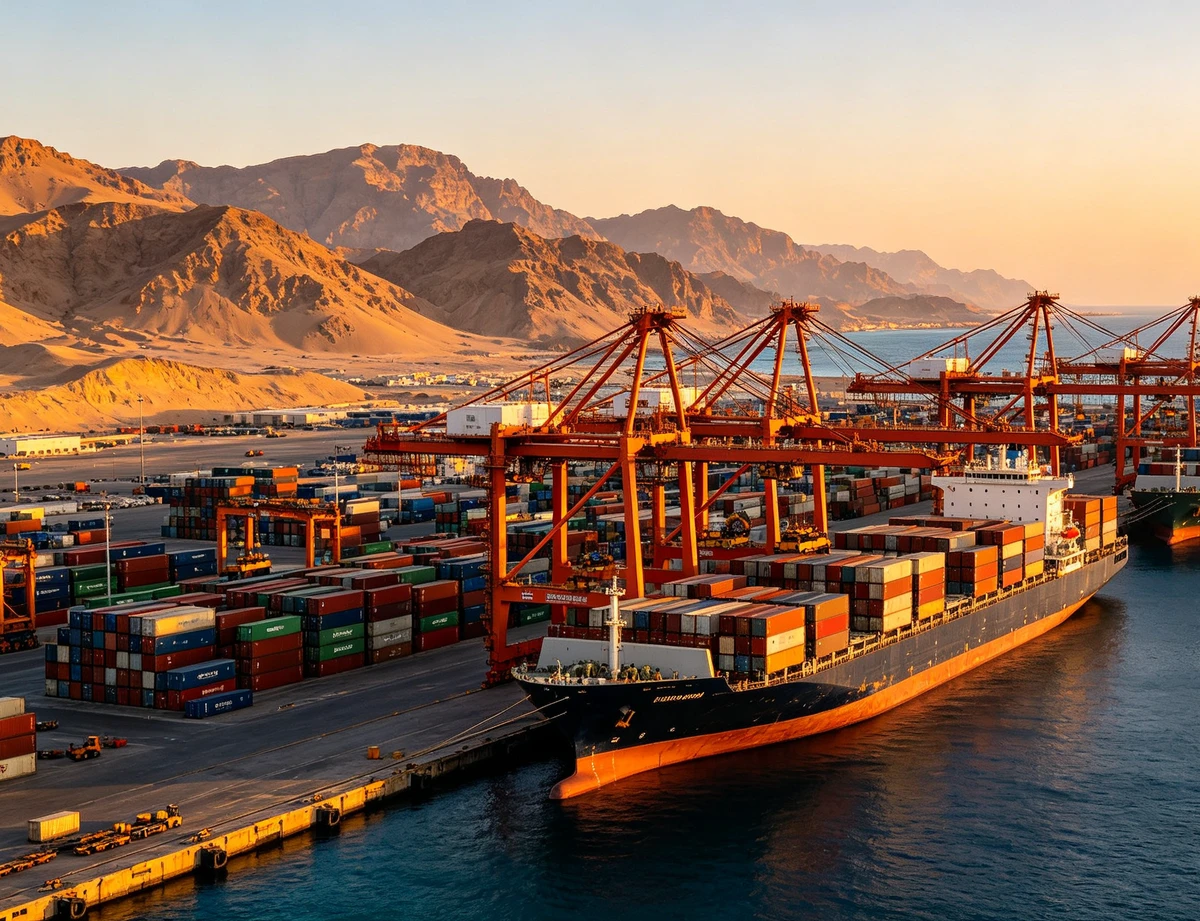
Unlike countries with multiple commercial seaports, Jordan relies on a single maritime entry point: the Port of Aqaba (port code: JOAQJ). Located at the northern tip of the Gulf of Aqaba on the Red Sea, this deep-water port handles containerized cargo, bulk commodities, liquid shipments, and RoRo (Roll-on/Roll-off) vehicle traffic across more than 23 specialized berths.
For importers, Aqaba’s most important feature is that it operates as a Special Economic Zone under the ASEZA (Aqaba Special Economic Zone Authority) framework. Goods imported into and consumed within the ASEZA zone benefit from a flat 5% duty rate — significantly lower than the standard national customs tariff, which can reach up to 30% depending on the product’s HS code classification. This is a major cost lever that many first-time importers overlook.
Industry Insight: We regularly advise clients to evaluate whether their business qualifies for ASEZA registration before finalizing their import strategy. If your warehouse or distribution center is located within the Aqaba zone, the 5% flat rate can reduce your total landed cost by thousands of dollars per container compared to clearing through standard national customs. The registration process itself is straightforward, but it must be completed before your first shipment arrives — retroactive applications are not accepted.
Aqaba’s Container Freight Station (CFS) handles LCL deconsolidation and short-term warehousing. For FCL shipments, containers can be trucked directly from the terminal to inland destinations or stripped at the CFS for distribution. The port is served by all major global shipping alliances, including vessels from COSCO, Maersk, CMA CGM, and MSC, with regular sailings connecting to Asian and European hub ports.
Major Shipping Routes and Transit Times from China to Aqaba
Sea freight from China to Jordan follows a well-established maritime corridor: South China Sea → Malacca Strait → Indian Ocean → Red Sea → Gulf of Aqaba. Because there are limited direct sailings to Aqaba, most shipments transship at major regional hubs — primarily Singapore, Jebel Ali (Dubai), or Port Said (Egypt) — before the final leg to Jordan. For importers routing through the Suez Canal corridor, our Container Shipping from China to Egypt guide covers port-to-port logistics via this same strategic waterway.
Your choice of Chinese departure port has a measurable impact on both transit time and cost. Here is the current reference table for FCL and LCL transit times from major Chinese ports to Aqaba:
| Origin Port (China) | Destination | FCL Transit Time | LCL Transit Time |
|---|---|---|---|
| Shenzhen (Yantian / Shekou) | Aqaba | 21–28 days | 24–31 days |
| Guangzhou (Nansha) | Aqaba | 22–29 days | 25–32 days |
| Shanghai | Aqaba | 25–32 days | 28–35 days |
| Ningbo | Aqaba | 23–29 days | 26–33 days |
| Qingdao | Aqaba | 28–35 days | 30–38 days |
Southern Chinese ports — Shenzhen and Guangzhou — offer the fastest transit to Aqaba, typically 21 to 29 days for FCL. Northern ports like Qingdao add roughly a week due to the longer domestic coastal transit before reaching the main trunk route. LCL shipments consistently take 3 to 7 days longer than FCL because of consolidation at the origin CFS and deconsolidation at Aqaba. For a regional transit time comparison, see our guide on How Long Does Shipping Take from China to Saudi Arabia.
Red Sea Route Realities
Any honest discussion of this shipping corridor in 2026 must acknowledge that Red Sea routing conditions have been volatile. Some carriers have adjusted schedules or applied risk surcharges, while others have rerouted via the Cape of Good Hope, adding 10 to 14 days to transit. Working with a freight forwarder that maintains active relationships with multiple carriers gives you access to the fastest available routing at any given time, rather than being locked into a single carrier’s disrupted schedule.
Industry Insight: During periods of Red Sea disruption, shipments routed via Jebel Ali (Dubai) as a transshipment hub have proven noticeably more resilient than those relying on Mediterranean-based hubs. Jebel Ali’s geographic position on the Arabian Gulf side means vessels can access it without entering the Red Sea’s most affected waters, then feeder services connect to Aqaba. This is the kind of routing intelligence that only comes from managing this corridor week after week — and it is why we always maintain at least two viable routing options for every client shipment. For businesses also shipping to the Gulf, our Air Freight from China to UAE service leverages Jebel Ali’s world-class cargo infrastructure for rapid regional distribution.
FCL vs. LCL Shipping: Choosing the Right Method
The decision between Full Container Load (FCL) and Less than Container Load (LCL) shapes your cost structure, transit time, and cargo handling risk. Here is how to decide.
FCL (Full Container Load)
With FCL, you rent an entire container exclusively for your cargo. This is the preferred option when your shipment volume exceeds approximately 15 cubic meters (CBM) or when your goods are fragile, high-value, or sensitive to contamination.
| Container Type | Internal Dimensions (L × W × H) | Approximate Capacity | Typical Payload |
|---|---|---|---|
| 20ft General Purpose (20GP) | 5.90 × 2.35 × 2.39 m | ~33 CBM | 28,000 kg |
| 40ft General Purpose (40GP) | 12.03 × 2.35 × 2.39 m | ~67 CBM | 28,500 kg |
| 40ft High Cube (40HQ) | 12.03 × 2.35 × 2.69 m | ~76 CBM | 28,500 kg |
FCL advantages include a lower cost per unit for high-volume shipments, faster handling at both origin and destination ports, and significantly reduced risk of cargo damage since the container remains sealed from the Chinese factory until it reaches your warehouse in Jordan. This is especially important for furniture, electronics, and machinery — all major import categories for the Jordanian market. For regional comparison, our fcl shipping from china to Iraq guide covers similar container specifications and transit considerations for the neighboring Iraqi market.
For oversized machinery or construction equipment, special container types are available: open-top containers (for tall cargo loaded from above), flat-rack containers (for heavy or irregularly shaped equipment), and reefer containers (for temperature-controlled goods).
LCL (Less than Container Load)
LCL is the economical choice for shipments between 1 and 15 CBM. Your cargo shares container space with other importers’ goods, and you pay only for the volume you occupy — typically charged on a weight or measure (W/M) basis, meaning the higher of actual weight (in tons) or volumetric weight (in CBM) is used for billing.
The trade-off is that LCL involves more cargo handling. Your goods are consolidated at the origin warehouse in China, deconsolidated at the Aqaba CFS, and handled at each transshipment point — increasing the risk of damage and adding 3 to 7 days to total transit time. LCL is ideal for trial orders, small business shipments, spare parts, and e-commerce cargo where filling a full container is not practical.
Industry Insight: Here is a practical rule of thumb we use with clients: at around 12 to 13 CBM, the total cost of LCL starts approaching the cost of booking a 20ft FCL container on the China-to-Jordan route. Once you cross roughly 15 CBM, FCL is almost always cheaper per unit, and you get the added benefit of a sealed, undisturbed container. If you are consistently shipping 8 to 12 CBM per order and your supplier is in Southern China, talk to us about consolidating two orders into one 20ft container — the math works in your favor more often than you would expect.
Sea Freight Costs from China to Jordan (2026 Rates)
Sea freight rates are dynamic — they shift with fuel prices, seasonal demand, and global container availability. The table below represents current market reference ranges for FCL container shipping from major Chinese ports to Aqaba as of mid-2026:
| Origin Port (China) | 20GP (USD) | 40GP / 40HQ (USD) |
|---|---|---|
| Shenzhen (Yantian / Shekou) | $1,050 – $2,400 | $1,650 – $3,200 |
| Guangzhou (Nansha) | $1,000 – $2,500 | $1,700 – $3,300 |
| Shanghai | $1,200 – $2,600 | $1,600 – $3,550 |
| Ningbo | $1,100 – $2,800 | $1,550 – $3,850 |
| Qingdao | $1,250 – $3,000 | $1,600 – $3,650 |
LCL rates typically range from $50 to $190 per CBM, depending on the origin port, consolidation schedule, and cargo characteristics. Air freight, for comparison, runs $4.00 to $8.00 per kilogram to Queen Alia International Airport (AMM) in Amman. For regional cost benchmarks, see our analyses of Air Freight from China to Saudi Arabia rates and comprehensive Freight Costs from China to UAE.
These are base ocean freight figures only. Your total landed cost includes several additional components. Here is a representative breakdown for a 20ft FCL shipment from Shenzhen to Amman:
| Cost Component | Description | Estimated Range (USD) |
|---|---|---|
| Ocean Freight (base) | Shenzhen → Aqaba, 20GP | $1,050 – $2,400 |
| Origin Charges | THC, documentation, export customs declaration at Chinese port | $150 – $300 |
| Destination Terminal Charges | Port handling and documentation at Aqaba | $200 – $450 |
| Customs Clearance | Brokerage and ASYCUDA filing in Jordan | $100 – $250 |
| Import Duty | 0–30% of CIF value (product-dependent) | Variable |
| GST (General Sales Tax) | 16% of (CIF value + duty) | Variable |
| Inland Trucking | Aqaba → Amman (approx. 330 km) | $400 – $700 |
Cost-Saving Strategies for Jordan-Bound Shipments
Book 3 to 4 weeks ahead of your target departure date. Spot market rates during peak demand periods — particularly the weeks before Chinese New Year (January/February), China’s Golden Week (October), and the pre-Ramadan import rush — can spike by 20% to 40%.
Optimize your container choice. A 40ft container carries roughly double the volume of a 20ft but costs only about 50% to 60% more in ocean freight. If you are shipping more than 30 CBM, a single 40ft or 40HQ is almost always more economical than two 20ft containers.
Consolidate at origin. If you source from multiple suppliers in China, consolidating all cargo at one warehouse before container loading eliminates multiple LCL shipments and unlocks FCL rates. This is one of the most overlooked cost levers for growing importers.
Jordan Customs Clearance and Import Documentation
Jordan Customs processes all import declarations through the ASYCUDA World digital platform — an automated system developed by UNCTAD that assigns each shipment a risk assessment channel: Green (immediate release), Yellow (document review), or Red (physical inspection). With complete and accurate documentation, clearance typically takes 2 to 4 business days. Missing or mismatched paperwork can extend this to a week or more, with compounding storage and demurrage fees at the port. For importers navigating Middle Eastern customs for the first time, our customs clearance service handles the entire process — from document preparation to ASYCUDA filing — on both the Chinese export and Jordanian import sides.
Import Duties and Taxes
Customs duty rates in Jordan range from 0% to 30% depending on your product’s HS code classification. Industrial machinery and raw materials often qualify for 0% to 5% rates to encourage local manufacturing. Consumer goods, furniture, and electronics typically fall in the 15% to 30% band. The General Sales Tax (GST) of 16% is then applied to the CIF value plus the customs duty — not just the CIF value alone, which is a common budgeting mistake.
If your business operates under ASEZA and the goods are consumed within the Aqaba Special Economic Zone, you may qualify for the flat 5% rate that replaces both standard customs duty and GST for qualifying imports.
Complete Jordan Import Documentation Checklist
This is where we see the most avoidable problems. Here is exactly what you need:
| Document | Requirement | Critical Notes |
|---|---|---|
| Commercial Invoice | Mandatory | Must match physical cargo contents exactly. Include HS codes for every line item. |
| Packing List | Mandatory | Detailed weights, dimensions, and quantity per package. |
| Bill of Lading (B/L) | Mandatory | Original or telex release. Ensure consignee name matches the importing entity exactly. |
| Certificate of Origin | Mandatory | Must be legalized by the China Chamber of Commerce (CCPIT) before shipment. |
| Import License | Conditional | Required for restricted goods categories — verify with your Jordanian customs broker. |
| JSMO Conformity Certificate | Conditional | Required for regulated products: electronics, construction materials, toys, food, cosmetics. This is the #1 cause of container holds at Aqaba for first-time importers. |
| Halal Certificate | Conditional | Required for food, meat products, and certain consumer goods. |
| MSDS / UN38.3 | Conditional | Required for dangerous goods — batteries, chemicals, liquids. |
Industry Insight: We cannot emphasize this enough: the number one reason containers get held at Aqaba is JSMO labeling non-compliance, not missing paperwork. Jordan’s Standards and Metrology Organization requires that all regulated products carry Arabic-language labels showing the product name, country of origin, manufacturer details, and any applicable safety warnings before the container arrives. If your Chinese supplier ships goods with only English or Chinese labels, your container will sit at the port accumulating storage fees while you arrange relabeling. Always confirm JSMO-compliant labeling with your supplier in writing before production begins.
Another critical timing factor: during the holy month of Ramadan, Jordanian government offices operate on reduced hours, and customs clearance times can double. If your shipment is scheduled to arrive during Ramadan, build an extra 3 to 5 business days into your delivery timeline and ensure your documentation is flawless to avoid being pushed into the next processing cycle.
Inland Logistics: Aqaba to Amman and Beyond
Once your container clears customs at Aqaba, it begins the inland journey to your final destination. The primary corridor is the Desert Highway (Route 15) — approximately 330 kilometers from Aqaba to Amman, typically covered in 4 to 6 hours under normal conditions.
Trucking options include standard container chassis for FCL deliveries, flatbed trailers for breakbulk or project cargo, and low-bed trailers for heavy machinery. Inland trucking rates for a standard FCL container from Aqaba to Amman typically range from $400 to $700, varying with fuel costs and seasonal demand.
Industry Insight: A detail that surprises many first-time importers: Jordan enforces strict axle-load regulations on the Desert Highway, with weigh stations positioned along the route. If your container is overloaded beyond the legal axle weight limit, the truck can be held at a weigh station for hours — or even a full day — while the load is adjusted or penalties are negotiated. This is why accurate cargo weight declaration on your packing list is not just a paperwork formality; it directly determines whether your shipment reaches Amman the same day it leaves Aqaba.
Key inland delivery destinations and their approximate transit times from Aqaba Port:
| Destination | Distance from Aqaba | Estimated Trucking Time |
|---|---|---|
| Amman (Capital) | ~330 km | 4–6 hours |
| Zarqa (Industrial Hub) | ~350 km | 5–7 hours |
| Irbid (Northern Hub) | ~390 km | 5–8 hours |
For importers seeking a fully managed solution, DDP (Delivered Duty Paid) door-to-door service covers the entire chain — factory pickup in China, export clearance, ocean freight, Jordan import customs clearance with duty and GST payment, and final trucking to your warehouse — under a single, transparent quote with no hidden charges.
The 7-Step Shipping Process: Factory to Final Delivery
Here is the complete journey your cargo takes from a Chinese factory to your warehouse in Jordan. Each step is managed as part of a coordinated logistics operation.
- Booking and Quotation — You provide your packing list and commercial invoice. We secure vessel space at a competitive contract rate and confirm the sailing schedule.
- Factory Pickup and Consolidation — We arrange trucking from your supplier’s factory to our consolidation warehouse in Shenzhen or Guangzhou. If you are sourcing from multiple suppliers, all cargo is gathered and consolidated into a single shipment.
- China Export Customs Clearance — Our in-house customs brokers prepare and submit the export declaration to China Customs, handle any inspection requirements, and obtain the export release.
- Container Loading and Port Departure — Cargo is professionally loaded into the container at the origin CFS or at the factory, then delivered to the port terminal (Yantian, Shekou, Nansha, or another origin port) and loaded onto the vessel.
- Ocean Transit — The vessel departs China, transships at a regional hub (Singapore or Jebel Ali), transits the Indian Ocean and Red Sea, and arrives at Aqaba Port.
- Jordan Import Customs Clearance — Our local customs broker submits the declaration via the ASYCUDA system before the vessel docks. Duties and GST are assessed and paid. Once the shipment clears (Green, Yellow, or Red channel), the container is released.
- Final Delivery — A truck transports the container from Aqaba to your specified address in Amman, Zarqa, Irbid, or any other Jordanian destination using the Desert Highway corridor.
Total door-to-door timeline from Shenzhen to Amman: approximately 32 to 42 days via sea freight, including factory pickup, ocean transit, customs clearance, and inland delivery.
Which Incoterm Works Best for Jordan?
For most importers, FOB (Free On Board) or CIF (Cost, Insurance, and Freight) offers a good balance of control and simplicity — the Chinese supplier or forwarder handles export logistics, and you manage import clearance and inland delivery on the Jordan side. If you prefer a fully hands-off experience without maintaining a local customs broker, DDP (Delivered Duty Paid) is the most convenient option: one forwarder manages the entire chain, and you receive the goods at your warehouse with all duties and taxes already settled.
Real Shipment Case Study: Shenzhen to Amman via Aqaba
To illustrate how these pieces fit together in practice, here is an anonymized shipment we handled recently from our Shenzhen operations desk.
The Shipment: A furniture importer based in Amman sourced a mixed 40HQ container from three suppliers in Foshan and Dongguan — upholstered sofas, wooden dining sets, and home decor accessories. Total cargo volume: 58 CBM.
The Challenges: The three suppliers had staggered production schedules with completion dates spread across two weeks. Furniture is bulky and prone to transit damage if not loaded correctly — maximizing space utilization while preventing shifting during ocean transit required careful load planning.
Our Approach:
- Consolidated all three supplier shipments at our Shenzhen consolidation warehouse over a 10-day window, avoiding multiple partial pickups and LCL fees.
- Designed a professional loading plan: heavy dining tables at the bottom, sofas stacked with load bars and plywood separation panels, fragile decor items secured with dunnage airbags to prevent movement.
- Booked a CMA CGM vessel from Yantian Port to Aqaba via Singapore transshipment — 26 days port-to-port.
- Pre-submitted the ASYCUDA import declaration and all supporting documents (including CCPIT-legalized Certificate of Origin and JSMO-compliant labeling verification) before vessel arrival.
- Customs clearance completed in 3 business days (Green channel — no inspection).
- Arranged container trucking from Aqaba to the client’s Amman showroom warehouse — delivered 5 days after vessel docking.
Total Door-to-Door Timeline: 38 days from first factory pickup to final delivery at the Amman warehouse.
While we do not disclose exact client costs, the landed cost framework for this shipment followed the structure: 40HQ ocean freight (~$2,800–$3,300 range) + origin charges + Aqaba terminal fees + customs duty (15% on furniture) + GST (16%) + inland trucking to Amman. When the client compared this to their previous approach of managing three separate LCL shipments with three different forwarders, they saved approximately 22% on total logistics costs and reduced their inventory lead time by two weeks.
Frequently Asked Questions
How long does sea freight take from China to Jordan?
Port-to-port FCL transit ranges from 21 to 35 days, depending on the Chinese departure port. Shenzhen is the fastest at 21 to 28 days. LCL adds 3 to 7 days for consolidation and deconsolidation. Door-to-door to Amman via sea freight typically takes 32 to 42 days including inland trucking and customs clearance.
What is the cheapest way to ship from China to Jordan?
For cargo volumes under 15 CBM, LCL sea freight is the most cost-effective option. For volumes above 15 CBM, FCL (preferably 40ft) offers the lowest cost per unit. Consolidating cargo from multiple suppliers at a single Chinese warehouse before container loading can reduce total freight costs by 15% to 25% compared to shipping each supplier’s goods separately.
What documents do I need to import goods into Jordan?
The mandatory documents are a Commercial Invoice, Packing List, Bill of Lading, and a CCPIT-legalized Certificate of Origin. Depending on your product type, you may also need a JSMO Conformity Certificate, Import License, Halal Certificate, or MSDS/UN38.3 for dangerous goods. See the full checklist in the customs clearance section above.
How much import duty will I pay when shipping from China to Jordan?
Customs duties range from 0% to 30% based on your product’s HS code classification, plus 16% GST on the (CIF value + duty). Goods imported under ASEZA (Aqaba Special Economic Zone) may qualify for a flat 5% rate if consumed within the zone.
What are the risks of shipping through the Red Sea to Aqaba?
Regional instability in the Red Sea has caused some carriers to adjust schedules or apply risk surcharges. Working with a freight forwarder that maintains relationships with multiple carriers provides access to alternative routing options when disruptions occur, helping to minimize transit delays and cost volatility.
Simplify Your Sea Freight to Jordan with Sinoshipment
Sea freight from China to Jordan is the most cost-effective way to move bulk cargo into the country, but success depends on three pillars: choosing the right port and shipping method for your cargo profile, preparing complete and accurate documentation before your container sails, and partnering with a forwarder who understands the operational realities of this corridor — from ASYCUDA customs procedures to Desert Highway weigh stations.
Sinoshipment Logistics brings 10+ years of Middle East trade lane experience from our base in Shenzhen, China’s logistics heartland. We provide transparent FCL and LCL pricing, ASYCUDA-ready documentation, professional cargo consolidation, and real-time shipment tracking — all backed by over 5,000 clients served since 2013. Whether you are shipping your first trial order or managing a steady pipeline of containers to your Amman warehouse, we are ready to help you move cargo from China to Jordan with confidence. Visit our dedicated Freight Shipping from China to Jordan route page for service details, real-time rate estimates, and a customized shipping plan tailored to your cargo.