How to Ship Air Conditioners from China to Europe: The Complete 2026 Guide (Costs, Transit Times, CE/F-Gas Compliance & HS Codes)
· By SinoShipment
When Europe’s summer heatwaves push temperatures past 40°C, air conditioner demand explodes across Germany, France, Italy, and Spain — and importers scramble to secure Chinese supply and container space before the season peaks. If you plan to ship air conditioners from China to Europe, you already know the hard part isn’t finding a factory in Guangdong. It’s everything after: the real freight cost, the transit time, passing CE and F-Gas compliance, and making sure a refrigerant-filled unit doesn’t get flagged as dangerous goods and seized at the port.
This guide answers the five questions every importer actually loses sleep over — how much, how long, how to stay compliant, will it get held up, and what’s my total landed cost — with real numbers, an EU compliance checklist, and the shipping strategy we use at Sinoshipment after more than a decade moving cargo from China to Europe. Let’s get your AC units moving.
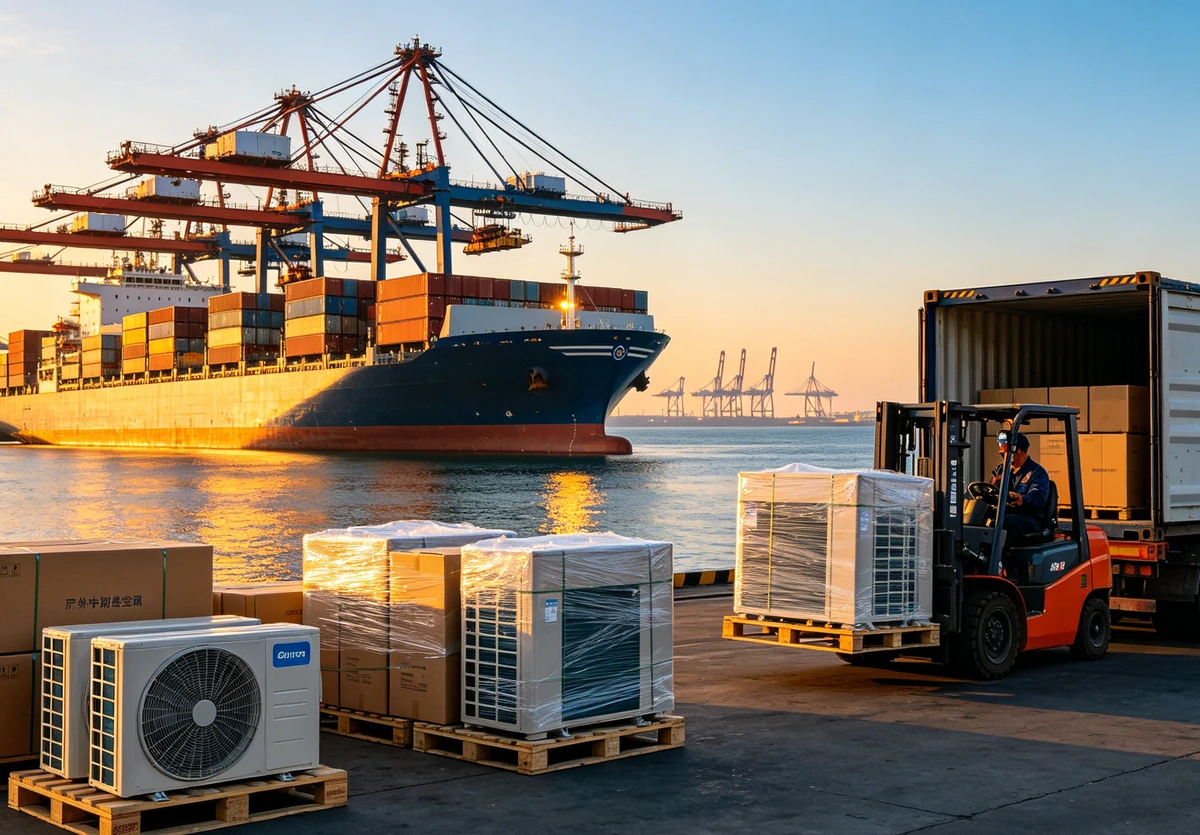
What You’re Actually Shipping: Air Conditioners from China
China is the world’s largest producer and exporter of air conditioners, with a complete industrial chain — compressors, condensers, evaporators, copper tubing, and control systems all made locally. That vertical supply chain is exactly why prices are competitive and lead times are short. But before you compare freight quotes, you need to understand that the type of AC you’re importing directly determines your logistics plan.
Here are the main categories exported from China and why each behaves differently in transit:
- Split systems — the most common export. An indoor unit, an outdoor unit, and copper refrigerant lines that are usually packed separately. Bulky, shock-sensitive, and refrigerant-charged.
- Window & portable units — self-contained, easier to pack and stack, popular for e-commerce.
- Cassette & ceiling units — commercial installs, larger cartons.
- VRF / Multi-Split systems — high-value commercial equipment.
- Heat pumps — booming in Europe thanks to energy-transition subsidies; classified differently for customs (more on that later).
- Commercial & industrial HVAC — oversized, often crated on wooden skids.
The physical characteristics — volume, fragility, and refrigerant content — drive three things: how many units fit in a container, how they must be packaged, and whether they count as dangerous goods. Most factories cluster near efficient export ports: Foshan, Zhongshan, and Guangzhou feed into Shenzhen (Yantian/Shekou) and Guangzhou (Nansha); Ningbo and Hefei feed into Ningbo-Zhoushan and Shanghai.
Shipping Methods: Sea vs Rail vs Air Freight from China to Europe
There are four realistic ways to move AC units from China to Europe. Choosing the right one — or the right combination — is where most of your cost and time savings live.
| Method | Transit Time | Relative Cost | Best For |
|---|---|---|---|
| Sea Freight (FCL/LCL) | 30–45+ days | Lowest | Full containers / bulk split-system orders |
| Rail Freight (China-Europe) | 14–25 days | Medium | Time-sensitive restocking |
| Air Freight | 4–7 days | High | Urgent, high-value, or sample units |
| Express (DHL/UPS/FedEx) | 3–5 days | Highest | Samples, spare parts, 1–2 units |
Sea Freight: The Default for Bulk AC Shipments
For any serious volume of air conditioners, sea freight is the workhorse. You’ll choose between:
- FCL (Full Container Load) — you book an entire 20ft (≈33 m³), 40ft (≈67 m³), or 40ft High Cube (≈76 m³) container. Sealed origin-to-destination, best value per unit once you exceed roughly 13–15 CBM.
- LCL (Less than Container Load) — you share container space and pay only for the volume you use. Ideal for smaller orders under 15 CBM.
Cargo lands at Europe’s major gateways — Rotterdam, Hamburg, Antwerp, Felixstowe, and Valencia — before moving inland. Port-to-port transit from South China typically runs 27–35 days depending on the destination.
Rail Freight: The Underrated Middle Ground
The China-Europe Railway (中欧班列) is the option most importers overlook, and it’s often the smartest for air conditioners headed inland. It’s roughly twice as fast as ocean freight and about 50% cheaper than air. Real, published corridor times:
| Route | Transit Time |
|---|---|
| Zhengzhou → Hamburg | 15–17 days |
| Chongqing → Duisburg | 16–17 days |
| Xi’an → Duisburg | 18–20 days |
| Yiwu → Madrid | ~20 days |
For a distributor in Germany or Poland who needs mid-season restocking without paying air freight prices, rail is frequently the sweet spot.
Air Freight & Express: Speed at a Price
Air freight (4–7 days) is reserved for urgent restocks, high-value components, or sample units — think a handful of premium inverter units a buyer needs on a showroom floor before a trade show. Express couriers (DHL, UPS, FedEx) handle samples and spare parts in 3–5 days but at a premium rate.
2026 Reality Check: Geopolitics Are Reshaping Your Options
Route planning in 2026 isn’t what it was three years ago. Since the Red Sea crisis, many carriers reroute around the Cape of Good Hope, adding an estimated 10–15 days to ocean transit and triggering blank sailings (canceled departures) that tighten capacity and swing rates. Rail has surged in demand — but bottlenecks at the Poland–Belarus border (Małaszewicze) and in Germany can cause delays, pushing some shippers toward emerging Central Asia / Trans-Caspian corridors.
Our practical recommendation at Sinoshipment: ship your bulk split-system orders by sea FCL, cover time-sensitive restocking by China-Europe rail, and reserve air freight for genuinely urgent units. Blending modes is the single best hedge against 2026’s volatility.
How Long Does It Take to Ship AC Units from China to Europe?
Transit time depends on mode, origin port, and destination. Here’s a realistic port-to-port sea freight matrix from the major South and East China ports:
| From \ To | Rotterdam | Hamburg | Antwerp | Valencia |
|---|---|---|---|---|
| Shanghai | 27 | 30 | 32 | 25 |
| Shenzhen | 28 | 31 | 33 | 26 |
| Ningbo | 28 | 31 | 33 | 26 |
Remember, door-to-door transit always runs longer than port-to-port. Your total timeline is: factory pickup + China export clearance + main leg (sea/rail/air) + EU import clearance + final delivery. Add buffer for two variables that consistently bite importers: peak season (Europe’s summer heatwave demand and the pre-Chinese New Year rush) and dangerous goods declarations for refrigerant-charged units, which can slow both booking and clearance if paperwork isn’t perfect.
Shipping Costs & Total Landed Cost
Freight is only part of the picture. Here are current reference ranges for moving AC units from China:
| Method | Reference Cost |
|---|---|
| LCL Sea Freight | USD 80–180 / CBM |
| 20GP Container | USD 2,000–4,500 |
| 40HQ Container | USD 2,500–5,800 |
| Air Freight | USD 4–9 / KG |
| Rail Freight | Between sea and air, by destination |
A standard 40HQ container holds roughly 76 m³ — enough for a substantial quantity of boxed split units, depending on model dimensions. But freight is where most importers stop calculating, and that’s a costly mistake. Your total landed cost includes duty and VAT.
A Real Landed Cost Example
Say you import a 40HQ of residential split air conditioners:
| Line Item | Amount |
|---|---|
| Goods value (FOB) | €30,000 |
| Ocean freight + insurance | €3,500 |
| CIF value (customs basis) | €33,500 |
| EU import duty (HS 8415.81, ~2.5%) | €838 |
| Customs value + duty | €34,338 |
| Import VAT (Germany, 19%) | €6,524 |
| Total landed cost | ≈ €40,862 |
Swap Germany’s 19% VAT for France’s 20% and the number shifts again — which is why you must calculate for the specific member state of entry. For route-specific cost guidance, our container shipping from China to France breakdown walks through a comparable Western-European lane. Also budget for hidden extras: terminal handling charges (THC), documentation fees, inspection fees, peak-season surcharges (PSS), and — for air freight — volumetric weight, calculated as (L × W × H in cm) ÷ 6000 for air cargo. Bulky AC units are often charged on dimensional weight, not actual weight.
EU Compliance Checklist for Air Conditioners
This is where shipments get stuck. An AC unit that clears the factory floor in China can be refused at a European port if it isn’t compliant. Air conditioners entering the EU market must meet several overlapping regulations:
- CE Marking — mandatory for market access, covering the Low Voltage Directive (LVD), the EMC Directive (electromagnetic compatibility), and the Machinery Directive.
- ErP / Ecodesign Directive — minimum energy-efficiency requirements, plus a mandatory EU Energy Label and a product fiche listing energy parameters for household units.
- F-Gas Regulation (EU) No 517⁄2014 — restricts high-GWP (Global Warming Potential) refrigerants like R410A, promotes lower-GWP options like R32, and imposes HFC quota and importer-registration obligations. This is the single most common compliance trap for AC imports.
- RoHS / REACH — restriction of hazardous substances.
- CBAM (Carbon Border Adjustment Mechanism) — an emerging 2026 consideration for goods with significant metal content; monitor its reporting obligations.
You must also keep a technical file and a Declaration of Conformity (DoC) on hand. Before you ever book freight, confirm your supplier can provide test reports, the CE technical file, and F-Gas documentation. A missing product fiche or an unregistered refrigerant can turn a routine clearance into a multi-week hold.
Refrigerant & Dangerous Goods: Don’t Get Your Cargo Seized
Here’s the detail most guides gloss over in a single sentence — and the one that most often causes seizures and delays. Air conditioners charged with refrigerant can be classified as dangerous goods.
Common refrigerants include R32 and R410A, each with a specific UN number and hazard profile. Depending on your mode of transport, the unit must be declared and packed according to the relevant regulation:
- IMDG Code for sea freight
- IATA DGR for air freight
- ADR for road transport in Europe
For pre-charged equipment (units shipped with refrigerant already inside), the copper lines must be properly capped and pressure-tested, and you’ll typically need an MSDS (Material Safety Data Sheet) and a transport classification report. The most common reasons cargo gets held: missing MSDS, incorrect UN labeling, an undeclared refrigerant charge, or unsealed refrigerant lines leaking during transit.
At Sinoshipment, our team handles refrigerant declarations and dangerous-goods-compliant routing as part of the booking process, precisely so a compliance gap doesn’t strand your container at the port. If you’re shipping charged units, insist your forwarder has genuine DG-handling experience — this is not the place to save a few dollars.
HS Codes, Customs Duty & Import VAT
Correct classification determines your duty rate and keeps customs clearance smooth. Air conditioners fall under HS heading 8415:
| HS Code | Product Category |
|---|---|
| 8415.10 | Window/wall types (self-contained or split-system) |
| 8415.20 | Air conditioners for motor vehicles |
| 8415.30 | IoT-enabled smart HVAC (added in HS 2025) |
| 8415.81 | Systems with reversal valve (heat pumps) |
| 8415.82 | Other, incorporating a refrigerating unit |
| 8415.83 | Not incorporating a refrigerating unit |
| 8415.90 | Parts of air-conditioning machines |
EU MFN (Most-Favored-Nation) duty rates for most consumer air conditioners sit around 2.2%–2.7% — but always verify the exact rate and check for any anti-dumping or trade-defense measures in the official EU TARIC database before shipping. Import VAT is charged by the member state of entry (Germany 19%, France 20%, Netherlands 21%, and so on) and is calculated on the customs value plus duty.
Watch out for the classic classification errors: filing a heat pump (8415.81) as a cool-only unit, missing the new IoT category (8415.30) for app-controlled systems, or declaring separately-shipped parts under the full-unit code. You’ll also need an EORI number to import into the EU.
Packaging Air Conditioners for Ocean Shipping from China
Air conditioners are shock- and moisture-sensitive, and split systems have particularly vulnerable components. Proper packaging isn’t optional — it’s the difference between a clean delivery and a damage claim.
- Split units — pack the indoor unit, outdoor unit, and copper line set separately, each reinforced.
- Compressors and coils — protect against shock and tipping; secure to prevent internal movement.
- Refrigerant lines — cap and pressure-test to prevent leakage in transit.
- Moisture protection — for long ocean voyages, add desiccants and humidity indicator cards, and use moisture-resistant wrapping.
- Large commercial units — crate in wood on pallets; a Fumigation Certificate is required for wooden packaging.
- Labeling & stacking — mark cartons “Fragile” and “This Side Up,” and stack to avoid crushing bottom units.
Documents & Incoterms for Importing AC Units
You’ll need a full document set for both China export and EU import clearance:
- Commercial Invoice & Packing List
- Bill of Lading (B/L) or Air Waybill (AWB)
- Certificate of Origin (CO)
- CE technical file / Declaration of Conformity
- EU Energy Label documentation
- F-Gas compliance evidence
- EORI number & customs declaration
- Cargo insurance certificate
Your choice of Incoterms 2020 decides who carries the risk and paperwork burden:
| Incoterm | Who Handles What |
|---|---|
| EXW | Buyer handles everything from the factory door |
| FOB | Seller delivers to port; buyer takes over from there |
| CIF | Seller covers cost, insurance, and freight to destination port |
| DDP | Seller delivers duty-paid, door-to-door — buyer does nothing |
If you don’t have your own customs broker in Europe, DDP (Delivered Duty Paid) is the hassle-free route — your forwarder handles export clearance, freight, EU import clearance, duty, VAT, and final delivery under one quote. If you have a trusted local agent and want more control, FOB or CIF may suit you better.
How to Choose a Freight Forwarder for AC Shipments
Not every forwarder can move air conditioners well. Use this checklist:
- Proven experience with HVAC / appliance cargo
- Genuine dangerous goods (refrigerant) declaration capability
- Customs clearance at both the China export and EU import ends
- Multi-mode options: FCL, LCL, rail, and air
- DDP door-to-door service for hands-off importing
- Real-time tracking and responsive support
- Cargo insurance
This is exactly where a specialist earns its keep. As a professional freight forwarder based in Shenzhen since 2013, Sinoshipment has served 5,000+ clients and offers all of the above — sea, rail, and air freight from China to Europe, DDP customs-paid solutions, refrigerant DG handling, and transparent quotes with no hidden fees. In our experience, for example, a Guangzhou AC manufacturer shipping a 40HQ of split units to a German distributor can move under a single DDP quote — factory pickup, China export clearance, ocean freight, EU import clearance, VAT and duty payment, and final delivery — with no surprises along the way. For importers expanding across Western Europe, we run dedicated lanes including shipping from China to Germany by sea and FCL shipping from China to Spain, backed by full freight shipping from China to Europe coverage.
Seasonal & Supply Chain Risks You Should Plan For
Honesty builds trust, so here are the real constraints:
- Europe’s summer demand spike — heatwave-driven AC orders surge from spring onward, tightening container space and pushing rates up. Book early.
- Pre-Chinese New Year (CNY) rush — Chinese factories slow or pause, and space gets scarce in the weeks before the holiday.
- 2026 route volatility — Red Sea rerouting, rail bottlenecks, and evolving CBAM reporting can all affect your timeline and cost.
We won’t over-promise transit times or bury surcharges. The smarter play is to plan your ordering window around these realities and build flexibility into your mode selection.
Frequently Asked Questions
How long does it take to ship air conditioners from China to Europe? Sea freight runs 30–45+ days port-to-port, China-Europe rail 14–25 days, and air freight 4–7 days. Door-to-door adds time for clearance and final delivery on both ends.
What is the cheapest way to ship AC units from China to Europe? Sea freight, especially a full container load (FCL), is the lowest cost per unit for bulk orders. Rail offers the best balance of speed and cost for mid-sized, time-sensitive shipments.
Do air conditioners count as dangerous goods when shipping? Often yes. Units charged with refrigerants like R32 or R410A can be classified as dangerous goods and must be declared and packed per IMDG (sea), IATA (air), or ADR (road) rules, usually with an MSDS.
What certifications do air conditioners need to enter the EU? CE marking (covering LVD, EMC, and Machinery directives), ErP/Ecodesign energy-efficiency compliance with an EU Energy Label, and F-Gas Regulation compliance for refrigerants. RoHS/REACH may also apply.
What is the HS code and import duty for air conditioners in the EU? Air conditioners fall under HS heading 8415 (e.g., 8415.10 for window/split units, 8415.81 for heat pumps). EU MFN duty is typically 2.2%–2.7%; verify in the TARIC database.
How many AC units fit in a 40HQ container? A 40HQ offers about 76 m³. The exact count depends on each model’s carton dimensions, but split-system boxes are palletized to maximize load efficiency.
Is DDP or FOB better for importing air conditioners from China? Choose DDP if you want a hassle-free, all-inclusive door-to-door service without your own EU broker. Choose FOB or CIF if you have a local customs agent and want more control over the destination leg.
Conclusion
Learning how to ship air conditioners from China to Europe comes down to five moving parts: picking the right transport mode (sea for bulk, rail for balanced speed, air for urgent), calculating your true landed cost including duty and VAT, clearing EU compliance (CE, ErP, and F-Gas), handling refrigerant as dangerous goods correctly, and classifying under the right HS 8415 code. Get those right and your units arrive on time, in one piece, and without a nasty clearance surprise.
You don’t have to manage all of it alone. Sinoshipment designs tailored sea, rail, air, and DDP solutions for air conditioner importers across Europe, with the compliance and refrigerant-handling expertise this cargo demands. Reach out for a transparent, no-hidden-fees quote and let’s get your shipment moving before the next heatwave hits.